
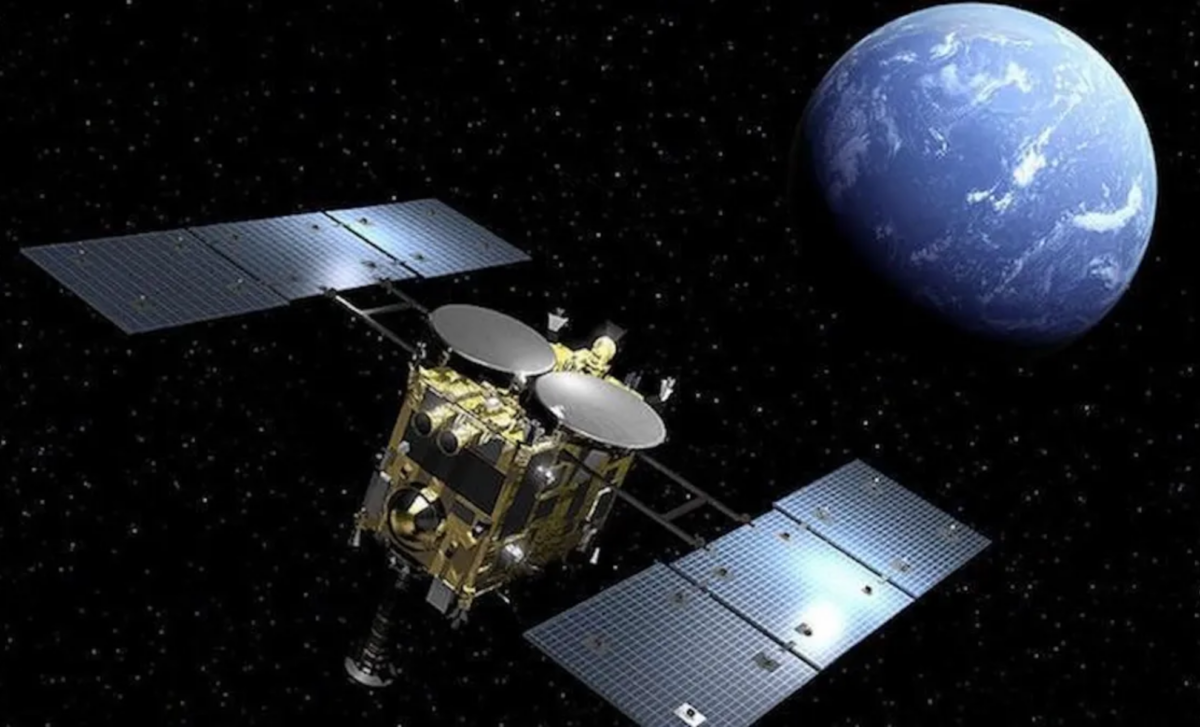
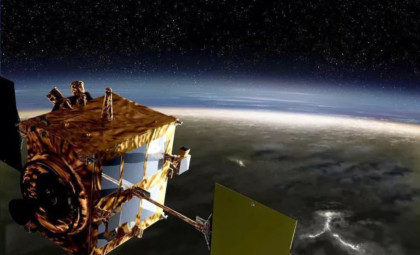
The Japanese spacecraft Hayabusa2 is gearing up for an exceptionally close approach to a near-Earth asteroid, showcasing the challenges of high-precision space navigation. Scheduled for July 5, the probe will zoom past the asteroid Torifune at a strikingly close range, capturing valuable data during a brief, high-speed flyby. This phase of the mission, led by JAXA, highlights a significant advancement in asteroid exploration years after its initial success in bringing samples back from space, while also enhancing techniques vital for future asteroid studies and planetary defense.
Hayabusa2 Enters a Critically Challenging Segment of Its Extended Mission
Following its groundbreaking work at asteroid Ryugu and the delivery of samples to Earth in 2020, Hayabusa2 has taken on a new mission requiring impeccable navigation. During its upcoming approach to Torifune, the spacecraft will pass roughly between 1 and 10 kilometers from the asteroid, traveling at a rapid pace of about 5.3 kilometers per second. This fleeting encounter leaves a narrow timeframe to gather imagery and scientific measurements before continuing its journey.
The maneuver is considered one of the most technically sophisticated ever undertaken by a spacecraft in this class. It relies on advanced autonomous control systems that ensure exceptional precision despite limited prior knowledge about the asteroid's characteristics. According to JAXA, every moment of the flyby has been meticulously orchestrated to maximize scientific gain while mitigating risks. The data collected is expected to shed light on the asteroid’s shape, spin, surface features, and internal composition, broadening our insight into the varied near-Earth asteroid population.

Hayabusa2 has successfully captured images of asteroid Torifune! (The asteroid is moving from bottom to top, left of centre🎥). Now on its extended mission, Hayabusa2#, the spacecraft will conduct flyby observations of Torifune on 5 July 2026. Read more🔗: https://t.co/4sKhwqCFdC pic.twitter.com/REaPkDfCoa
— HAYABUSA2@JAXA (@haya2e_jaxa) June 25, 2026
At a recent conference, researcher Satoshi Tanaka highlighted the mission's importance, stating,
“This is one of the closest asteroid encounters ever attempted by a mission of this class. By combining advanced navigation techniques and the engineering capabilities of Hayabusa2, we have made it possible to achieve a flyby at a distance of only about 1 kilometer.”
This milestone results from over ten years of engineering advancements and operational expertise since Hayabusa2 launched in 2014.
Torifune’s Mysteries Pose Both Opportunities and Challenges for Scientists
Despite continuous observation, Torifune remains largely elusive. With an estimated diameter of about 450 meters, details about its precise size and structure are still unknown. Experts remain uncertain if it is a monolithic body, a porous conglomerate of debris, or a contact binary resulting from the gradual merging of two smaller asteroids over time.
This ambiguity not only makes the mission exciting but also technically demanding. Patrick Michel, lead investigator for the European Space Agency's Hera project and member of the Hayabusa2 science team, acknowledged the challenge. “It’s still a risky operation, because they had not planned for this,” Michel, who is also principal investigator for Hera, shared with Space.com.
Researchers anticipate valuable discoveries because asteroid encounters often defy prior assumptions. Past missions have revealed unexpected geological features and terrains that telescopes could not predict. Michel emphasized this unpredictability when discussing the upcoming approach.
“We’re going to discover what it looks like. And each time we have seen a new asteroid, we’ve been surprised,” Michel said. “We’re going to discover another beast to put in the zoo of asteroids.”
This perspective embodies the wonder and humility driving modern planetary science, where even smaller celestial bodies continue to reshape our knowledge.
Insights from This Flyby Could Inform Future Planetary Defense Efforts
The flyby’s significance goes beyond investigating a single asteroid. Effective planetary defense depends on swift characterization of newly identified space objects that might threaten Earth. Future missions will need to rapidly approach unfamiliar asteroids, collect crucial data on their physical and rotational properties, and determine appropriate mitigation tactics.
The Hayabusa2 close encounter provides a practical test of this capability. Successfully navigating near an asteroid at just about one kilometer distance while gathering scientific observations offers invaluable hands-on experience for engineers and scientists. The knowledge acquired will support planetary defense initiatives like NASA’s DART mission, which proved asteroid deflection is feasible in 2022. Rapid reconnaissance is essential before any impact mitigation, making maneuvers such as this increasingly relevant as global space agencies collaborate to protect Earth.
Beyond Torifune: Hayabusa2’s Ambitious Future Objectives
This upcoming encounter is just one chapter in Hayabusa2’s extraordinary ongoing journey. During its extended mission, the spacecraft continues to collect scientific data, including zodiacal light studies and exoplanet observations performed remotely during its deep space cruise. These efforts help maintain its scientific productivity as it ventures toward new targets.
Looking further ahead, the probe aims to reach the tiny asteroid 1998 KY26 by 2031. Measuring a mere 11 meters, it would become the smallest asteroid ever visited by a spacecraft. There are considerations for attempting a landing on this tiny body, a challenge that could mark yet another technological milestone.
If the July 5 flyby goes smoothly, Hayabusa2 will once again highlight how spacecraft initially designed for a single mission can continue to achieve pioneering science long after their primary goals are met. Although brief, the Torifune flyby’s data could have lasting impacts on asteroid science, navigation technology, and planetary defense strategies.
- Categories:
- Space






0 comments
Sign in to Comment