

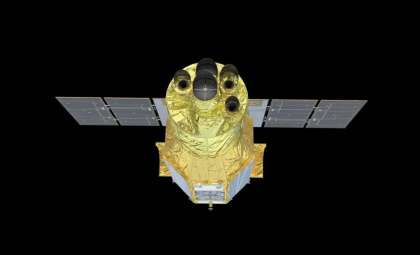
The Japan Aerospace Exploration Agency (JAXA) has announced it has lost communication with its Akatsuki spacecraft, currently the sole operational mission investigating Venus. This interruption raises concerns about ongoing Venus research, as Akatsuki has been pivotal in delivering critical data on the planet’s atmospheric conditions and climate dynamics.
Overview of the Mission and Its Obstacles
Deployed on May 21, 2010, via an H2-A launch vehicle, Akatsuki, also referred to as the Venus Climate Orbiter, was built to explore Venus’s atmospheric behavior, including the search for lightning in its dense cloud cover and signs that volcanic activity might still be ongoing.
Although the spacecraft initially failed to enter Venusian orbit following an engine malfunction, JAXA’s team engineered a backup plan that successfully placed Akatsuki into orbit on December 7, 2015, after it had orbited the Sun for five years. This accomplishment highlighted the mission team’s resourcefulness in employing the craft’s smaller thrusters to achieve orbital insertion.

Since insertion, Akatsuki has yielded invaluable observations about Venus’s extreme atmosphere. Its onboard instruments have offered key information on weather systems, cloud movements, and surface features, deepening scientific comprehension of Venus’s climate systems.
The probing data has illuminated Venus’s super-rotating atmosphere, where winds travel faster than the planet rotates itself—one of the most enigmatic features of Venusian meteorology.
Status Update on Akatsuki
The Institute of Space and Astronautical Science (ISAS) shared on X, on Wednesday, May 29, that they "lost communication with Akatsuki following operations in late April due to prolonged low attitude stability control mode," and are actively working to reestablish contact with the spacecraft.
[From the Akatsuki team](1/2)
ISAS has lost contact with Akatsuki after an operation in late April due to an extended period of low attitude stability control mode, and is currently making efforts to reestablish communication with the spacecraft.— 「あかつき」チーム (@Akatsuki_JAXA) May 29, 2024
Attempts to reconnect have been underway but so far have yielded no success. Maintaining precise spacecraft orientation is critical because Akatsuki must align its antenna to Earth to transmit and receive signals.
JAXA notes that the probe has significantly outlasted its designed operational period of 4.5 years, having remained active for nearly 14 years. The agency is deliberating on how to proceed with the current challenges and will release a formal update once decisions are made. The loss of contact threatens extensive ongoing studies on atmospheric waves and trace gas distributions in Venus’s atmosphere, crucial for understanding the planet’s climate and geological past.
Scientific Achievements
Akatsuki’s mission has greatly surpassed original expectations by continuing operations well past its intended lifespan, entering an extended phase in 2018. It has generated groundbreaking insights into Venus’s climate, identifying large-scale atmospheric wave patterns and unique cloud formations.
These discoveries have enhanced knowledge of Venus’s weather systems and are vital for comparing the planet’s climate to Earth’s environment. Akatsuki’s infrared observations of Venus’s night side revealed active atmospheric phenomena and shifting cloud layers, essential data for building accurate climate models.
The potential termination of Akatsuki would leave a considerable void in Venus research since it remains the only active spacecraft devoted solely to studying the planet. Equipped with cameras and spectrometers, Akatsuki has provided detailed imagery and atmospheric composition analysis unattainable through Earth-based methods alone.
Additionally, its findings have offered clues about Venus’s puzzling “pioneer anomaly,” a gravitational irregularity that may reflect internal geological activity.
- Categories:
- Astronomy ,
- News ,
- Space ,
- Aircraft











0 comments
Sign in to Comment