
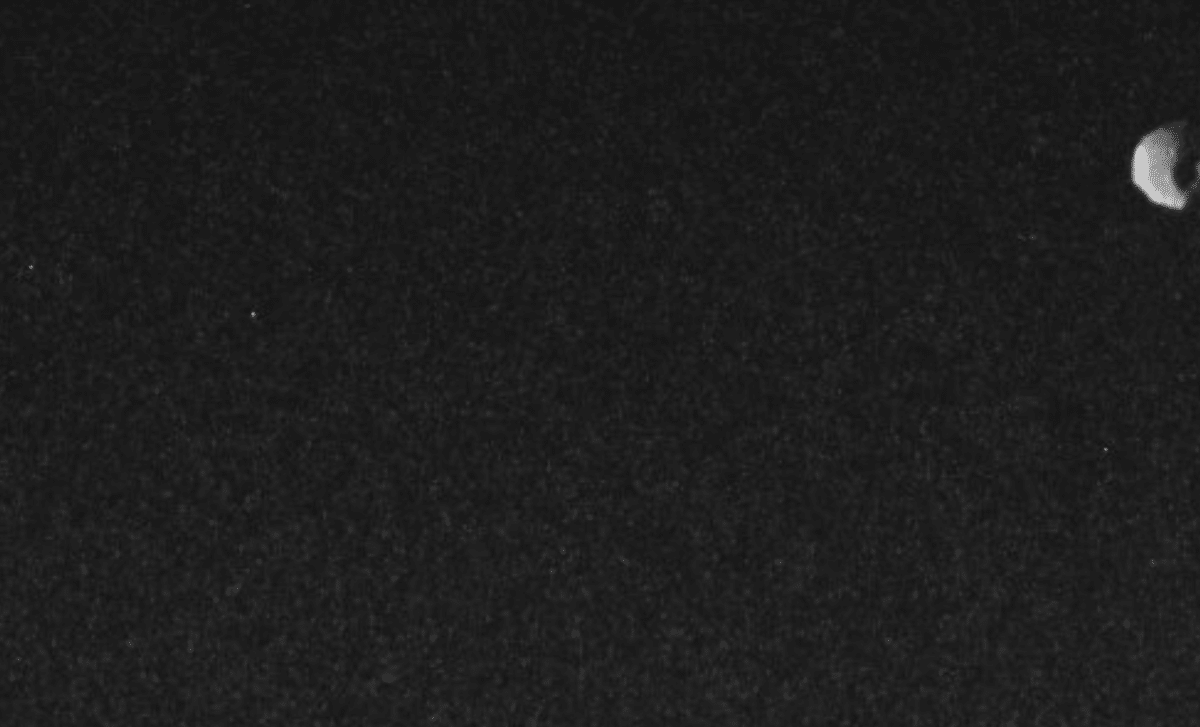
NASA’s Juno probe has returned a breathtaking image of Thebe, Jupiter’s second-largest inner moon, offering fresh perspectives on the planet’s extended ring system. The close encounter on May 1, 2026 represents a significant advance in our grasp of Jupiter’s celestial surroundings, showcasing Thebe’s vital influence on the mysterious “gossamer” ring. Data collected by Juno’s Stellar Reference Unit (SRU) delivers an unprecedented level of detail, deepening our appreciation of the Jovian environment.
Examining Thebe: Crucial to Jupiter’s Ring Formation
Situated at the outer margin of Jupiter’s faint ring ensemble, Thebe plays a pivotal role in maintaining the ring’s structure. Researchers think that Thebe’s gravitational pull, together with dust expelled from its surface, contributes largely to the formation of the delicate “gossamer” ring. This subtle, barely-visible ring is made up mainly of tiny particles believed to be ejected from Thebe or neighboring moons.
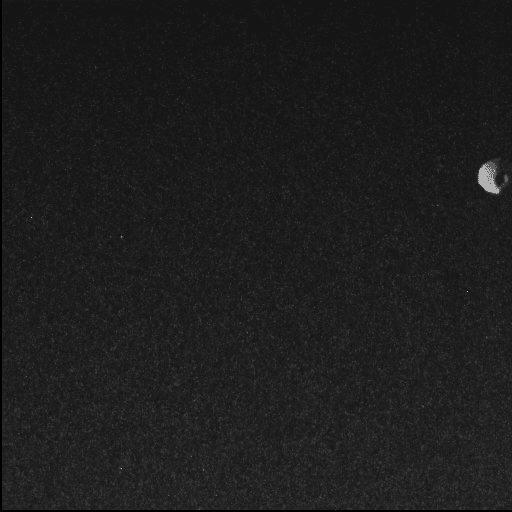
NASA’s Juno spacecraft approached Thebe within 3,100 miles (5,000 kilometers) during its May 1 flyby, capturing imagery with exceptional clarity—approximately 1.9 miles (3 kilometers) per pixel. This extraordinary resolution provides researchers with a detailed view of the moon’s surface and its spatial context, shedding light on the complex mechanisms shaping Jupiter’s rings.

The Stellar Reference Unit: Instrumental Beyond Navigation
Though primarily designed to aid navigation by capturing star fields for precise positioning, Juno’s SRU has unexpectedly contributed to scientific studies. Its high sensitivity to dim light has rendered it a powerful tool for observing Jupiter and its satellites. In the past, the SRU has helped identify phenomena like “shallow lightning” in Jupiter’s atmosphere and captured high-resolution images of the planet’s iconic rings.
The dual use of the SRU as both a navigation aid and a scientific instrument highlights the innovative design behind the Juno mission. This multifunctional approach enables the collection of detailed data that older missions couldn’t achieve.
Tracking Juno’s Mission: Coordinated by NASA’s JPL
Managed by NASA’s Jet Propulsion Laboratory in Pasadena, California, Juno’s expedition is led by principal investigator Scott J. Bolton from the Southwest Research Institute. It forms part of NASA’s New Frontiers Program, supervised by the Marshall Space Flight Center in Huntsville, Alabama.
Launched in 2011, Juno’s chief goal is to analyze Jupiter’s atmosphere and internal structure to reveal insights into its origin and development. The discovery regarding Thebe adds a valuable new chapter to this pioneering exploration, demonstrating how even smaller moons can greatly influence our understanding of planetary systems.
Scientific Importance of Thebe’s Latest Image
While often eclipsed by larger Jovian satellites such as Ganymede and Io, Thebe is gaining prominence as a subject of scientific interest. Studying its impact on Jupiter’s tenuous ring helps clarify the underlying forces involved in ring formation and stability. Moreover, the enhanced imaging powered by Juno’s SRU makes it possible to map Thebe’s surface composition more precisely, offering clues into ring systems around other planets and dynamics of moon-ring interactions around gas giants.
This recent close approach could pave the way for further in-depth investigations into Jupiter’s smaller moons and their collective effect on the planet’s extensive ring architecture, potentially uncovering unknown aspects of this complex planetary environment.
- Categories:
- Nasa







0 comments
Sign in to Comment