
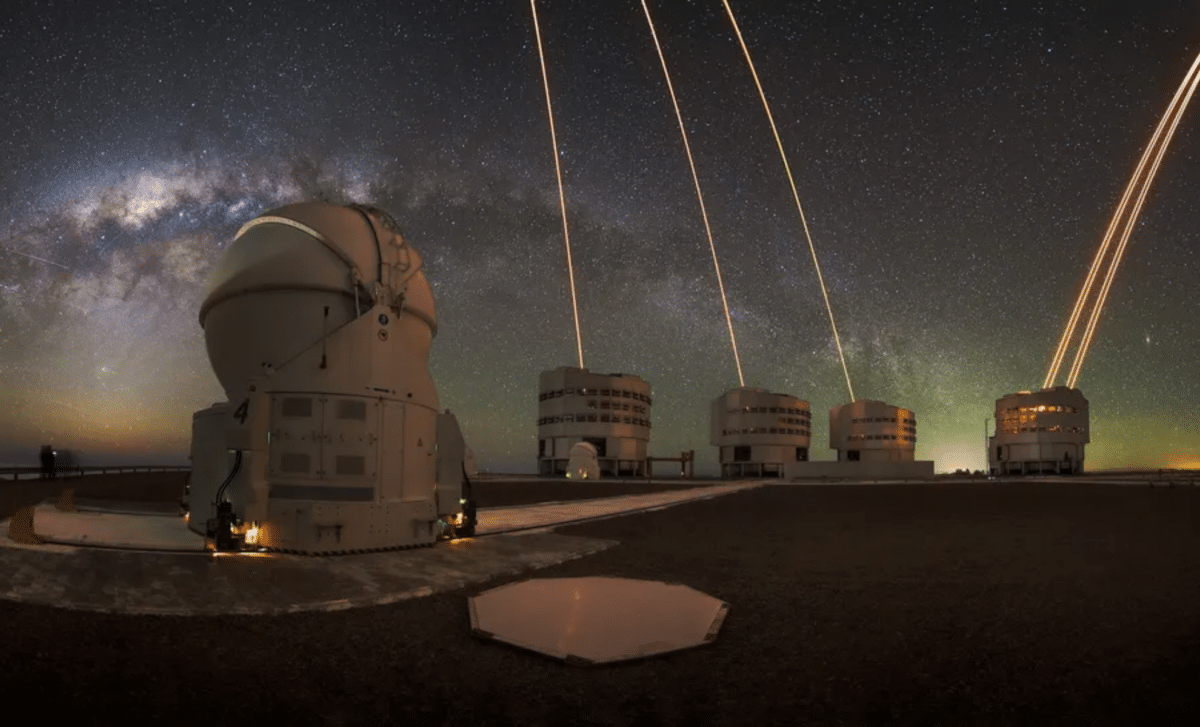
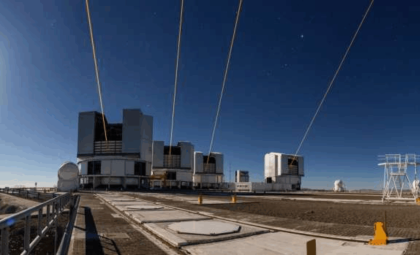
Chilean astrophotographer Alexis Trigo captured a stunning view over the Paranal Observatory, where the Milky Way stretches majestically across the sky punctuated by bright beams of light. These striking beams emanate from the European Southern Observatory’s (ESO) Very Large Telescope (VLT) and serve a critical scientific purpose. They generate “artificial stars” by firing lasers into the upper atmosphere, helping astronomers improve the clarity of observations by compensating for atmospheric disturbances.
How Lasers Facilitate the Creation of Artificial Stars
At first glance, the laser beams slicing through the night might evoke a science fiction vibe. These lasers, however, are indispensable to modern astronomy. Originating from the VLT’s Unit Telescopes, they reach approximately 56 miles above Earth’s surface where they stimulate sodium atoms to emit light, effectively crafting artificial stars. These luminous reference points enable the telescope’s adaptive optics system to correct distortions caused by atmospheric turbulence.
Generating these artificial stars has dramatically advanced observational astronomy. Without these laser-created reference points, the striking turbulence in the Earth’s atmosphere would blur celestial images. By projecting lasers into the upper layers of the atmosphere, astronomers can stabilize their view, leading to sharper and more detailed pictures of faraway galaxies, stars, and exoplanets. This technology is fundamental for exploring the cosmos with exceptional precision.

Capturing the Spectacle: Alexis Trigo’s Astrophotography
Alexis Trigo, a Chilean astrophotographer, captured this breathtaking moment displaying both the grandeur of the Milky Way and the innovative laser technology employed by the ESO.
Trigo’s photograph crisply displays the laser beams launched from the VLT’s Unit Telescopes, bringing the concept of artificial stars to vivid life. His image blends art with science, visually illustrating how cutting-edge technology aids astronomers in unveiling the universe’s secrets.
An Overview of the Very Large Telescope and Its Capabilities
Located at Paranal Observatory, the VLT ranks among the world’s premier astronomical facilities. It comprises four Unit Telescopes (UTs) each featuring a primary mirror measuring 8.2 meters in diameter. These enormous mirrors combined with advanced instruments empower astronomers to probe deep into the universe with extraordinary resolution, studying phenomena from distant exoplanets to remote galaxies.
The observatory also includes a maneuverable 1.8-meter auxiliary telescope, which supports the larger UTs by enhancing their light collection capabilities. Working together, these telescopes provide the VLT with exceptional observational strength, revealing minute details of cosmic objects situated billions of light-years away.
Why Atmospheric Effects Challenge Astronomical Imaging
While Earth's atmosphere is vital for sustaining life, it poses significant hurdles for astronomers. Light traveling from remote stars and galaxies is distorted by atmospheric turbulence, caused by fluctuations in temperature, moisture, and pressure. This distortion makes stars twinkle and blurs images, reducing clarity.
To mitigate this, astronomers employ adaptive optics that leverage lasers and adjustable mirrors to counteract atmospheric distortion in real time. By tracking the artificial stars generated by laser beams, the VLT’s system fine-tunes its mirrors, producing sharper and cleaner images. This advancement has revolutionized astronomical observation, enabling highly precise and detailed views of the cosmos.
Laser Technology and Adaptive Optics: A Leap Forward in Astronomy
The integration of guide star lasers across the VLT’s Unit Telescopes marks a major technological breakthrough. While these lasers have been operational on the Melipal Unit Telescope since 2016, as of December 2025, every one of the four UTs is outfitted with lasers. This upgrade significantly enhances the VLT’s capacity to correct for atmospheric blurring, resulting in superior image quality and more accurate data.
These technological improvements enable astronomers to investigate distant celestial bodies with unprecedented clarity, from detecting exoplanets in far-flung star systems to observing the earliest galaxies in the universe. The VLT’s enhanced performance is propelling scientific discovery and deepening humanity’s comprehension of the cosmos.
- Categories:
- Space







0 comments
Sign in to Comment