
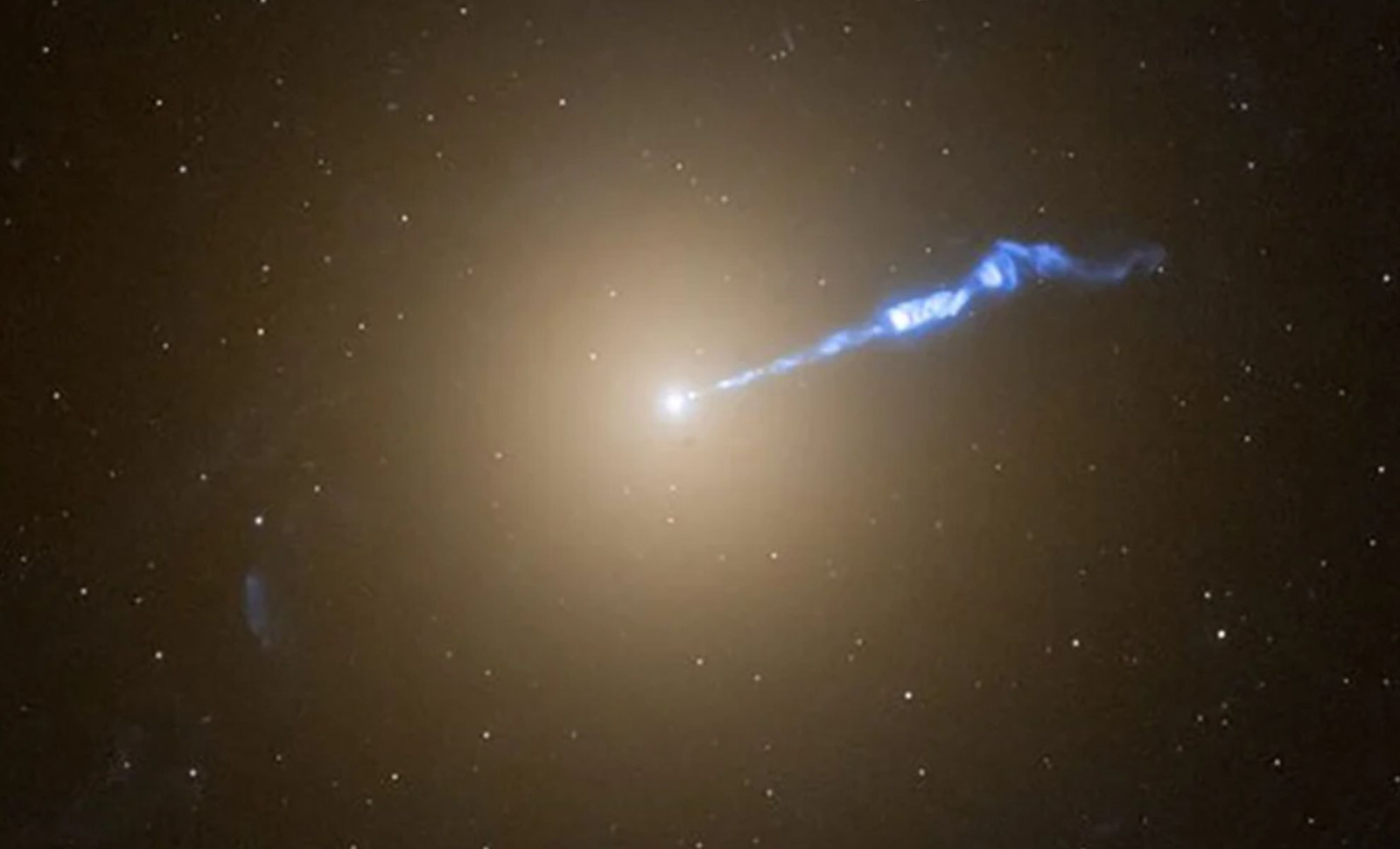
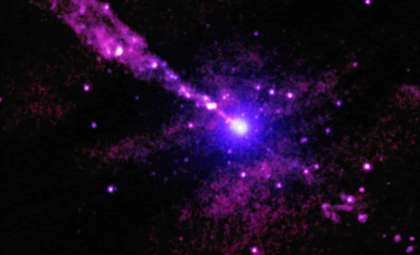
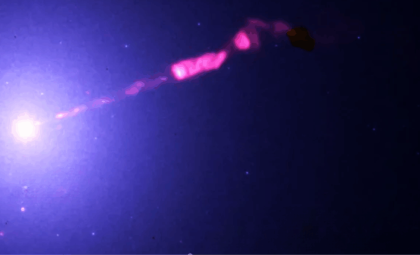
The Chandra X-ray Observatory from NASA has generated an unprecedentedly detailed X-ray image of the powerful jet emerging from the supermassive black hole at the heart of Messier 87 (M87). By integrating over ten years of observations and utilizing cutting-edge image enhancement methods, scientists have mapped the jet’s development with remarkable clarity. The new study, shared in a recent arXiv preprint, sheds light on the mechanisms by which black holes launch matter at extreme velocities and influence their galactic environments.
Decades-Long Data Reveals Previously Unseen Jet Details
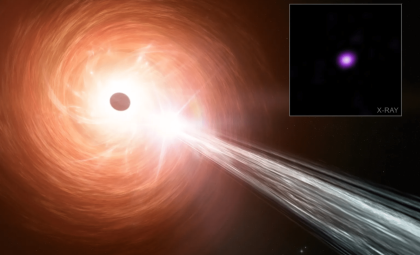
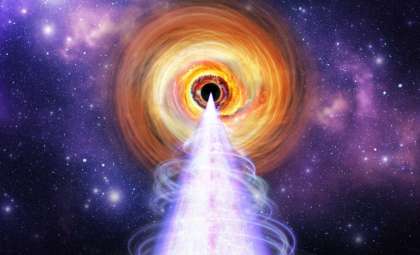
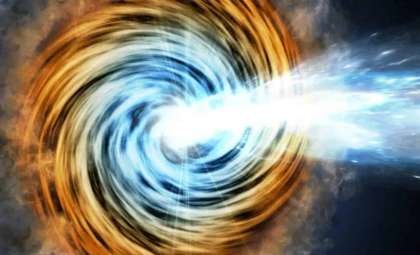
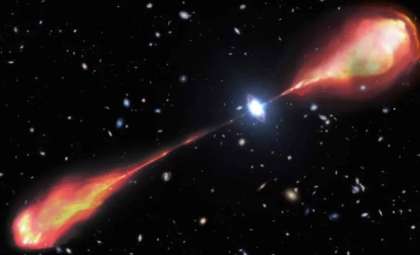
About 55 million light-years away, the galaxy M87 harbors one of the most extensively examined supermassive black holes in existence. The black hole gained global attention in 2019 when the Event Horizon Telescope produced the first-ever direct image of a black hole’s silhouette. However, the black hole itself is only part of the narrative. Extending thousands of light-years outwards, a massive jet of charged particles streams out at nearly light speed, powered by material falling inward.
From 2012 through 2025, the Chandra X-ray Observatory conducted repeated observations of this remarkable jet. Although previous Chandra data revealed its high-energy X-ray output, many subtle features were blurred due to inherent imaging limitations. Under the leadership of Camille Poitras, a doctoral researcher at Laval University, the team applied advanced deblurring algorithms that significantly sharpened the images beyond earlier capabilities. These improvements bring X-ray data into much closer alignment with views captured by the Hubble Space Telescope and James Webb Space Telescope, facilitating precise cross-wavelength comparisons.

As Poitras explained in a Chandra news release, this breakthrough enables novel investigations into how the jet changes over time:
“We could already see changes in the jet, but never with this level of detail in X-rays. Structures that previously appeared blended together can now be distinguished, allowing us to better follow the jet’s evolution over more than a decade of observations.”
These refined images demonstrate that what previously looked like smooth zones are actually composed of multiple distinct elements that vary independently. This advancement enhances the ability to study how energy flows through one of the cosmos’ most extreme settings.
The Jet Exhibits More Complex Dynamics Than Previously Known
The enhanced data uncovers a surprisingly detailed internal flow pattern within the relativistic jet. While some luminous knots remain nearly stationary for years, others surge outward at incredible apparent velocities. The fastest knots appear to move at nearly five times the speed of light, an optical illusion called superluminal motion. This phenomenon happens when material moves extremely close to light speed and at a small angle to our line of sight, giving the impression of faster-than-light travel without breaking physics.
This allows astronomers to monitor real, large-scale changes happening in an object tens of millions of light-years away on human-observable timescales. The shifting brightness and changing positions indicate that shocks from collisions in the plasma energize particles to immense energies. Magnetic fields also play a crucial role by directing flow patterns and influencing the movement of energy throughout the jet.
Rather than a simple outflow, the observations reveal a bustling environment where various physical effects overlap dynamically. Each newly uncovered feature offers astronomers a fresh opportunity to test theories of matter under conditions impossible to recreate in labs on Earth.
Observations Support Advanced Theories of Black Hole Jets
Published as an arXiv preprint, the study bolsters theoretical simulations that forecast shock waves and magnetic interplay inside relativistic jets. Models have long anticipated that collisions between plasma streams with differing speeds create small zones of intense particle acceleration and X-ray emission. These newest results provide some of the clearest observational backing to date.
The enhanced correlation between X-ray, optical, and infrared data marks a significant achievement. By aligning features seen by Chandra, Hubble, and James Webb, researchers can examine the same phenomena at multiple wavelengths, generating a more comprehensive understanding of jet physics. This multiwavelength synergy reveals how particles gain energy, how magnetic fields evolve, and how massive energy flows from the black hole into its galaxy.
As co-author Gerrit Schellenberger from the Center for Astrophysics | Harvard & Smithsonian (CfA) stated:
“These results demonstrate how uniquely powerful Chandra remains for tracking the evolution of extreme phenomena over long timescales. They help us better understand how energy released near a supermassive black hole is carried through its jet and deposited into the surrounding galaxy.”
The paper also underlines the importance of long-duration monitoring missions. By compiling years of data rather than relying on single snapshots, scientists revealed evolving features that would otherwise go unnoticed.
- Categories:
- News


0 comments
Sign in to Comment