
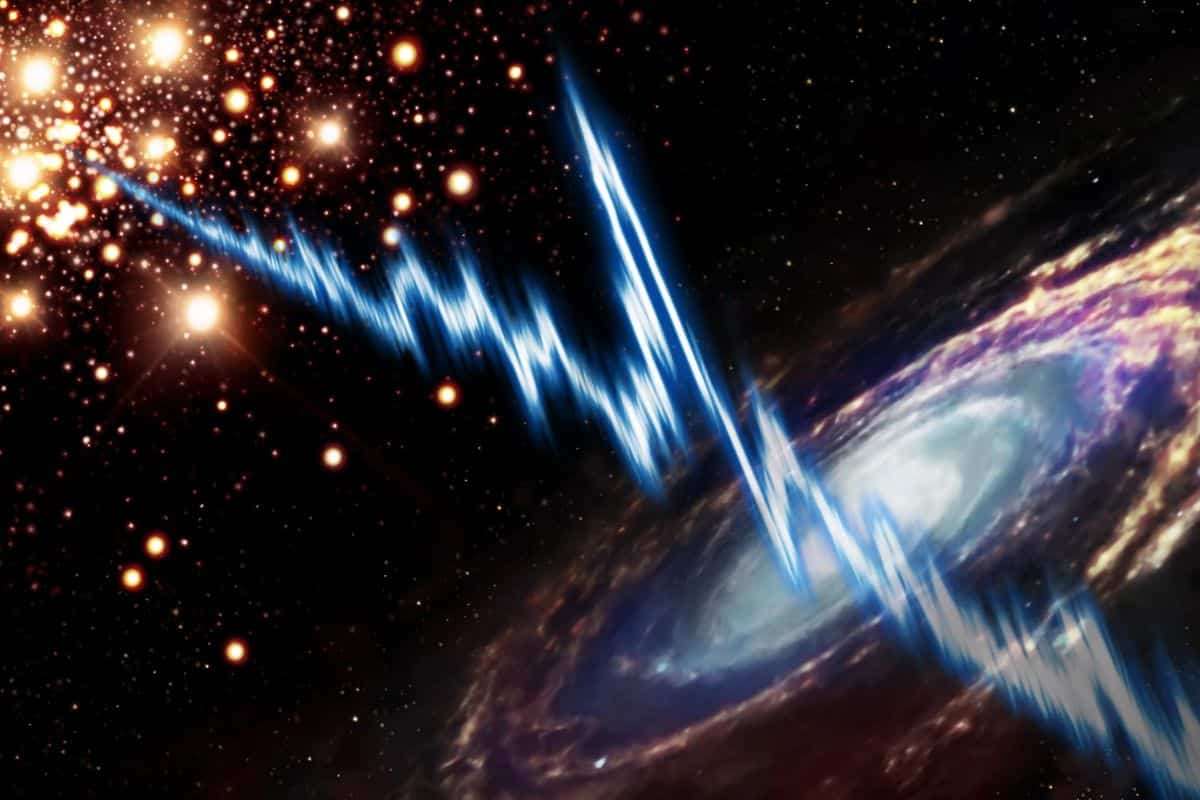
Researchers have successfully identified the origin of an unusual type of radio signal long confounding astronomers. The source is a binary star system comprised of a white dwarf and a red dwarf. This breakthrough could reshape current theories on stellar processes during late evolutionary phases.
Unprecedented Radio Emissions
For quite some time, scientists struggled to explain radio bursts that didn’t fit established categories like pulsars or fast radio bursts. Known as long-period transients (LPTs), these signals last significantly longer—sometimes for several minutes—and recur over unusual intervals, far exceeding the brief flashes generated by neutron stars.
These perplexing features led to uncertainty regarding their origin. Recent studies now attribute them to a rare stellar duo located more than 1,600 light-years away.

A Peculiar Stellar Pair in Ursa Major
Using the LOFAR telescope array, astronomers from the University of Amsterdam, University of Oxford, and University of Sydney managed to pinpoint the signal’s source within the constellation Ursa Major.
Follow-up studies employing observatories in Arizona and Texas uncovered a close binary system consisting of a white dwarf—the dense remnant of a star similar to our Sun—and a cool, low-mass red dwarf companion.
The two stars complete an orbit around each other every 125 minutes, likely creating the environment responsible for the peculiar radio waves detected from Earth.
Mechanisms Behind the Radio Emissions
Scientists hypothesize that the intense magnetic field of the white dwarf may be powering the radio bursts. The star could be rotating, emitting energy in a sweeping pattern reminiscent of a lighthouse beam.
Alternatively, the radio signals might arise from magnetic interactions between the white dwarf and its red dwarf partner. Regardless, this system challenges existing assumptions about the origins of radio wave production in space.
A Newly Identified Category of Cosmic Signals
Previously, strong and coherent radio emissions were primarily linked to neutron stars—the compact, spinning remains of exploded stars. This discovery establishes that white dwarfs are also capable of generating consistent, robust radio signals.
“Each new detection offers fresh insights into the extreme astrophysical phenomena responsible for these radio emissions. For example, the surprising observation of coherent radio emission from the white dwarf in this research could illuminate the evolution of magnetic fields in these stars,” commented Dr. Kaustubh Rajwade, an expert on LPTs affiliated with LOFAR.
This finding not only expands the field of radio astronomy but also hints at the presence of more such extraordinary systems awaiting discovery.

An image of LOFAR (LOw Frequency ARray) core, featuring numerous European substations. Credit: ASTRON
Unlocking the Galaxy’s Subtle Signals
These prolonged radio pulses provide an innovative perspective on the subtle yet potent astrophysical dynamics within the Milky Way. Far from explosive events or dazzling outbursts, they reveal valuable details on interactions occurring as stars age and their magnetic fields intertwine.
With each newly mapped signal and identified stellar system, astronomers advance closer to deciphering the galaxy’s hidden cosmic symphony.
- Categories:
- Space










0 comments
Sign in to Comment