
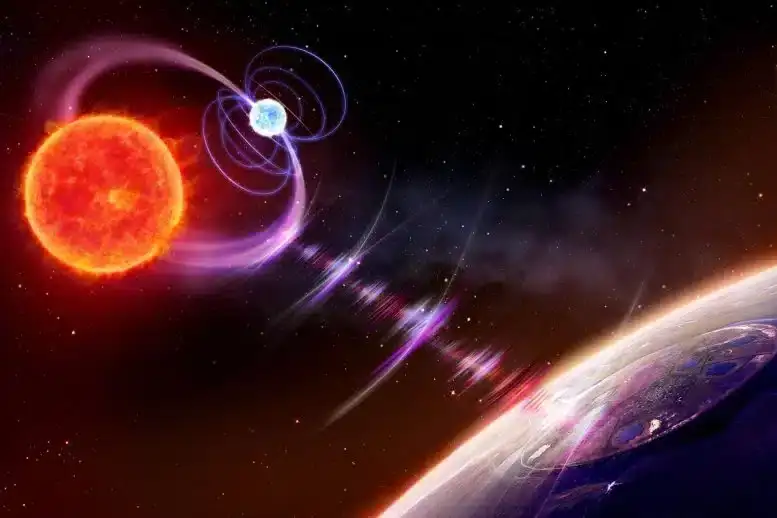
After a decade of intrigue, researchers have finally pinpointed the source of puzzling, periodic radio emissions: a unique binary star pair. These signals, repeating every two hours, come from a close orbiting system of a white dwarf and a red dwarf, whose magnetic fields collide to generate powerful bursts of energy, previously thought to be exclusive to neutron stars.
Decoding a Long-standing Astronomical Puzzle
For years, astronomers observed consistent radio signals near the Big Dipper region, initially detected in 2015. These rhythmic pulses prompted numerous theories until a collaborative effort involving Northwestern University and the University of Sydney pinpointed the true origin using an array of telescopes.
Instead of a lone star, the source was identified as a binary system 1,600 light-years from Earth, composed of an aged white dwarf and its dimmer, cooler red dwarf partner. Their tight orbit enables their magnetic fields to interact intensely, emitting radio bursts precisely every 125.5 minutes.

White Dwarfs as Unexpected Radio Signal Sources
Previously, such steady radio pulses were linked only to neutron stars, known for their intense magnetic fields and phenomena like magnetars and fast radio bursts (FRBs). This finding reveals that even stars with lower mass like white dwarfs can emit comparable signals under certain magnetic conditions.
“Several powerful magnetars showcase radio pulses repeating every few seconds,” explained Charles Kilpatrick, astrophysicist at Northwestern University.
Advanced Techniques Unearth the Source
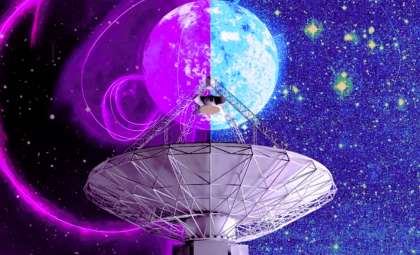
The distinctive pulses first appeared in historic datasets from the Low Frequency Array (LOFAR), one of the planet’s premier radio observatories. As scientists revisited this archival material, they uncovered additional signals dating back to 2015 that resembled fast radio bursts, though lasting from seconds to several minutes.
Follow-up measurements with telescopes in Arizona and Texas revealed that the source wasn’t a solitary star but a binary pair orbiting a common center. Their tightly coupled motion confirmed the red dwarf’s orbit was influenced by an unseen but dense companion.
Magnetic Fields Synchronized in a Celestial Dance
The secret behind the radio bursts lies in the dynamic magnetic interactions between the binary partners. As the white dwarf and red dwarf revolve, their magnetic fields twist and snap together, releasing energy as bursts of radio emissions.
Detecting the white dwarf directly is challenging due to its faintness. Yet by analyzing variations in the red dwarf’s trajectory, astronomers deduced the mass of its companion, which fits with the mass expected of a white dwarf. This strongly suggests similar systems could explain other mysterious radio transient signals.
Opening New Avenues in Stellar Astronomy
This breakthrough marks only the start. Researchers intend to perform ultraviolet studies on the system, named ILTJ1101, aiming to ascertain the white dwarf’s temperature and its evolutionary history.
By investigating other binary white dwarf systems, scientists hope to uncover the mechanisms driving their development and their role in producing widespread long-period radio transients observed throughout the cosmos.
- Categories:
- Space









0 comments
Sign in to Comment