
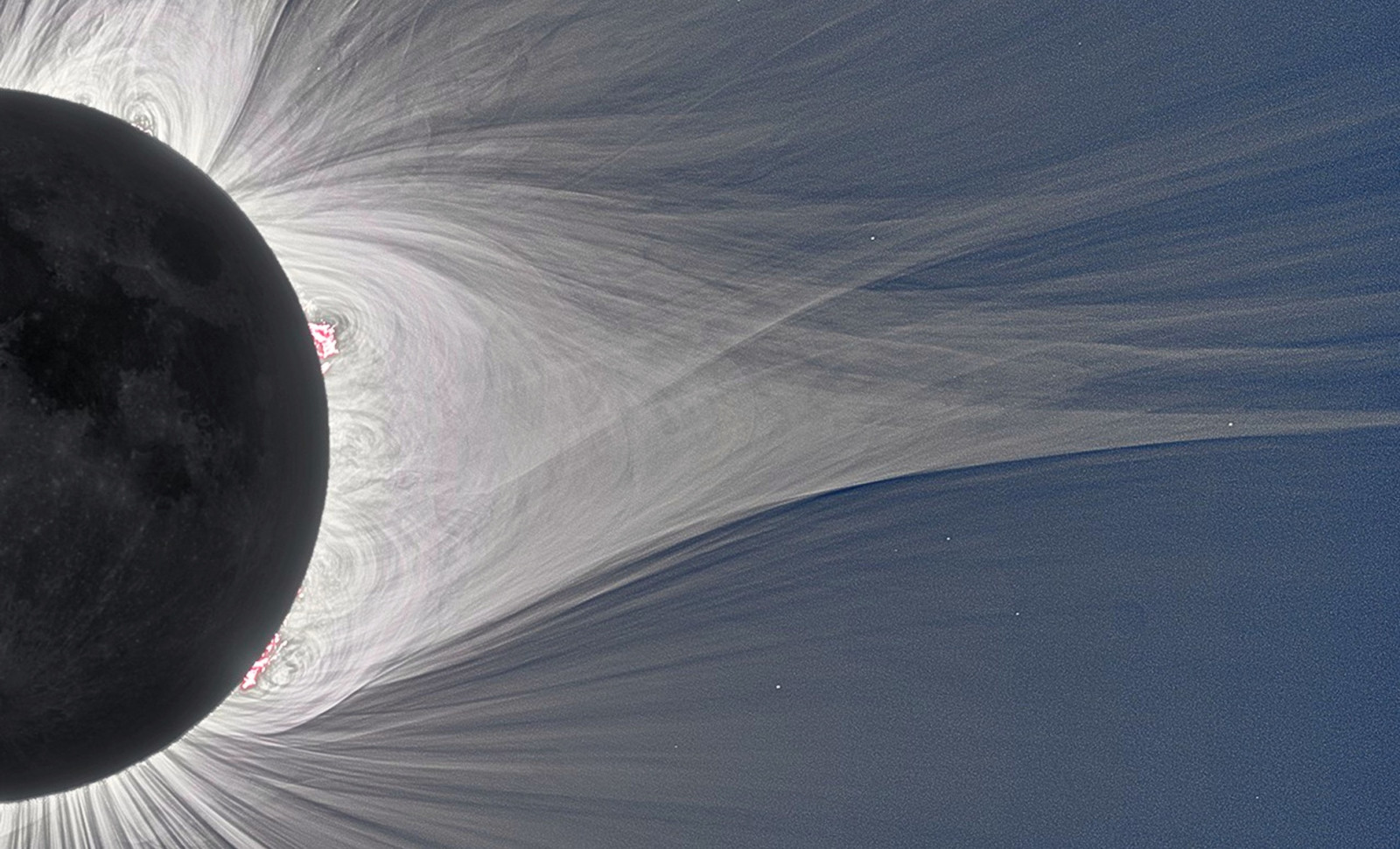
In August 2025, researchers at NASA detected a radio emission originating from the Sun that defied typical patterns. Unlike standard solar radio bursts that often dissipate within hours or a few days, this particular transmission continued without fading for an astounding 19 days, surpassing the previous record of five days.
This event was classified as a Type IV radio burst, caused by energetic electrons trapped within the Sun’s magnetic field lines. Although the radio waves themselves present no danger, such magnetic activity can trigger solar eruptions that pose risks to satellites and spacecraft. Understanding why this burst endured for such a lengthy period became a top priority for space weather researchers.
Published in The Astrophysical Journal Letters, the study sheds light on massive magnetic structures that can hold and release energy over several weeks. The investigation relied on data gathered from multiple spacecraft, a novel analytical method, and a detailed chronology of solar eruptions that likely maintained the burst.

Multiple Spacecraft Monitored the Signal Across the Solar System
Tracking a signal persisting for 19 days requires coordinated observations from multiple vantage points. As the Sun rotates, active regions move in and out of sight from any single spacecraft. To capture the entire event, the team combined data from NASA’s STEREO (Solar Terrestrial Relations Observatory), Parker Solar Probe, and Wind satellites, alongside the Solar Orbiter, a collaborative mission between the European Space Agency and NASA.
Each probe detected a different phase of the burst. Earliest signs appeared in Solar Orbiter readings on August 21, 2025, when the source was positioned on the Sun’s far side relative to Earth. Twelve days later, Wind and Parker Solar Probe observed the signal as it rotated into their field of view. Finally, STEREO-A tracked the lingering emission until September 9.
This sequential observation matched the Sun’s rotation rate, confirming that a single, long-lasting magnetic structure was responsible. The researchers characterized it as a corotating electron reservoir, a magnetic trap that only became visible depending on the viewing angle.
The Origin: A Massive Helmet Streamer Extending Millions of Miles
Determining the exact location of low-frequency radio sources within the solar corona is challenging because radio waves are distorted by the corona’s structure. To address this, the scientists introduced the wavevector-corrected ray sphere (WCRS) technique, which compensates for the deflection caused by solar wind influences.
Applying this correction revealed the source as a helmet streamer, an enormous magnetic loop stretching far into the Sun’s outer atmosphere. These structures can trap hot gas and energetic particles for extended durations. Calculations placed this structure between 6 and 10 solar radii above the solar surface and measured its width at approximately 2.5 to 3 solar radii, making it a large coronal feature.
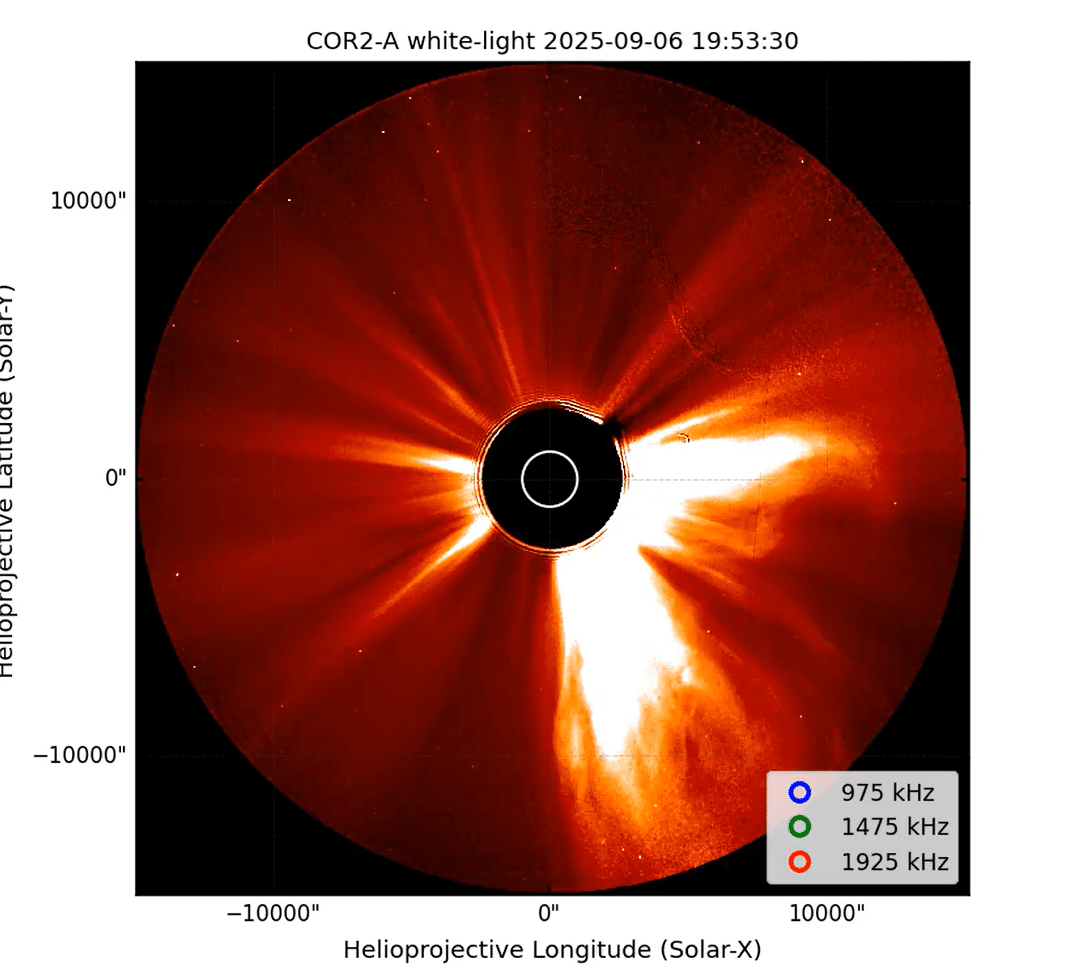
Such sustained radio emissions cannot be powered by stored energy alone. The study identified three coronal mass ejections (CMEs) from the same region that likely rejuvenated the trapped electron population. The first CME coincided with Solar Orbiter’s initial detection on August 21.
The second CME on August 30 was accompanied by a surge in type III radio storm activity, indicating fresh electrons were injected into the corona. A third eruption occurred on September 4, just before the burst reached its peak intensity.
Each of these eruptions either supplied new energetic particles or altered the magnetic environment enough to sustain the emission. Following the third CME, Wind observations near Earth revealed an unusually sparse solar wind, with proton counts dropping to about 0.1 particles per cubic centimeter. This rarefied plasma environment may have contributed to reduced radio wave scattering, making the signal more observable.
A Rhythmic Flicker Reveals the Magnetic Trap’s Size
During its most intense phase, the radiosignal exhibited periodic fluctuations. Data from STEREO-A displayed pulsations with intervals between 45 and 60 minutes. These quasiperiodic pulsations provided an additional method to estimate the magnetic structure’s dimensions.
The team interpreted this rhythmic oscillation as standing waves within the magnetic cavity itself. By applying magnetoseismology—a technique translating wave frequencies into spatial characteristics—they derived a minimum size consistent with estimates based on solar rotation. This concordance reinforced the idea of a singular, extensive magnetic reservoir.
Due to density irregularities in the solar wind, low-frequency radio waves scatter, making the source appear larger than its true size. STEREO’s measurements indicated an apparent angular width of about 20 degrees. Researchers calculated a broadening factor near 60, meaning the observed size was an inflated image of a compact source.
This insight carries implications for space weather prediction. If long-lasting Type IV bursts routinely appear larger due to scattering effects, forecasters could overestimate their size unless corrections like the WCRS technique are applied.
Unanswered Questions and Future Prospects
The researchers acknowledged unresolved issues. The precise process confining electrons for 19 days remains unclear. Distinguishing between steady injection from lower regions of the solar atmosphere versus episodic replenishment by eruptions will require advanced modeling and observational capabilities beyond current spacecraft technology.
They also noted that their height estimations assumed the emission was plasma radiation at the fundamental frequency. Should the emission stem from electron cyclotron frequencies, altitude calculations would shift, but the overall picture of a vast magnetic structure would remain valid.
Comparisons were drawn to a similar, lengthy Type IV burst observed in May 2002, which lasted roughly six days and showed comparable polarization and pulsation patterns. Both events were followed by unusually low-density solar winds at Earth’s orbit, suggesting that these rarefied CME wakes help such extended radio emissions become visible from Earth.
By introducing the WCRS method and utilizing data from multiple spacecraft, this study establishes a new framework for real-time identification and measurement of similar events, advancing the field of space weather forecasting.
- Categories:
- Science










0 comments
Sign in to Comment