
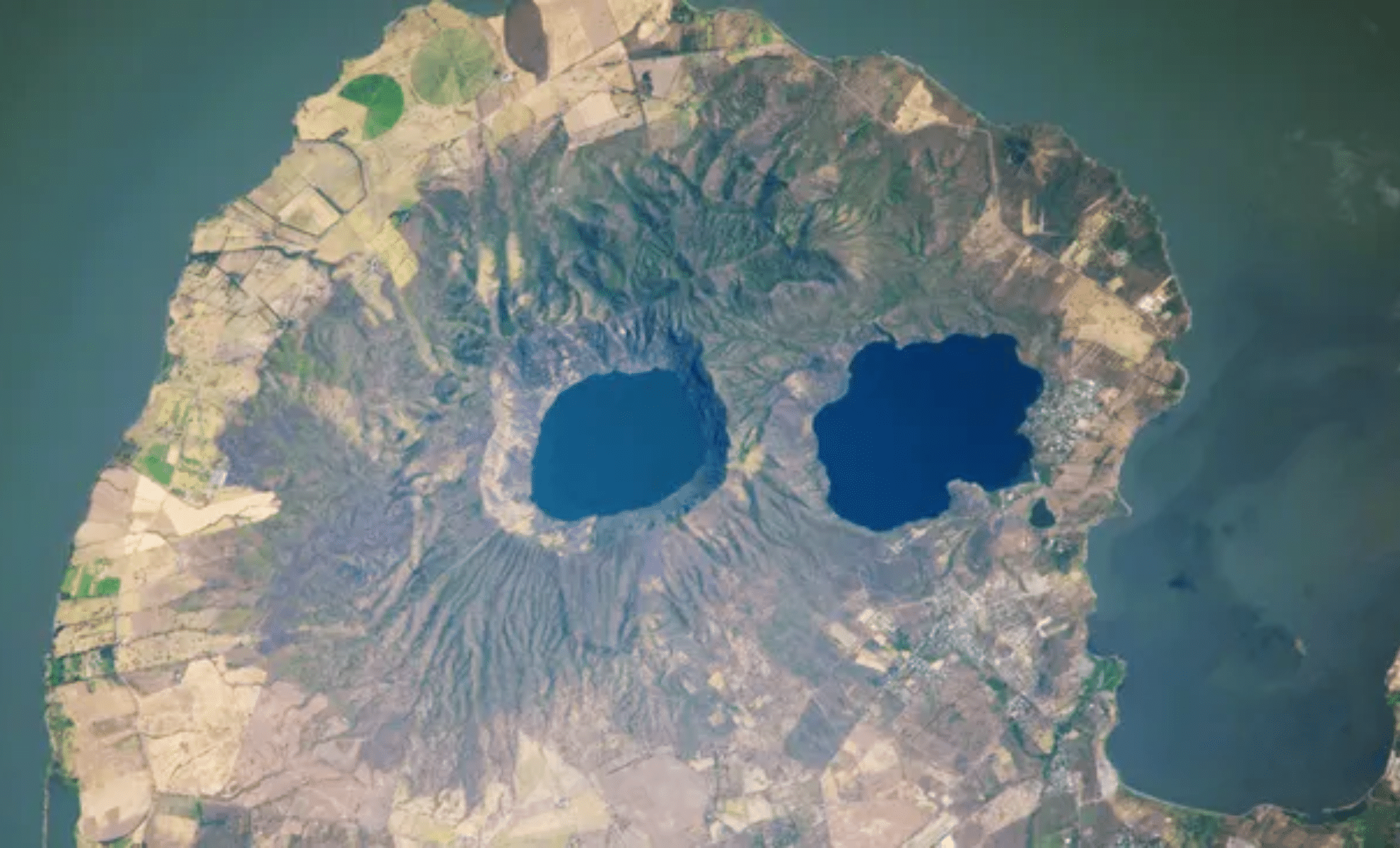
An extraordinary photograph, released by NASA’s Earth Observatory, showcases two volcanic lakes nestled in Nicaragua that resemble a pair of eyes gazing upward into space. Located on the Chiltepe Peninsula, these lakes originated from massive volcanic eruptions thousands of years ago and now form a captivating natural feature on Earth’s surface.
The Volcanic Landscape of the Chiltepe Peninsula
Situated in the center of Lake Managua in Nicaragua, the Chiltepe Peninsula protrudes into the lake and hosts these distinctive “googly eyes.” This landform emerged from pyroclastic shield eruptions that happened some 17,000 years ago, leaving behind a terrain filled with volcanic craters and calderas. The explosive events, which ejected pumice and other light volcanic materials, sculpted the peninsula’s striking topography. Although older, the area has seen less intense volcanic activity within the last 2,000 years.
NASA’s Earth Observatory emphasizes the scientific value of these volcanic structures, which serve as natural laboratories for understanding geological transformations. The creation of calderas and expansive volcanic lakes from such eruptions allows experts to investigate volcanic processes and their environmental effects over extended timelines. Despite their quiet status, these volcanoes are crucial for regional geology and hazard assessment.

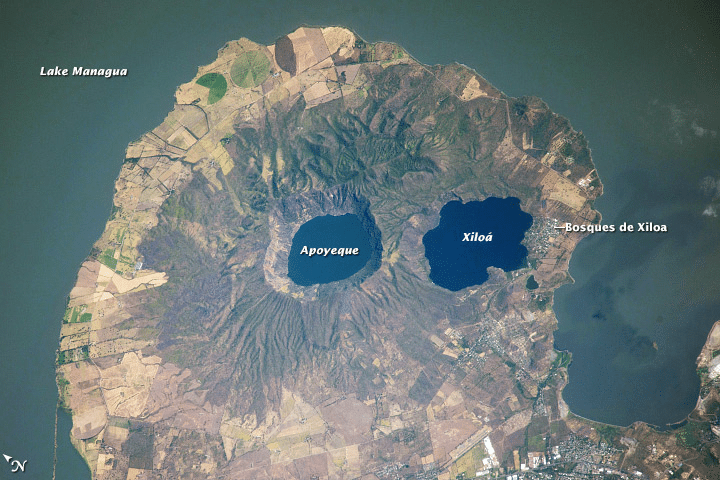
The Distinctive Twins: Laguna Xiloa and Apoyeque
The lakes at the core of this optical phenomenon are Laguna Xiloa and Apoyeque, noted for their striking shapes and contrasting colors. Laguna Xiloa, the larger lake, measures roughly 1.5 miles at its widest point, while Apoyeque spans about 1.1 miles. Seen from orbit, these two bodies of water sit side-by-side, conjuring the image of two eyes fixed on the sky. Their vivid hues further enhance the illusion: Laguna Xiloa’s deep blue contrasts sharply with Apoyeque’s greenish tint, resembling heterochromatic eyes.
The illusion is heightened by altitude differences as well. Apoyeque rests at an elevation near 1,300 feet, whereas Laguna Xiloa lies almost at lake level. This variation visually aligns the lakes more perfectly when observed from space, deepening their “eye-like” appearance.
Volcanic Origins: A Tale of Explosive Eruptions
These volcanic lakes owe their existence to dramatic geological events. Apoyeque occupies an ancient caldera formed by violent eruptions around 50 BC that left the crater containing today’s lake. Laguna Xiloa, meanwhile, originated from a powerful eruption triggered when underground magma reacted explosively with groundwater beneath Apoyeque, reshaping the surrounding landscape.
Despite an apparent calm, both volcanoes remain active according to the Smithsonian Institution’s Global Volcanism Program. Laguna Xiloa’s last major eruption occurred roughly 6,000 years ago, while Apoyeque has seen four significant eruptions since then. Although dormant for millennia, continuing seismic activity, such as minor quakes in 2012 linked to magma shifts beneath Apoyeque, demonstrates ongoing geological dynamism.
Astronauts Capture Stunning Views from Space
The image igniting worldwide interest was captured on January 21, 2014, by an astronaut aboard the International Space Station. From this vantage point, Earth’s surface is revealed in a unique way—where the skull-shaped Chiltepe Peninsula frames the two lakes, transforming them into a piercing gaze from orbit. This visual marvel adds a mysterious flair to an otherwise scientifically important volcanic area.
Beyond their aesthetic impact, these lakes offer a profound illustration of how volcanic forces have sculpted Earth’s terrain over thousands of years, attracting both geologists and space enthusiasts alike.
Monitoring Volcanic Activity and Potential Hazards
Although no immediate eruption threats exist, the Apoyeque and Laguna Xiloa volcanoes remain closely watched by experts and local residents. In 2012, minor tremors caused by magma movements beneath Apoyeque highlighted that volcanic processes are still active beneath the surface, even without eruptive activity.
Communities around Lake Managua, including Bosques de Xiloa near Laguna Xiloa, could face considerable danger if an eruption were to occur. The close proximity to these volcanoes means populations could be at risk from lava flows, ashfall, and other volcanic hazards impacting the surrounding environment.
- Categories:
- News







0 comments
Sign in to Comment