
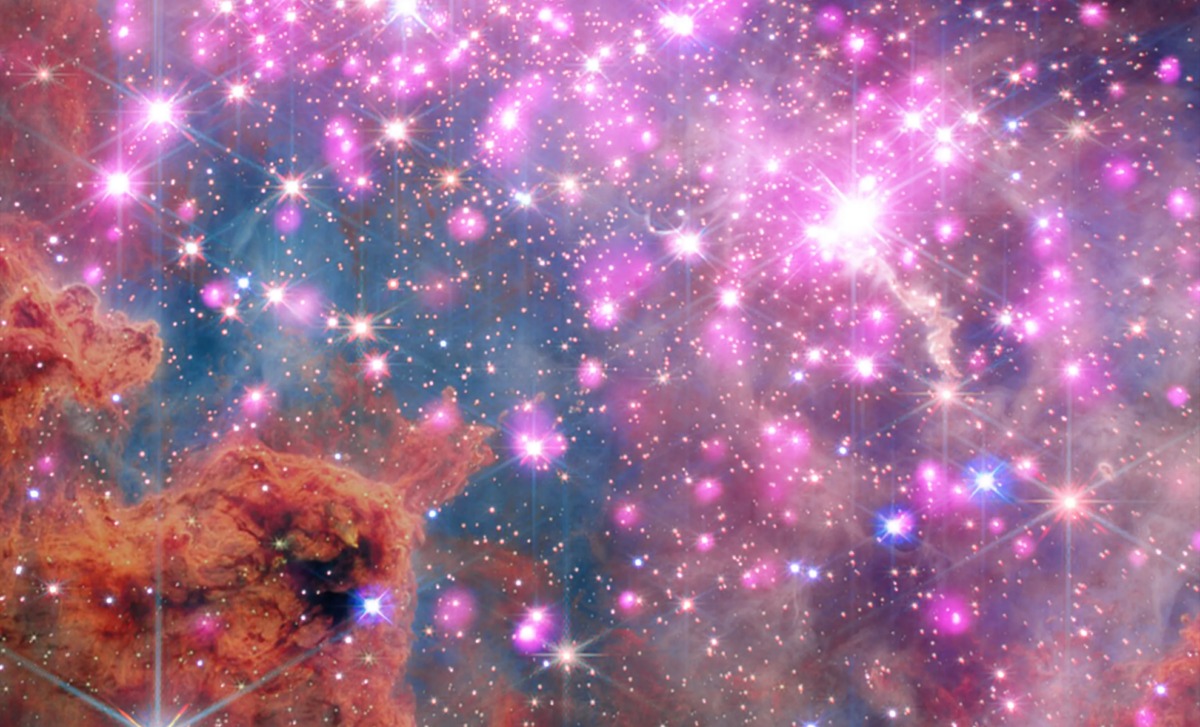
On March 19, 2026, NASA unveiled a breathtaking image showcasing Westerlund 2, a luminous star cluster bathed in bright pink hues, located within one of the Milky Way’s most bustling stellar nurseries. Using data from both the Chandra X-ray Observatory and the James Webb Space Telescope, this image reveals stars aged between one and three million years, set against striking brick-orange clouds of dust – the very building blocks of star formation.
Exploring the Westerlund 2 Cluster
Situated within the Gum 29 nebula of the Carina Constellation about 20,000 light-years from Earth, Westerlund 2 is a tumultuous region where stars rapidly emerge. The image highlights numerous stars glowing neon pink due to X-ray emissions detected by Chandra, while Webb’s infrared observations expose the surrounding dust clouds in a spectrum of reds, oranges, greens, cyans, and blues. These combined wavelengths enable astronomers to examine the birth, development, and makeup of young stars and their environments with unprecedented detail.
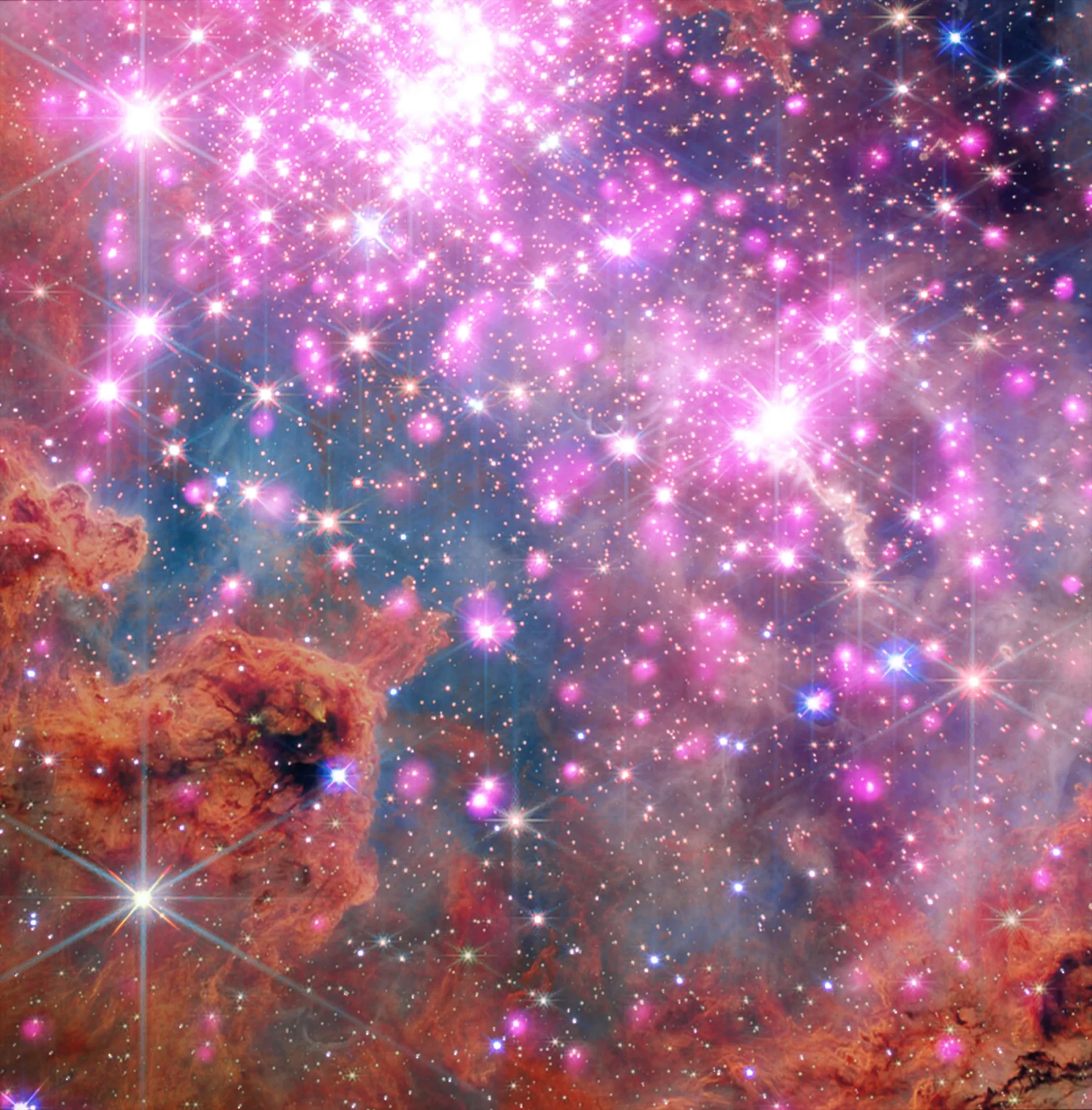
Blending X-ray with infrared imaging is vital for piercing through thick gas and dust layers that typically hide young stars. Many stars here are still in their formative phases, burning hydrogen and beginning to impact their surroundings. The prominent brick-orange clouds at the image’s base represent the raw material for future stars, illustrating the ongoing cycle of cosmic creation.

What Neon Pink X-Rays Reveal
The neon pink X-rays captured by Chandra signify energetic events within young stars. These emissions point to intense magnetic activity, including strong stellar flares, affecting the nearby environment by dispersing gas and dust and potentially sparking new star formation.
Studying these X-rays sheds light on stars’ earliest phases, crucial for understanding cluster and galactic evolution. NASA highlights that combining these data with Webb’s infrared imagery enables scientists to trace both hot, energetic stars and the cooler material around them, granting a comprehensive look at the dynamic forces shaping Westerlund 2.
A Cosmic Laboratory for Star Formation
Westerlund 2 serves as an astronomical testbed, offering a rare look at stars forming densely packed together. This cluster reveals how massive stars emerge and interact in crowded spaces, providing clues about early conditions in the Milky Way and helping to piece together our galaxy’s history.
By integrating Chandra’s X-ray insights with Webb’s infrared views, researchers can assess star temperatures, densities, and radiation, delivering a multi-faceted perspective on stellar nurseries. The findings also have implications for planet formation, as these dust clouds eventually condense into planetary systems.
Bridging Galactic Phenomena
Studying clusters like Westerlund 2 helps astronomers connect star formation processes across our galaxy and beyond. Each observation enriches understanding of stellar development, cluster interactions, and galactic architecture. NASA underscores that such images not only highlight cosmic beauty but also provide critical data, blending scientific inquiry with visual wonder in the exploration of space.
The bright neon pink hues alongside vivid infrared colors demonstrate how multiwavelength astronomy exposes phenomena invisible to unaided vision. As observational technology advances, astronomers look forward to even sharper studies of young clusters, unlocking the mysteries behind star birth and complex cosmic forces at play.
- Categories:
- Nasa







0 comments
Sign in to Comment