

In 2021, scientists detected the Amaterasu particle — one of the universe’s most energetic cosmic rays— carrying an astonishing energy around 244 exa-electronvolts. Its initial direction, seemingly from a nearly empty patch of space, puzzled astronomers. However, new statistical insights now favor a closer starburst galaxy as the likely origin.
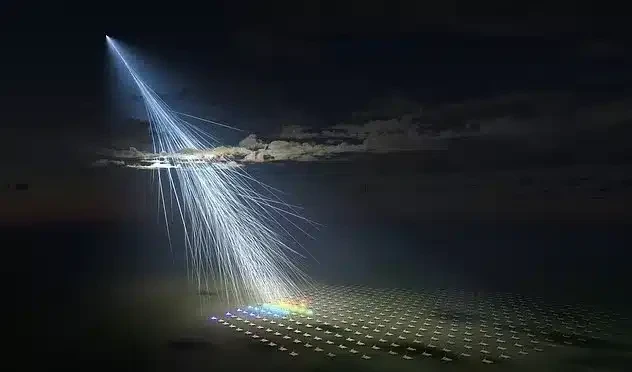
The particle’s arrival was recorded in May 2021 by Utah’s Telescope Array Project, revealing an energy level approximately 40 million times that of the highest-energy collisions achieved at the Large Hadron Collider. The particle appeared to come from the Local Void, a sparse cosmic region adjoining the Local Group, stirring questions about how such high-energy particles are produced.
Unexpected Arrival from an Empty Cosmic Region
As highlighted in an EurekAlert article, ultra-high-energy cosmic rays are incredibly rare and typically emerge from the universe’s most extreme settings. When Amaterasu hit Earth’s atmosphere, the Telescope Array Project measured an estimated 244 EeV, ranking just below the top-energy cosmic ray ever detected.

At the time, researchers could not conclusively identify whether the particle was a proton, a light atomic nucleus, or a heavier nucleus like iron. The event’s direction seemed to originate from the Local Void, a region sparsely populated with potential sources capable of accelerating particles to such immense energies, posing an intriguing mystery.
Tracking Particle Paths Through Space
Tracing the origin of charged cosmic rays is challenging because magnetic fields across galaxies and intergalactic space alter their trajectories. Even minor deflections can cloud the true source location.
A recent paper in The Astrophysical Journal tackled this problem by combining physics simulations with Approximate Bayesian Computation, a sophisticated statistical technique. This method produced three-dimensional models of cosmic-ray propagation and their interactions with magnetic fields in the Milky Way.
Researchers emphasized the difficulty of estimating the energies of such particles, making source identification via statistics particularly complex. By merging simulations with observational data, they broadened the scope of possible origins beyond initial directional predictions.
The Nearby Cigar Galaxy as a Probable Source
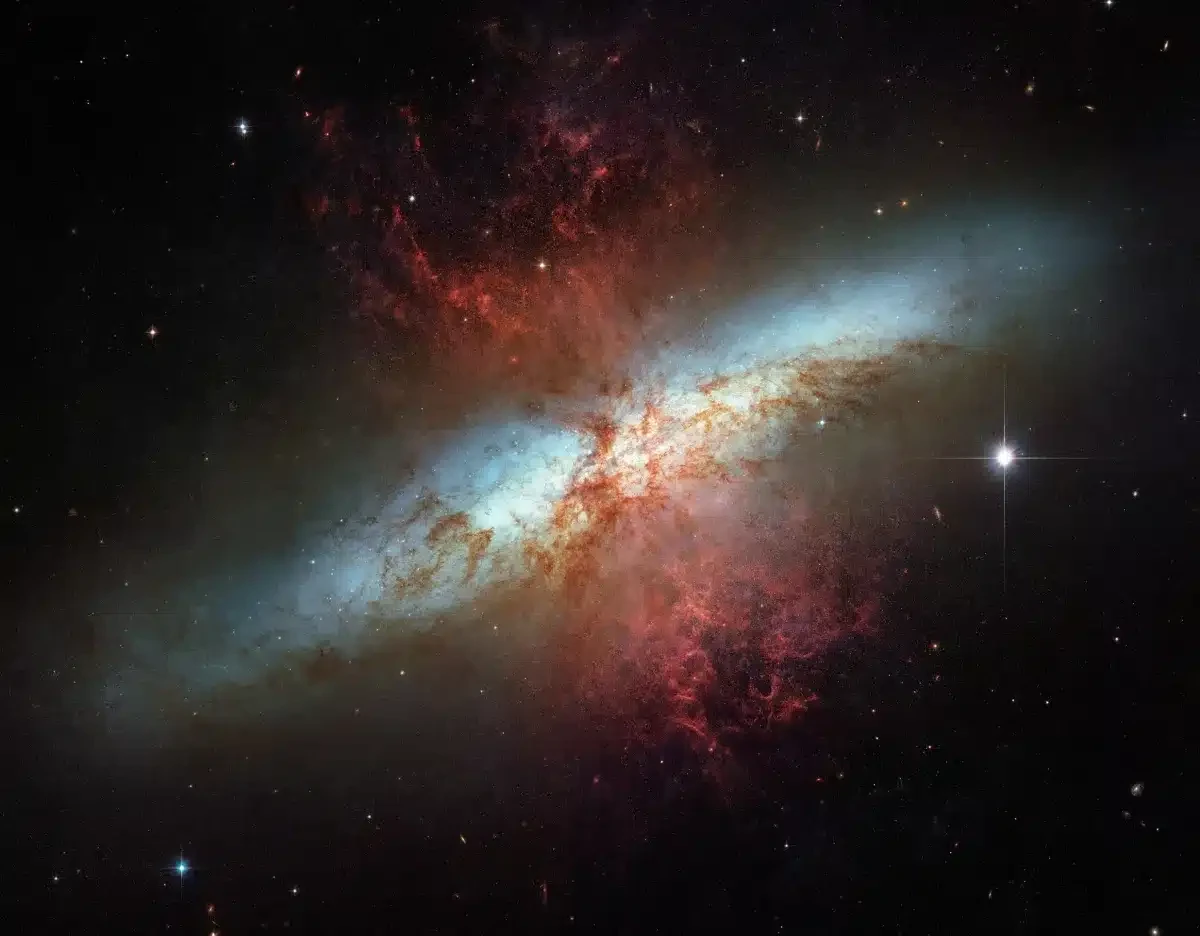
The latest study suggests Amaterasu’s origin is unlikely confined to the Local Void but instead may stem from a nearby starburst galaxy. One strong candidate is M82, also called the Cigar Galaxy, situated roughly 12 million light-years away.
Nadine Bourriche from the Max Planck Institute for Physics stated the findings support the idea that the particle more plausibly originated in an active star-forming galaxy like M82 rather than a low-density void. This research introduces a framework that better integrates simulations and observational evidence.
Francesca Capel, head of the Astrophysical Messengers team at MPP, explained the significance of studying these cosmic rays to unveil the universe’s mechanisms for accelerating matter to extreme energies and to pinpoint environments where such energetic matter can be examined.
“Our goal is to develop advanced statistical analysis methods to exploit the available data to its full potential and gain a deeper understanding of the possible sources of these energetic particles,” she said.
- Categories:
- News





0 comments
Sign in to Comment