

Since its discovery in 1978, Charon has captivated astronomers with its distinctive orbit alongside Pluto. Unlike conventional satellite systems, Pluto and Charon revolve around a shared center of gravity, defining them as a binary pair. This unusual feature was a key factor in Pluto’s categorization as a dwarf planet.
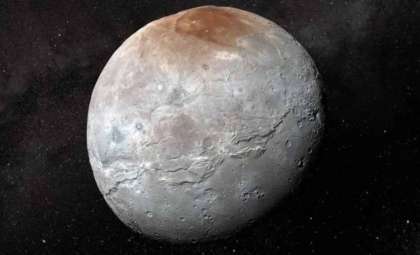
Charon measures about 1,200 kilometers across — roughly half the diameter of Pluto — making it the largest moon relative to its parent planet in our solar system. Its surface and makeup differ markedly from Pluto and other trans-Neptunian objects, which mainly consist of methane and nitrogen ices.
The moon’s crust is dominated by water ice and contains an intriguing mix of chemicals, including:

- Ammonia
- Organic carbon compounds
- Newly identified carbon dioxide
- Hydrogen peroxide
Charon also features cryovolcanoes that erupt icy material instead of lava, adding to its scientific interest. These characteristics establish Charon as a key target for examining the diversity of bodies in the outer solar system, akin to the remote objects discovered beyond the Kuiper Belt.
Breakthrough discoveries by the Webb telescope
The James Webb Space Telescope, operational since 2021, continues to enhance our cosmic knowledge. With its expansive 6.5-meter mirror and advanced infrared sensors, Webb has enabled the detection of carbon dioxide and hydrogen peroxide on Charon’s frozen surface, deepening our insight into this faraway moon.
Thanks to spectroscopy — a tool that decomposes light into its spectral components — researchers can identify unique chemical fingerprints on planetary surfaces. This technique has been pivotal in characterizing everything from distant exoplanets to bodies within our own solar neighborhood.
The identification of carbon dioxide on Charon is especially noteworthy. Scientists propose that this molecule emerges from beneath the moon’s icy exterior, exposed by asteroid impacts that excavate fresh material from below. Such craters provide a glimpse into Charon’s inner makeup.
This finding parallels recent observations such as the discovery of a water-abundant atmosphere on exoplanet GJ 9827 d, underscoring the Webb telescope’s prowess in unveiling diverse celestial environments.
Significance for comprehending the outer solar system
Spotting carbon dioxide and hydrogen peroxide on Charon offers vital evidence about the origins and development of objects in the solar system’s distant reaches. These chemical clues could clarify how Charon formed and its dynamic with Pluto.
Two main hypotheses dominate the scientific discussion on Charon’s birth:
- A colossal impact between Pluto and a massive Kuiper Belt object roughly 4.5 billion years ago, creating Charon from the resultant debris.
- The merger of two separate entities that later settled into a mutual orbit.
Analyzing Charon’s chemical profile, especially with the newly discovered compounds, might confirm one of these scenarios or inspire novel theories.
Moreover, understanding Charon’s composition could shed light on the make-up of other Kuiper Belt members and related distant bodies. Studying Charon enhances our grasp of the processes shaping the outer solar system and uncovers the characteristics of these far-flung worlds.
Ongoing investigations and upcoming missions
The revelation of carbon dioxide on Charon marks a major advance in solar system exploration, though numerous questions persist. Continued study is essential to fully appreciate these discoveries’ implications.
Researchers will keep examining data from Webb and other observatories to refine our knowledge of Charon’s geology and evolution. Future spacecraft missions to the Pluto-Charon pair may deliver even richer details about these intriguing satellites.
Expanding our understanding of Charon and other distant objects holds promise for unveiling fundamental insights on planetary formation and the potential habitability of worlds beyond Earth. Such research extends to the broader quest for life and conditions suitable for living elsewhere in the universe.
Object Diameter (km) Key Characteristics Pluto 2,377 Nitrogen and methane ice, mountains, glaciers Charon 1,212 Water ice, carbon dioxide presence, cryovolcanoes Earth’s Moon 3,475 Craters, maria, surface-wide water distribution
As explorations venture farther into our solar system, findings like carbon dioxide on Charon reveal the rich complexity and diverse nature of celestial bodies. Each step forward advances our understanding of our cosmic surroundings and our place within the universe.
- Categories:
- Nasa








0 comments
Sign in to Comment