
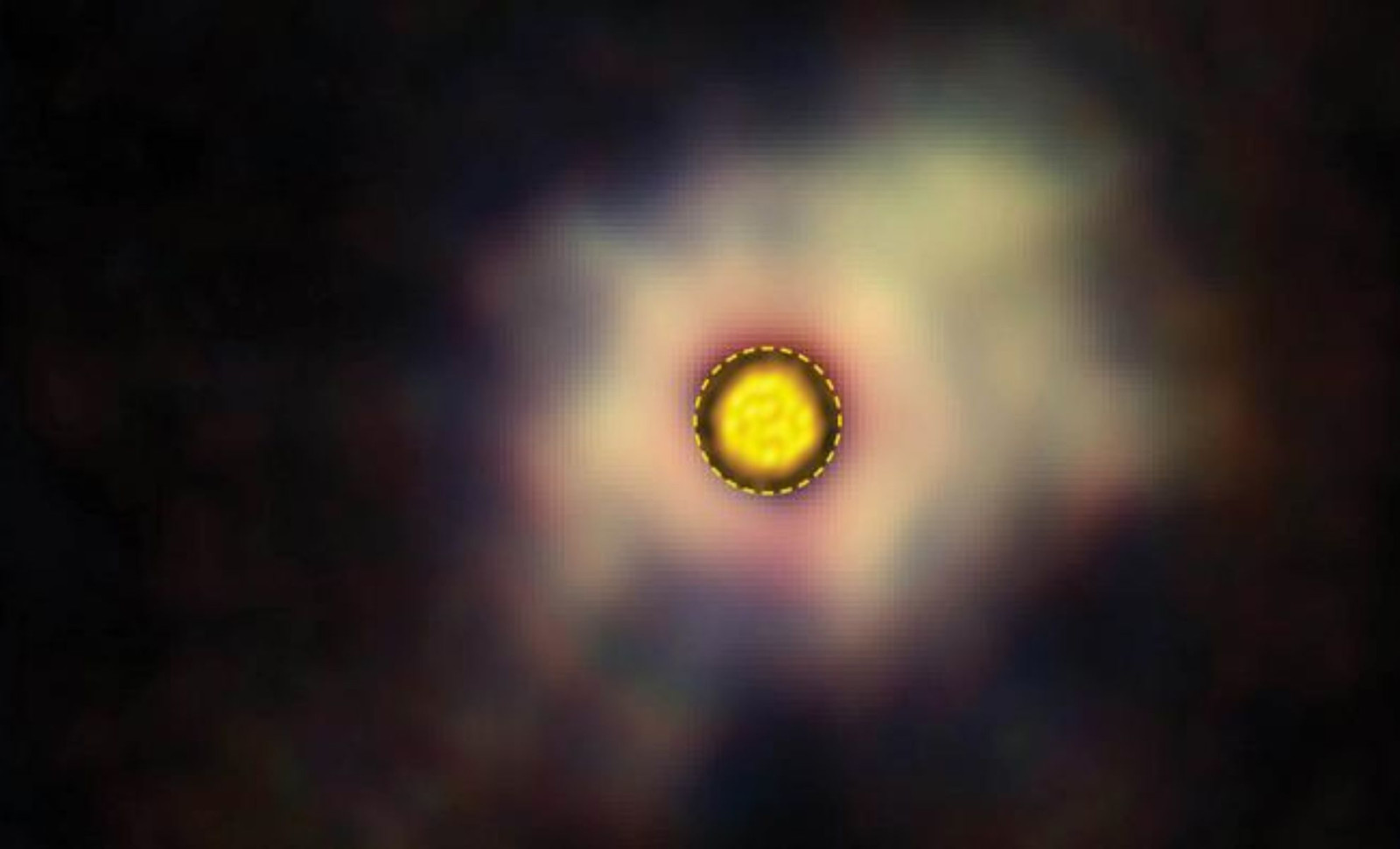
For years, scientists believed that aging stars expelled vital elements for life into space by pushing stardust outward with their light. However, new studies of a nearby red giant challenge this idea, showing that dust alone doesn’t create enough force to drive the stellar winds responsible for distributing these materials.
By closely examining R Doradus, a star located just 180 light-years away, astronomers observed the early phases of its mass loss. This research overturns longstanding views on how stars enrich the cosmos with critical elements like carbon, nitrogen, and oxygen, which are fundamental to the formation of stars, planets, and potentially life itself.
Stellar Internal Motions Likely Key to Wind Generation
Utilizing the SPHERE instrument on the Very Large Telescope in Chile, scientists studied polarized light reflected by dust grains around R Doradus. This enabled detailed observation of faint atmospheric features where the stellar wind originates. According to the study, published in Astronomy & Astrophysics, they identified silicates and alumina, typical dust components in oxygen-rich settings.

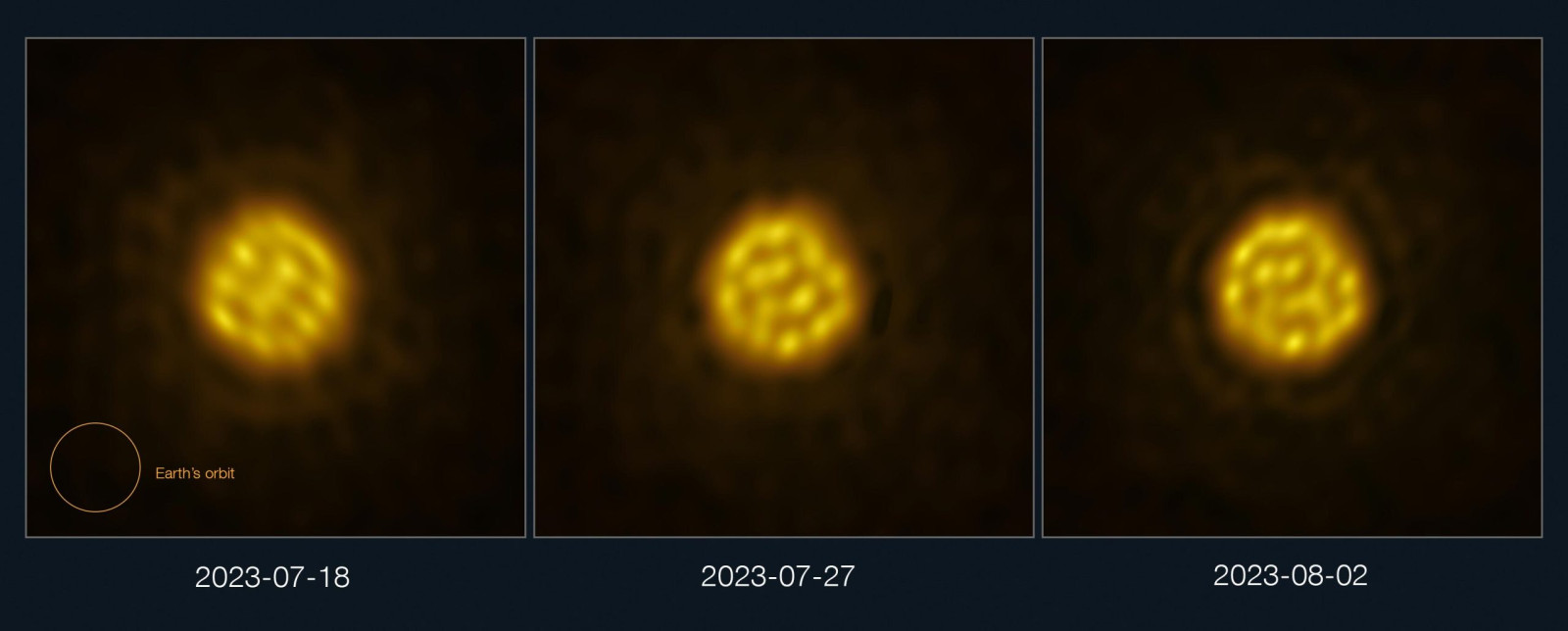
To evaluate whether these grains could propel gas away, the team employed radiative transfer simulations, modeling how light interacts with matter. Findings revealed that the dust particles were too minute to absorb sufficient light for a meaningful push. Lead investigator Theo Khouri remarked:
“We thought we had a good idea of how the process worked. It turns out we were wrong. For us as scientists, that’s the most exciting result.” Even assuming that every available atom of silicon or aluminum condensed into solid grains, gravity still dominated.
Iron-Rich Dust Grains Don’t Survive Close to the Star
The team also analyzed the possibility that iron-containing dust, known for absorbing more light, could push gas more effectively. Yet, such grains heat rapidly and undergo sublimation—transforming directly from solid to gas—before they can significantly aid stellar wind acceleration.
This limitation rules out both small and large dust grains as the primary force propelling gas away from the star. According to the research, even under ideal conditions, iron-rich particles do not survive long enough near the star to facilitate stellar wind initiation.
Star’s Pulsations and Inner Movements Offer New Clues
With dust ruled out, astronomers are exploring the role of the star’s own dynamic behavior in driving the outward gas flow. R Doradus experiences regular brightness variations, expanding and contracting roughly every 175 and 332 days. These rhythmic pulsations likely create shock waves that can push gas outward.
Simultaneously, convection—the rise of hot plasma and descent of cooler plasma—may lift gas to cooler regions where new dust might form, potentially aiding the process. Yet the key takeaway is that dust is not the main driver.
“Even though the simplest explanation doesn’t work, there are exciting alternatives to explore,” explained Wouter Vlemmings, professor at Chalmers and co-author of the study. “Giant convective bubbles, stellar pulsations, or dramatic episodes of dust formation could all help explain how these winds are launched.”
As highlighted by EurekAlert!, future research will require monitoring stars like R Doradus across their pulsation phases to capture the precise moments and mechanisms behind the onset of stellar winds.
- Categories:
- Space




0 comments
Sign in to Comment