
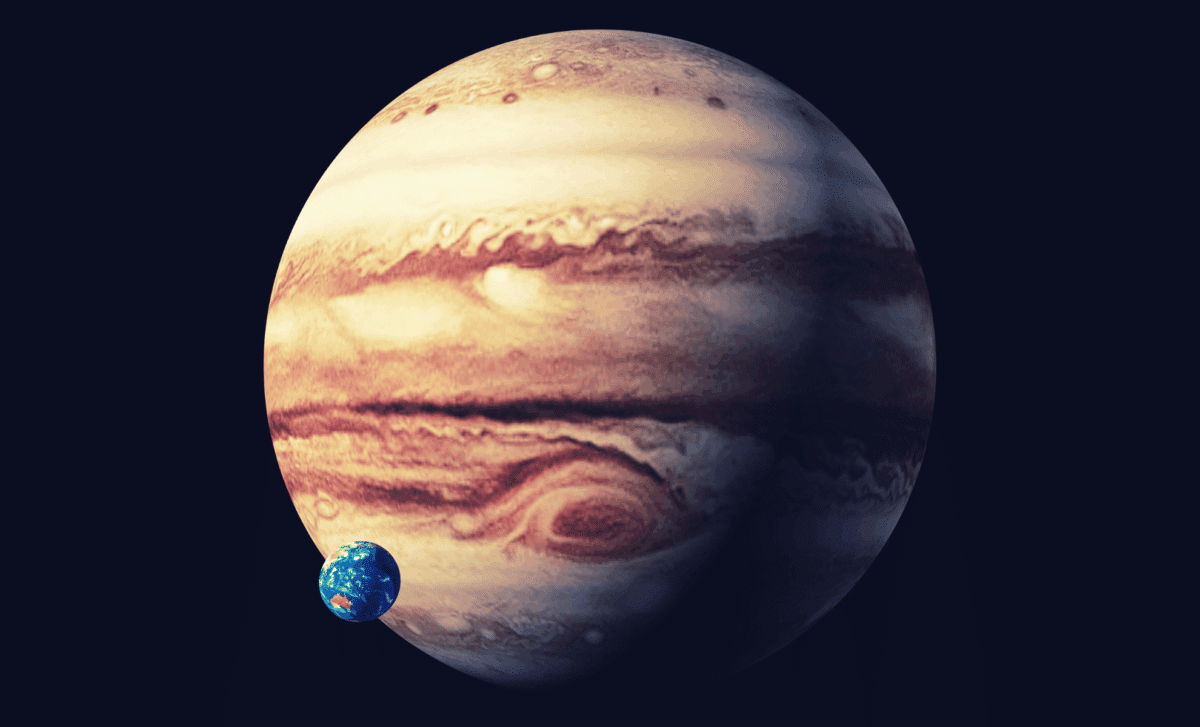
As the largest planet in our solar system, Jupiter has intrigued scientists for centuries. Recently, a team at Rice University uncovered fresh insights into Jupiter’s origins, highlighting how its emergence impacted the solar system’s early environment. Their findings clarify not only the formation of ancient meteorites but also Jupiter’s significant role in Earth's own development.
The Early Growth of Jupiter and Its Effects on Solar Nebula Dynamics
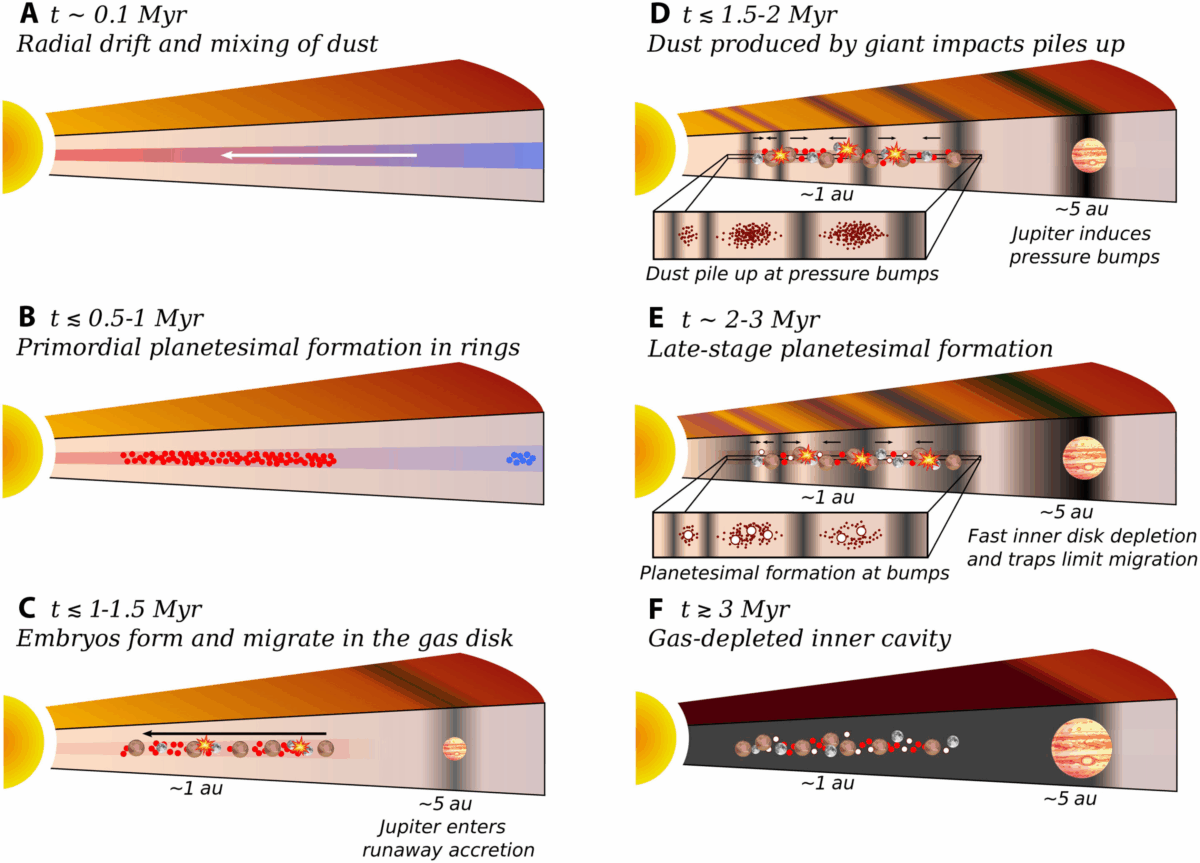
Jupiter’s creation was more than just developing the massive planet we know today—it was a crucial event shaping the solar system’s infancy. Researchers André Izidoro and Baibhav Srivastava from Rice University demonstrated that Jupiter’s swift expansion disrupted the surrounding gas and dust, which coalesced to form the planets. This disturbance carved gaps and rings within the solar nebula, the primordial disk encircling the young Sun, effectively blocking smaller particles from drifting inward toward the Sun.
Scientists describe this phenomenon as “cosmic traffic jams,” where particles amassed in crowded rings. Interestingly, these dense zones were not from the initial planet-building materials but instead represent a second generation of matter, forming well after the solar system’s first solids. This surprising discovery alters our understanding of when and how planetesimals—the rocky precursors to planets—actually emerged.

Unlocking the Mystery Behind Primitive Meteorite Formation
One perplexing issue in planetary science involves the late arrival of primitive meteorites, particularly chondrites, which are regarded as archival material from the solar system’s earliest days. Despite containing original solar system components, many of these meteorites formed millions of years after the initial solid bodies appeared.
The latest study offers a novel explanation. Srivastava explains,
“Our model ties together two things that didn’t seem to fit before—the isotopic fingerprints in meteorites, which come in two flavors, and the dynamics of planet formation. Jupiter grew early, opened a gap in the gas disk, and that process protected the separation between inner and outer solar system material, preserving their distinct isotopic signatures. It also created new regions where planetesimals could form much later.”
This revelation suggests Jupiter’s influence was critical not only in the inner solar system’s shaping but also in the delayed appearance of these primordial meteorites, opening new avenues for understanding solar evolution.
How Jupiter Kept Earth and Nearby Planets Anchored
Jupiter’s reach extended beyond distant planetesimals, playing a vital role in forming Earth, Venus, and Mars close to the Sun. Traditional models predicted that smaller planets would migrate inward, spiraling toward the star due to gravitational forces from the gas and dust. Yet, these terrestrial planets maintained stable orbits, puzzling scientists.
Jupiter’s substantial gravity acted as a barrier, halting inward drift and preserving the inner planets' positions. This gravitational checkpoint also ensured Earth’s residence in the habitable zone, the Goldilocks zone ideal for sustaining life. Reflecting on this cosmic arrangement, Izidoro remarked,
“Jupiter didn’t just become the biggest planet—it set the architecture for the whole inner solar system. Without it, we might not have Earth as we know it.”
These insights highlight Jupiter’s pivotal importance in both planetary configuration and the emergence of life-supporting conditions on Earth.
Decoding Jupiter’s Role in Our Solar System’s Origins
The rapid growth of Jupiter shaped the solar system’s layout profoundly. By carving gaps and rings in the protoplanetary disk, it separated inner and outer solar materials, influencing planet formation and dictating the distribution of meteorites. Published in Science Advances, this research shows how Jupiter’s gravity preserved crucial isotopic distinctions between different solar system regions. Meteorites carrying these signatures serve as tangible records of the conditions that influenced planetary birth.
Comparisons with young star systems observed via telescopes such as ALMA reveal similar features—rings, gaps, and crowded particle bands—signalling the early phases of planet formation. Izidoro noted, “Viewing these young disks, we witness giant planets forming and reshaping their surroundings. Our solar system’s history mirrors this progression. Jupiter’s early emergence imprinted a signature preserved within meteorites arriving on Earth today.”
- Categories:
- Space







0 comments
Sign in to Comment