
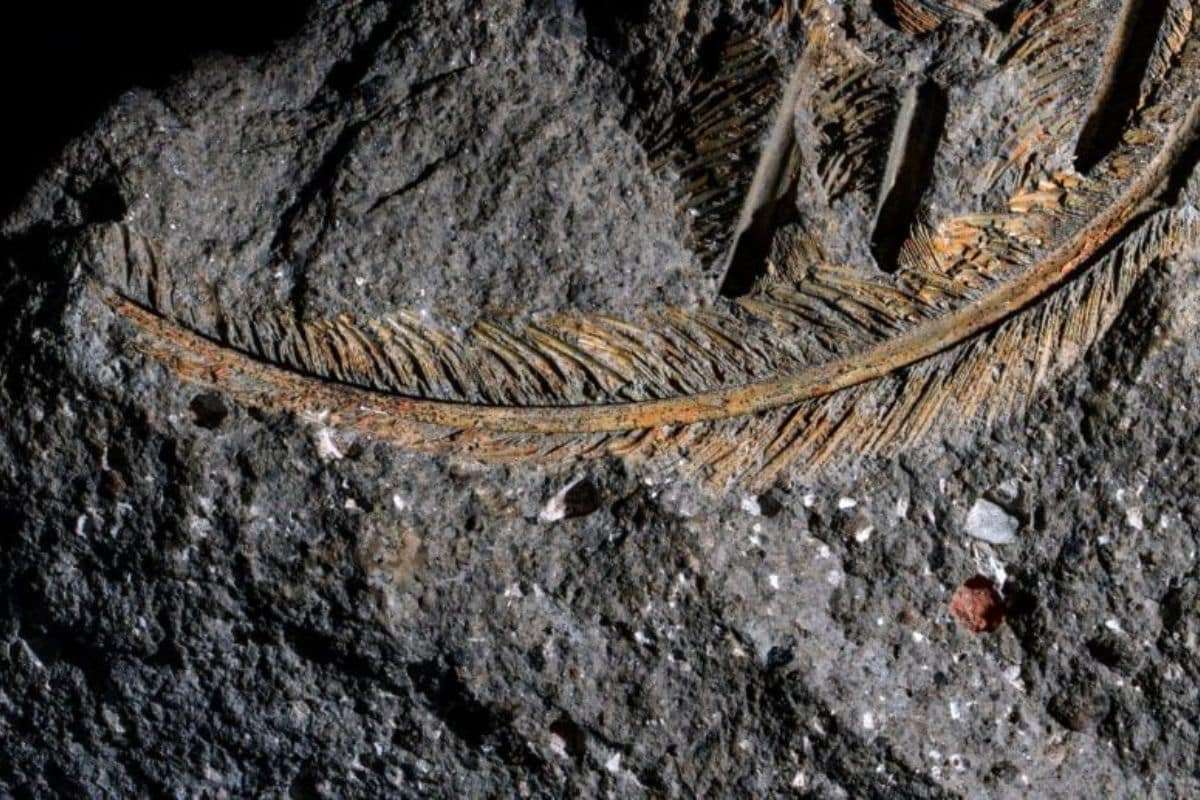
A remarkable 30,000-year-old vulture fossil encased in volcanic ash in Italy has provided scientists with surprising insights into how fossils can form. Unlike the usual fossils embedded in sedimentary layers, this specimen was exquisitely preserved within volcanic material, breaking previous expectations about fossil preservation. Researchers revealed that a unique mineralization process captured fine details of the bird’s feathers, eyelids, and even pigment cells, offering an extraordinary look at ancient species.
Fossil Preservation Among Volcanic Deposits
First uncovered in 1889 near Rome, this fossil remained mostly unstudied for over 100 years. More recent examinations revealed that its feathers were fossilized with intricate three-dimensional detail.
Usually, paleontologists find fossilized feathers in mudstones from prehistoric lakes, which provide gentle conditions for soft tissues to survive. Discovering plumage preserved within volcanic rock was completely unexpected.

“Examining the vulture’s feathers led us into completely new territory,” commented Dr. Valentina Rossi, the study’s lead researcher at University College Cork. “The preservation styles here differ dramatically from any fossil feathers we've seen before.”
The Role of Zeolite Minerals in Preservation
According to the report in Geology, this represents a novel preservation mechanism involving the mineral zeolite.
Zeolites, rich in silicon and aluminum, commonly form in volcanic and hydrothermal fields. Researchers found that interaction between water and volcanic ash induced zeolite nanocrystals to grow, perfectly replicating feather microstructures down to the cellular level.
“The exquisite feather preservation suggests the bird was encased within a cooler pyroclastic deposit,” Rossi elaborated. This implies volcanic materials can sometimes protect organic remains instead of destroying them.
Reevaluating Volcanic Deposits as Fossil Sites
These results call into question the assumption that volcanic deposits are too violent for preserving soft tissues. As Professor Dawid A. Iurino from the University of Milan explains, pyroclastic flows may under certain conditions create optimal fossilization environments.
“Typically, we think of volcanic deposits as scorching, fast-moving flows that obliterate soft material,” Iurino notes. “But these volcanic settings are more complex and can include low-temperature layers that maintain delicate tissue structures at cellular resolution.”
This discovery hints that volcanic ash strata might be overlooked as promising fossil-rich locales.
Broadening Horizons for Future Fossil Finds
The study paves the way for expanded fossil explorations in volcanic areas. If fragile feathers can endure these environments, other soft tissues like skin or internal organs might also be preserved within volcanic rock.
“The fossil record continues to surprise, revealing new species, unusual anatomies, and now, unprecedented preservation modes,” said Professor Maria McNamara, a co-investigator of the research.
“We never expected to find delicate tissues such as feathers preserved in a volcanic rock. Discoveries such as these broaden the range of potential rock types where we can find fossils, even those preserving fragile soft tissues.”
- Categories:
- Science


0 comments
Sign in to Comment