
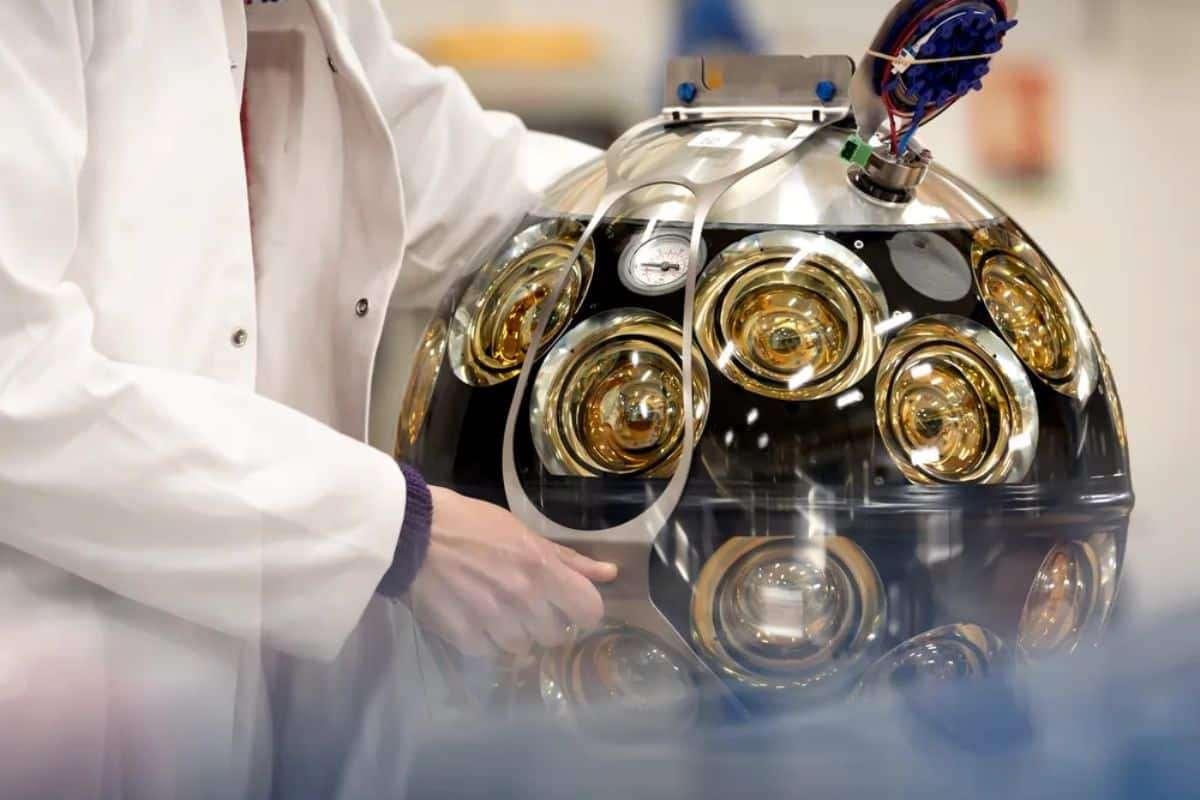
Researchers have identified one of the most energetic neutrinos ever captured, detected far beneath the Mediterranean Sea, marking a significant milestone in particle physics. This elusive particle, designated KM3-230213A, was recorded by the KM3NeT underwater detector and carries an extraordinary energy of 220 PeV, placing it among the highest-energy particles observed to date.
Underwater Observatory Spots an Unbelievable Event
Neutrinos are known for their elusive nature, capable of passing through matter virtually undisturbed. Capturing a neutrino event with such high energy as KM3-230213A demands exceptional sensitivity. The KM3NeT facility, located deep underwater, uses an array of sensitive photomultiplier tubes designed to detect the faint blue Cherenkov light produced when neutrinos interact with water molecules.
“Neutrinos stand out as some of the most enigmatic fundamental particles. They possess no electric charge, have almost negligible mass, and interact extremely weakly with other matter. They are unique cosmic messengers,” explained Rosa Coniglione, a scientist at the INFN National Institute for Nuclear Physics.

Situated near Sicily, the ARCA detector recorded a solitary muon, a secondary particle produced by the neutrino’s interaction, confirming the cosmic origin of the event. This detection marks a historic first for spotting such an energetic neutrino in the Mediterranean, contributing valuable data to the field of high-energy astrophysics.
Unraveling the Origins of Ultra-Energetic Neutrinos
Scientists are now investigating the cosmic phenomena capable of generating particles with such immense energies. Hypotheses include sources like supernova remnants, supermassive black holes, and energetic collisions between cosmic rays and interstellar matter.
Another candidate explanation is the production of cosmogenic neutrinos, which arise when ultra-high-energy cosmic rays interact with the cosmic microwave background — the leftover radiation from the Big Bang.
Confirming this would offer direct insight into some of the universe’s most powerful processes.
Advancing the Frontiers of Neutrino Detection
As noted by Earth, the KM3NeT initiative continues to grow. Once fully deployed, the ARCA site will host 230 detection units, while the ORCA site, situated off France’s coast, will include 115 units — all fitted with state-of-the-art optical modules to monitor neutrino interactions with remarkable precision in real time.
This groundbreaking discovery highlights that deep ocean observatories can identify extremely rare natural phenomena. The ongoing goal is to trace cosmic particle accelerators across the universe and pinpoint the origin points of these high-energy neutrinos.
Exploring the Next Wave of Cosmic Signals
This milestone places researchers at the forefront of a promising new chapter in neutrino science. Next, they aim to pinpoint the source of KM3-230213A by correlating data with observations from gamma-ray telescopes and various astronomical instruments. Future findings could profoundly reshape our understanding of cosmic particle acceleration and unveil the dynamics driving the universe’s most extreme environments.
At present, KM3NeT advances its quest to push the limits of astrophysical research, with each new detection bringing us closer to unraveling the mysteries behind the cosmos’ most energetic events.








0 comments
Sign in to Comment