
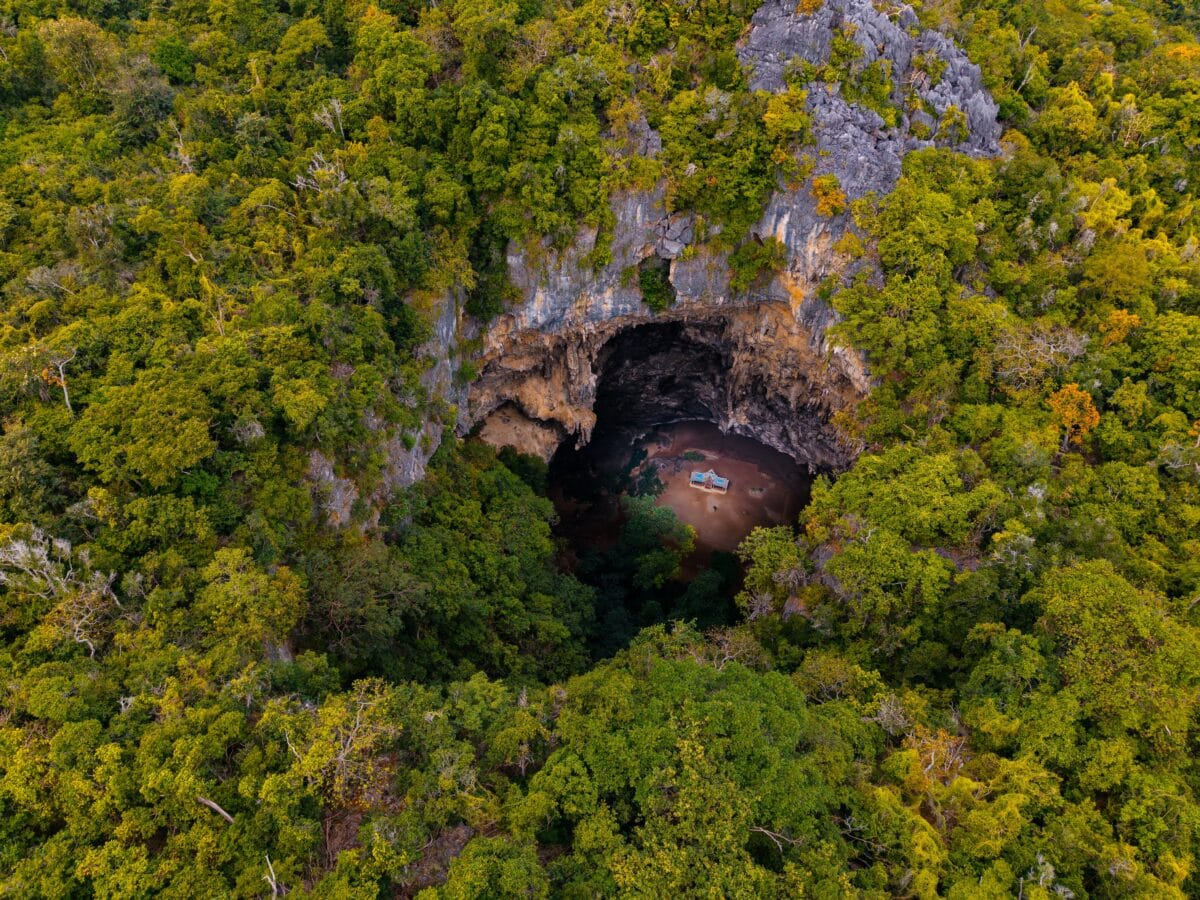
In the secluded regions of southern China, an enormous sinkhole has revealed an astonishing subterranean cave network, thrilling the geological community. Dubbed Hong Kong ‘Haiting Hall’, this monumental cavity is considered one of the most outstanding geological finds of recent times.
Situated in Guangxi province, the sinkhole was initially identified by a Hong Kong expedition in 2023. However, it was only when a collaborative Chinese-British team revisited the site this year that its true magnitude and importance were thoroughly documented.
Delving Into the Hidden Realm
The Xinhua news agency reports that between October 4 and 8, a group of 19 researchers led by Zhang Yuanhai from the Institute of Karst Geology alongside Andy Eavis representing the British Caving Association explored the deep rocky crevice using a single rope. Their main objective was to chart the cave’s layout and evaluate its geological significance. The results surpassed expectations.

The volume of the sinkhole is an incredible 6.7 million cubic meters, making it a standout among global sinkholes. As Zhang remarked, this find ranks it among the world’s most exceptional sinkhole systems. Employing 3D scanning technology, they captured intricate images of the interior’s multitude of tunnels, passageways, and geological formations sculpted over millennia by water and earth movements.
Notably, the cavern harbors cave pearls—small, spherical stones formed through long-term polishing by mineral-rich flowing water.
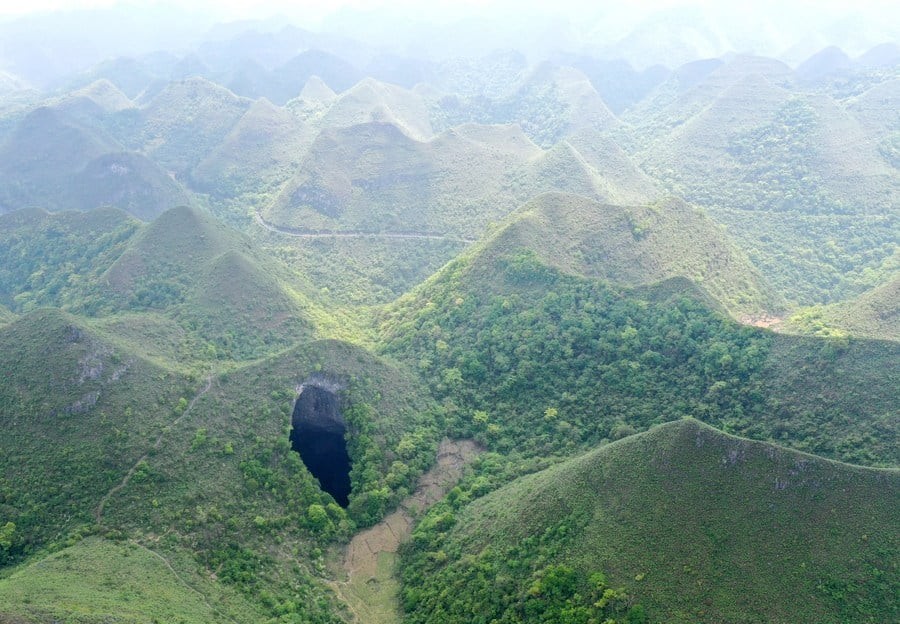
Impressive Scale of the Sinkhole
The research team measured the sinkhole to be approximately 100 meters wide, nearly 200 meters in length, and plunging down to 118 meters deep. These massive proportions place it among the largest documented sinkholes worldwide. Equally fascinating is how the collapse on the southeast side of the sinkhole has formed a labyrinth of subterranean chambers. What initially appeared as an open pit now reveals a complex geological maze, exposing the dynamic subterranean forces.
A remarkable feature is the subterranean river flowing within the cave system, which ultimately connects to the nearby Panyang River.
“These giant caves are natural caves, most of which are caused by collapses and are related to underground rivers,” he added.
An Evolution Over Millennia
Sinkholes such as Hong Kong·Haiting Hall form over extensive timescales rather than instantaneously. Zhang explains that the sinkhole’s origin likely stems from the gradual erosion of subterranean limestone by water, weakening the rock until a collapse occurred.
This karst topography is typical within limestone-rich regions and is responsible for some of Earth’s most breathtaking landscapes. Rather than a singular event, this formation represents a history spanning more than 2 million years of ongoing erosion and collapse processes.
“Three-dimensional scanning found that Hong Kong·Haiting Hall has retained a lot of evidence of the collapse of the crater evolution, especially the traces of rock mechanics produced after the collapse, which are clearly visible, demonstrating the evolutionary characteristics of this tiankeng.”
The formation shares similarities with renowned sinkholes like the Xiaozhai Tiankeng, the world’s largest sinkhole, which also formed above an underground river. The geological narrative of Hong Kong·Haiting Hall seems closely aligned with these monumental features.
- Categories:
- Science










0 comments
Sign in to Comment