

Physicists have long been intrigued by the universe’s accelerating growth, commonly attributed to an enigmatic force known as dark energy, which is believed to compose nearly 70% of all cosmic content. However, recent research published in the Journal of Cosmology and Astroparticle Physics from scientists at the Center of Applied Space Technology and Microgravity (ZARM) at the University of Bremen, alongside collaborators from the Transylvanian University of Brașov, proposes an alternative explanation. Their findings suggest that the acceleration may emerge intrinsically from an expanded framework of Einstein’s general relativity, offering a novel geometric interpretation of the universe.
Unraveling the Mystery Behind Cosmic Acceleration
Since the late 20th century, data from phenomena such as supernovae and the cosmic microwave background radiation have revealed that not only is the universe expanding, but this expansion is also accelerating. Traditional cosmological models require the introduction of dark energy into Einstein’s Friedmann equations to account for this observation. Yet, dark energy remains undetectable and serves more as a theoretical fix than a proven physical entity.
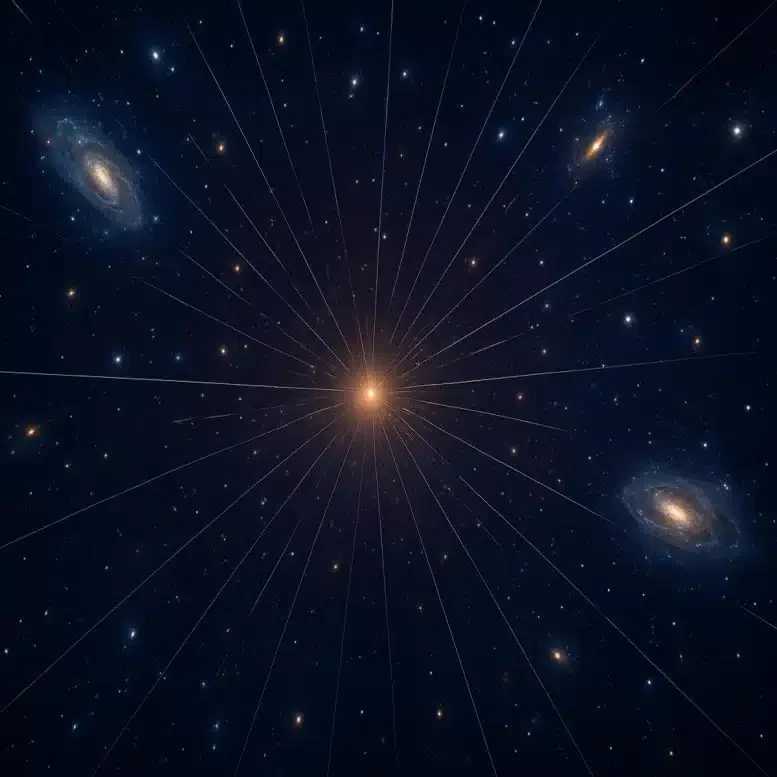
The ZARM team aimed to explore whether the acceleration could be a geometric phenomenon. Their focus was on Finsler gravity, an extension of general relativity that alters the standard conception of spacetime. This approach broadens how space and time can interact with matter and energy, potentially eliminating the need to postulate dark energy as a separate force.

Introducing Finsler Gravity into Cosmological Equations
The researchers reexamined cosmological models through a new lens. Whereas the conventional Einstein-Friedmann framework demands an extra component representing dark energy to model acceleration, their adaptation using Finsler gravity resulted in modified Finsler-Friedmann equations that naturally predict cosmic acceleration without any dark energy input.
“Our results present a compelling possibility that accelerated cosmic expansion can be explained fundamentally through a generalization of spacetime geometry, without relying entirely on dark energy,” notes Christian Pfeifer, a ZARM physicist involved in the study. “This geometric standpoint offers fresh avenues to deepen our grasp of universal physical laws.”
The findings, published in the Journal of Cosmology and Astroparticle Physics, provide a mathematically sound alternative that reconciles the accelerating universe with Einstein’s field equations under an expanded geometric principle. These results imply the effects attributed to dark energy could instead stem from the intrinsic nature of spacetime at vast cosmic scales.
Broader Consequences for Cosmological Theory
If corroborated, this paradigm would challenge the foundational ΛCDM model that dominates contemporary cosmology, possibly altering our understanding of cosmic history, the universe’s long-term trajectory, and gravity itself.
The research emphasizes that dark energy’s existence is not entirely ruled out but cautions it may no longer be considered the only explanation behind cosmic acceleration. Framing the phenomenon in terms of spacetime geometry suggests that acceleration arises as a fundamental characteristic of the universe’s fabric, rather than from some unknown energy field.
Ongoing and future precise measurements—such as those involving gravitational lensing, cosmic background radiation studies, and other precision cosmology techniques—will be critical to testing this geometric model’s validity. Confirmation could herald a major breakthrough in physics, potentially advancing efforts to integrate general relativity with quantum theory in a unified framework.
A Transformative Geometric Perspective on Space-Time
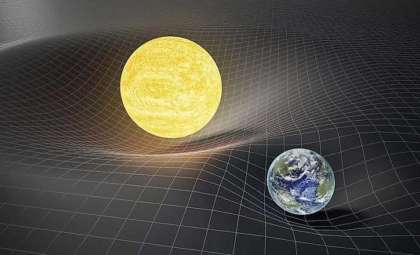
The innovative work by Pfeifer and colleagues marks a shift in conceptualizing the cosmos, treating geometry not as a static stage but as an active player influencing cosmic dynamics. This recalls Einstein’s vision of gravity as a product of spacetime curvature.
Extending this curvature using the flexible structure of Finsler geometry opens possibilities for interpreting universal acceleration as a natural property of spacetime itself, rather than the consequence of an invisible entity. This theoretical advance could deepen insights into the interplay between gravity, matter, and the universe’s underlying fabric.
- Categories:
- Physics




0 comments
Sign in to Comment