
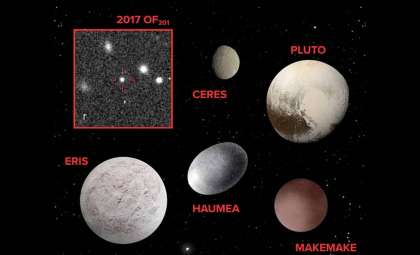
Researchers have made a remarkable find beyond Pluto by detecting a tiny celestial body that could transform our understanding of the Solar System's distant boundaries. Named 2023 KQ14, this object was uncovered through observations by the Subaru Telescope, part of the FOSSIL initiative (Formation of the Outer Solar System: An Icy Legacy).
An Unusual Visitor in the Outer Solar Domain
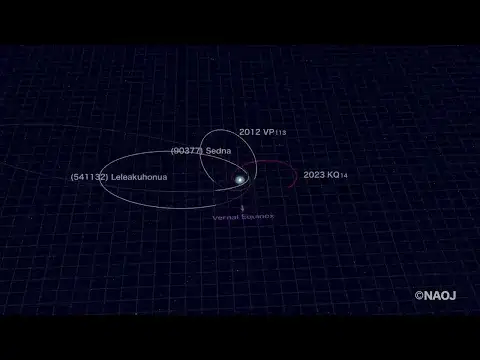
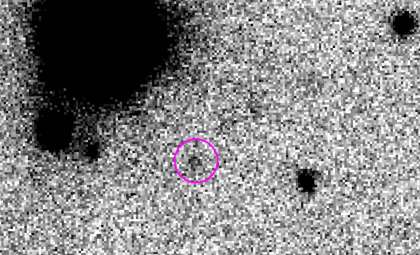
The object 2023 KQ14 came to light during observations from March to August 2023. Captured by the Subaru Telescope's expansive field of view, it has been classified as a sednoid due to its distinctive orbital characteristics. Sednoids represent a scarce group of objects with far-flung orbits around the Sun. As only the fourth sednoid discovered, 2023 KQ14 holds significant importance for astronomers examining the farthest regions of our cosmic environment.
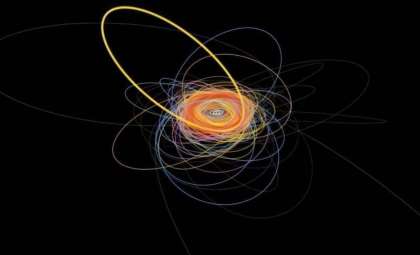
The FOSSIL research team applied computational models to analyze the object's orbital stability. Their findings suggest that 2023 KQ14 has preserved its consistent trajectory for an impressive span of approximately 4.5 billion years. This persistent orbit, combined with its unusual path, may reveal fresh perspectives on how the outer Solar System evolved during its earliest phases.

Challenging the Planet Nine Theory
This finding is particularly intriguing for its potential to question the prevailing Planet Nine hypothesis. For years, astronomers have proposed the existence of a ninth planet lurking far beyond Pluto to explain the strange orbits of certain distant objects through gravitational effects. Yet, the orbit of 2023 KQ14 does not coincide with those of other sednoids, hinting that the dynamics in this remote region are more intricate than earlier understood.
Dr. Yukun Huang from the National Astronomical Observatory of Japan remarked on the discovery's impact: “The fact that 2023 KQ14’s current orbit does not align with those of the other three sednoids lowers the likelihood of the Planet Nine hypothesis.” Huang also suggested that while such a planet might have existed, it could have been expelled from the Solar System over time.
A Finding That Could Transform Our Solar System’s Portrait
The remarkable orbit of 2023 KQ14 is more than an oddity; it points to a Solar System that is far more varied and dynamic than once believed.
Dr. Fumi Yoshida, a leading researcher on the FOSSIL team, highlighted the discovery's importance: “2023 KQ14 was detected in a zone where Neptune’s gravitational pull is minimal. The existence of objects with elongated orbits and large perihelion distances in this region indicates extraordinary events in the ancient past when 2023 KQ14 formed.”
Yoshida stressed that unraveling the orbital histories of such distant entities is key to reconstructing the Solar System’s early narrative.
- Categories:
- News




0 comments
Sign in to Comment