
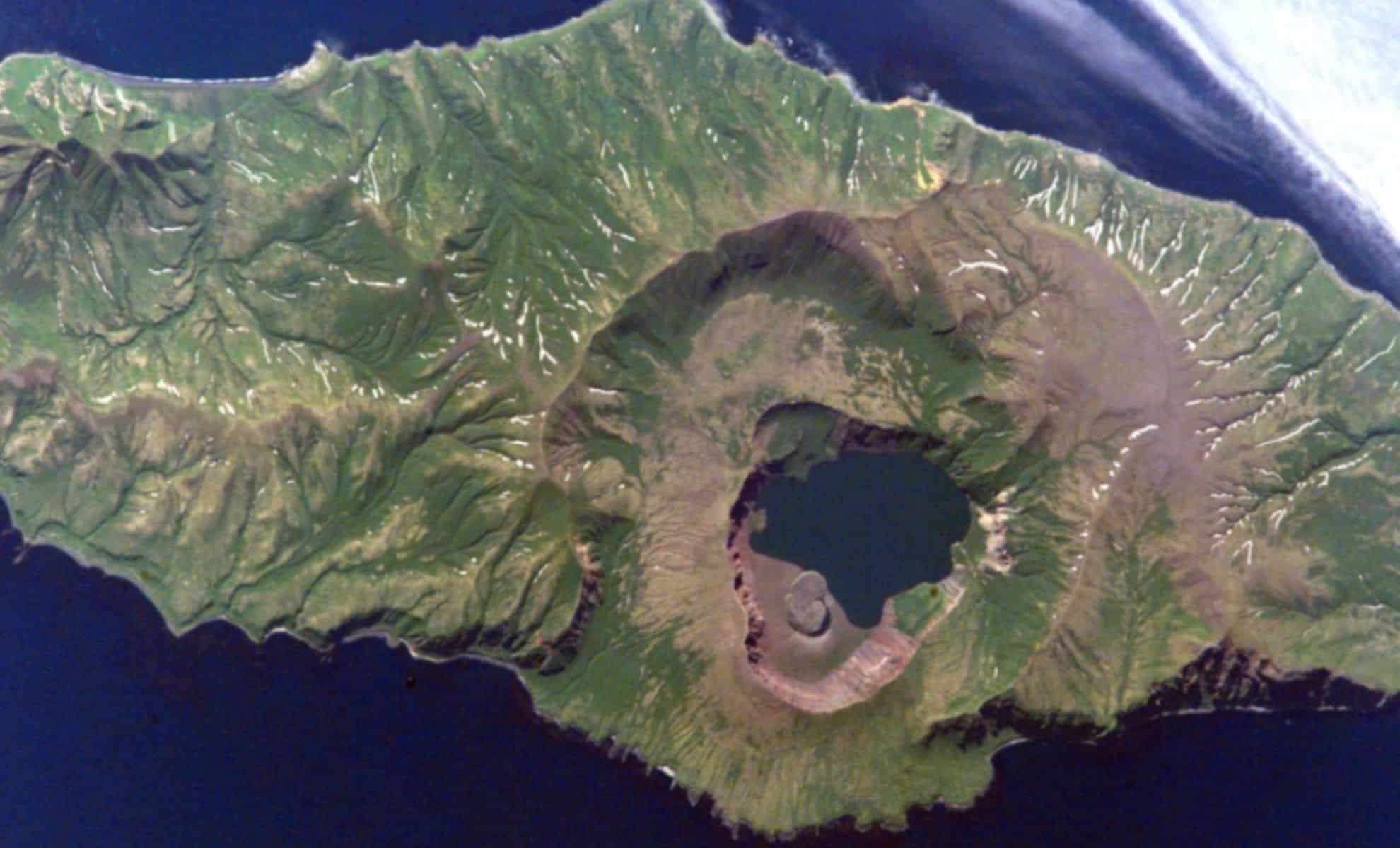
During the summer of 1831, strange atmospheric phenomena bewildered inhabitants of the Northern Hemisphere: the sun shimmered in shades of blue, purple, and green, while summer temperatures plunged unexpectedly. Eyewitnesses spoke of grim weather and prolonged cold spells that defied the usual warmth of the season, casting an eerie chill over many regions. For nearly 200 years, the source of this baffling event remained unknown until new research revealed a volcanic eruption on the remote Simushir Island within the Kuril archipelago as the culprit.
This breakthrough, detailed in the Proceedings of the National Academy of Sciences (PNAS), provides critical insights into a pivotal historical climate anomaly. The investigation underscores how volcanic eruptions—even those far from civilization—can profoundly affect global weather and climate dynamics.
Uncovering the 1831 Volcanic Explosion
The cataclysmic blast of 1831 unleashed enormous quantities of sulfur compounds into the atmosphere, cooling the Northern Hemisphere by roughly 1 degree Celsius (1.8 degrees Fahrenheit). This sudden temperature drop disrupted weather cycles and agriculture, contributing to widespread food shortages and social upheaval worldwide.

Eyewitness accounts from across Europe documented these effects. The composer Felix Mendelssohn described traveling through the Alps during a summer that felt “as cold as winter.” The eerie hues of the sun were caused by scattering effects from suspended volcanic particles, amplifying the unsettling atmosphere.
Despite clear evidence of a major eruption, its origin was unknown. “Although 1831 is relatively recent, we had no clue this particular volcano caused such a powerful eruption,” noted Dr. William Hutchison, volcanologist at the University of St Andrews. “It was completely invisible to the scientific community.”
Pinpointing the Source on Simushir Island
Scientists examined volcanic ash trapped in polar ice cores extracted from Greenland, which preserve a timeline of atmospheric events. The ash’s chemical fingerprint initially pointed to volcanoes near Japan, but this was dismissed due to Japan’s detailed volcanic records and dense population.
Attention then turned to the Kuril Islands, an isolated volcanic chain between Russia and Japan. Researchers identified the ash from ice cores matched deposits from the Zavaritskii volcano on Simushir Island.
“Finding this connection was like identifying fingerprints at a crime scene,” Hutchison said. “It was an exhilarating moment—one of my most memorable discoveries.”
The island’s seclusion helps explain why this massive eruption went unnoticed; the area is often cloaked in thick fog and inhabited by only a few people.
A Volcanic Event That Reshaped Climate
The Zavaritskii eruption was more than just a geological outbreak; it triggered a significant shift in global climate. The volcanic sulfur dioxide transformed into sulfate aerosols in the atmosphere, reflecting sunlight and causing widespread cooling.
“We know with large volcanic eruptions like this one that when you get cooling, you get changes to rainfall, you get changes to crop yield,” Hutchison explained. “And that has a knock-on effect that there’s simply not enough food for people to eat.”
This cooling was felt worldwide. Changes in the monsoon affected agriculture in India and Japan, leading to famine, while Europe endured crop failures and economic turmoil.
Implications for Volcano Monitoring
Discovering the Zavaritskii eruption emphasizes the difficulties in tracking volcanic activity in inaccessible regions. Even with modern advances, many volcanos remain unmonitored, making societies vulnerable to sudden eruptions with major climate impacts.
“If a similar eruption happened now, we might still be caught off guard,” admitted Hutchison. “It highlights how challenging it is to forecast when and where future global-impact events will arise.”
The lack of monitoring infrastructure in places like the Kuril Islands calls for heightened investment in volcano surveillance using satellites, real-time atmospheric data, and global cooperation to detect warning signs earlier.
Why This Finding Is Important
Attributing the 1831 eruption to the Zavaritskii volcano reinforces the profound influence natural forces wield over human history. By understanding past eruptions, scientists can better link volcanic activity to climate shifts and improve preparation against future crises.
Furthermore, this research exemplifies the value of integrating geology, atmospheric science, and historical evidence to unravel Earth’s complex systems. It serves as both a tribute to our planet’s volcanic power and a cautionary tale about the challenges that lie ahead.
- Categories:
- News











0 comments
Sign in to Comment