

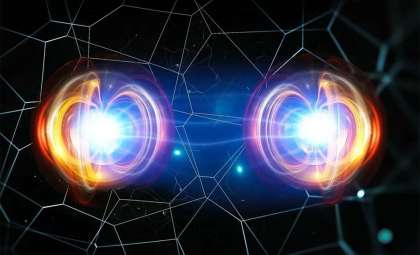
Light is famously the universe's fastest phenomenon, traditionally viewed as an immutable speed threshold. Yet, recent breakthroughs demonstrate that light can be dramatically slowed or even brought to a complete stop. This remarkable advancement leverages a rare quantum state: the Bose-Einstein condensate.
Venturing deep into the domain of quantum physics, researchers have found ways to trap and regulate light, paving the way for innovations in quantum computing, protected information transfer, and a fresh understanding of the fundamental nature of reality.
The Quantum Approach: Harnessing a Bose-Einstein Condensate to Trap Light
Consider a gas chilled to temperatures just a hair above absolute zero. Under such extreme cooling, atoms merge into a unified quantum entity known as a Bose-Einstein condensate (BEC). First proposed by Albert Einstein and Satyendra Nath Bose, this unique matter state was experimentally realized in the 1990s and has since become a vital platform for exploring quantum phenomena.

One distinctive characteristic of a BEC is its 'quantum fluid' nature, where atoms flow seamlessly and exhibit unusual optical behavior. Light traveling through this fluid interacts intricately with the atoms, resulting in an extraordinary deceleration—or even a complete halt—effectively turning photons into temporarily trapped quasiparticles, like light slowed by a “quantum syrup.”
Reducing Light Speed to Near Zero
Utilizing a cloud of ultracold sodium atoms, scientists have masterfully executed this extraordinary manipulation. Through carefully calibrated laser pulses directed into the condensate, they controlled light-matter interactions to decelerate light to a mere 17 meters per second, approximately 61 km/h—comparable to a quick human jog.
More impressively, they succeeded in briefly freezing the light entirely before releasing it to continue its journey. This milestone paves the way for transformative methods in data storage and processing.
What’s the Purpose of Halting Light? Unlocking Quantum Innovations
You might wonder why slowing or stopping light is so crucial. The implications of this capability extend far beyond curiosity:
- Quantum computing: Manipulating slow or stopped light could enable cutting-edge processors that exploit the mysteries of quantum physics for radically enhanced computation.
- Data storage with light: Using photons to hold information promises instantaneous access and the foundation for ultra-speedy communication systems.
- Quantum-secure communication: Controlling light on a quantum scale opens avenues for encryption methods impervious to hacking.
- Fundamental quantum studies: Trapping light in a BEC offers physicists a powerful tool to investigate the underlying fabric of spacetime and existence.
Implications for Our Understanding of Time and Space
Beyond technological advances, this research prompts profound scientific and philosophical reflection. Since light has long symbolized the ultimate cosmic speed limit, the ability to drastically control its velocity challenges established principles of relativity and quantum mechanics, potentially reshaping our conception of reality itself.
Could mastery over light speed someday translate to manipulating time, or even enable futuristic warp drive technologies? Such prospects remain speculative, but the feat of pausing light—once deemed impossible—shows that our grasp of physical laws continues to deepen in surprising ways.
Find the full study in Nature.
- Categories:
- Physics








0 comments
Sign in to Comment