
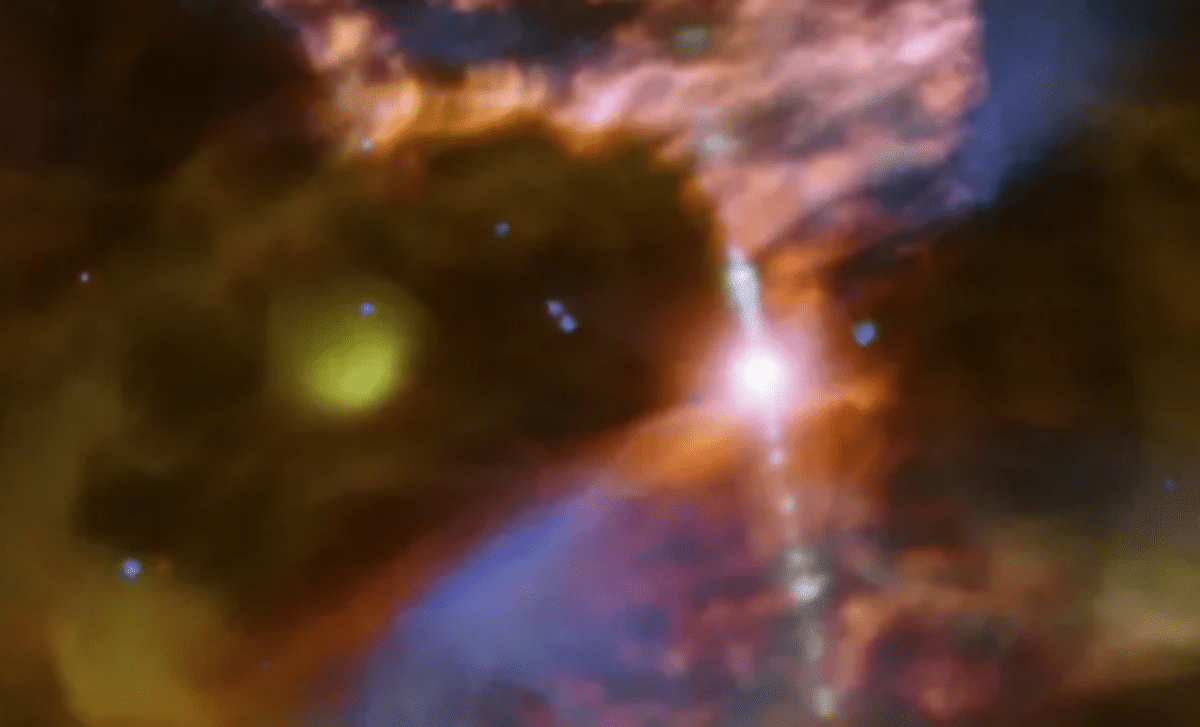
The European Southern Observatory’s Very Large Telescope (VLT) recently unveiled a remarkable image capturing the coexistence of a neutron star’s remnants and the inception of a youthful star. Released on February 3, 2026, this striking photograph showcases the intriguing object Ve 7-27, which was once assumed to be a star in decline but is now understood to be a star in its infancy, shedding new light on the continuous and dynamic life cycle within our universe.
An Astounding Capture: The Intersection of Stellar Death and Genesis
The VLT’s image of Ve 7-27 beautifully illustrates the stark contrasts that fill outer space. Initially identified as a planetary nebula, a dying star casting off its outer layers, the latest observations with the MUSE instrument reveal that Ve 7-27 is actually a star in the process of formation.
Ve 7-27 exhibits powerful jets emitting bright clumps of matter known as “bullets,” a hallmark behavior of young stars actively shaping their environment as they begin their stellar evolution.

“Instead of being the ‘last breath’ of a dying star, Ve 7-27 is a newborn one,” said Janette Suherli, a Ph.D. candidate at the University of Manitoba and the study’s lead author.
This groundbreaking finding enriches our comprehension of how stars take shape and highlights a pivotal cosmic discovery. The image presents a captivating juxtaposition of the echoes of ancient star explosions alongside the luminous emergence of a new star, emphasizing the cyclical nature of cosmic rebirth and demise.
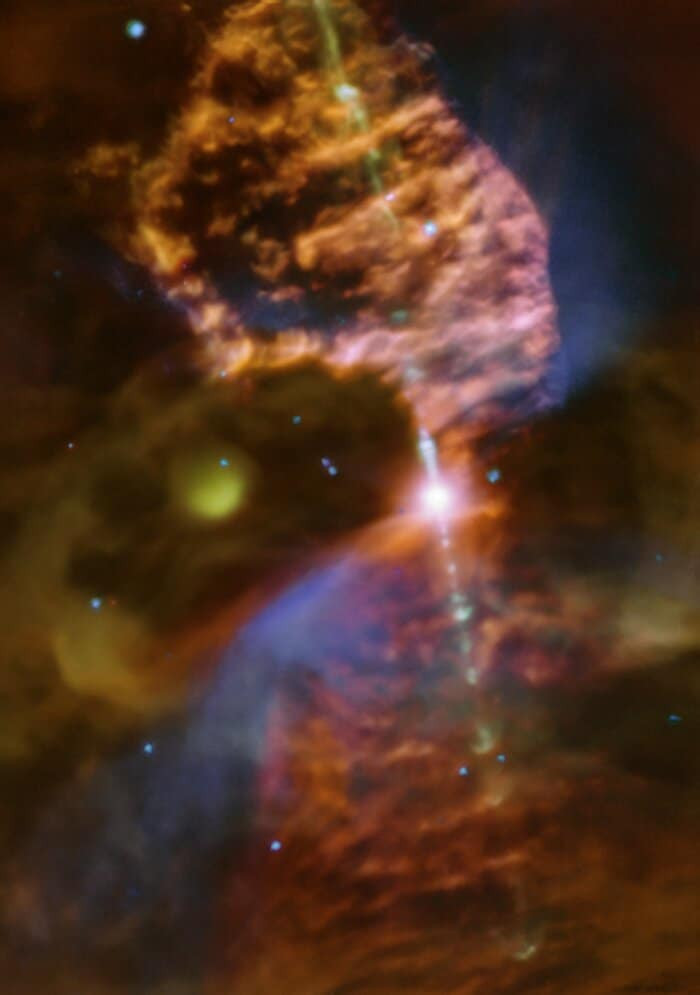
Ve 7-27 Within the Vela Junior Supernova Cloud
Ve 7-27 resides inside the Vela Junior supernova remnant—an expansive shell of debris left from a long-ago stellar explosion. This cloud envelops Ve 7-27 and weaves a striking cosmic connection between the death of one star and the birth of another. Situated roughly 4,500 light-years away, this region offers a deep look into historic and ongoing star-forming activity.
The Vela Junior remnant’s characteristics have been debated for years, but by associating it with Ve 7-27, researchers gained improved insight into its distance and dimensions. This link resolves previous uncertainties about the remnant’s growth rate, size, and age, allowing astronomers to map this celestial object with greater accuracy and detail.
How the VLT Advances Our Cosmic Knowledge
Operating from Chile, the Very Large Telescope stands as a premier tool for astronomical discovery. Composed of four collaborative telescopes, the VLT captures high-definition images of distant stars, nebulae, and galaxies. Its unparalleled resolution equips scientists with critical data about the physical and chemical properties of celestial bodies.
For the case of Ve 7-27, the VLT's MUSE instrument played a crucial role by gathering vital data that distinguished the object’s nature—clarifying that it is indeed a forming star rather than a dying one. This insight deepens our understanding of complex star-forming environments and supernova remnants.
The Eternal Cycle of Star Death and Birth
The universe is a theater of both creation and destruction, with new stars emerging amid the remnants of ancient ones. Ve 7-27 exemplifies this cosmic interplay, where nascent stars rise from energetic clouds of gas and dust, while neutron stars mark the dramatic endpoints of massive stellar lifespans.
This ongoing cycle drives the evolution of the cosmos: newborn stars shape their surroundings with energy and radiation, and when stars perish in supernova explosions, they distribute heavy elements essential for forming subsequent generations of stars, planets, and potentially life itself. Ve 7-27 acts as a vivid demonstration of these profound processes that sculpt our universe.
- Categories:
- Space


0 comments
Sign in to Comment