

Advanced solar spectroscopy has uncovered numerous absent wavelengths within the Sun’s light spectrum—distinct gaps that have eluded explanation despite centuries of scientific scrutiny. These enigmatic absorption features remain unexplained, with their elemental sources still unidentified.
Although many dark bands in the solar spectrum correspond to known elements such as hydrogen, helium, oxygen, and iron, a substantial portion resists association with any recognized chemical signatures. Discovered in data stretching back several decades, this enduring mystery challenges the completeness of current atomic and molecular spectral catalogs.
Sunlight’s Unsolved Clues in Spectral Lines
These dark notches, termed Fraunhofer lines, were initially identified in 1814 by German physicist Josef von Fraunhofer. They appear as minute interruptions in the spectrum when sunlight passes through a prism or is analyzed with a spectrograph. As highlighted by ScienceAlert, each line acts like a distinctive signature of atoms absorbing specific wavelengths within the Sun’s atmosphere. Over time, most of these spectral lines have been successfully matched to known elements, providing crucial insight into the Sun’s composition.

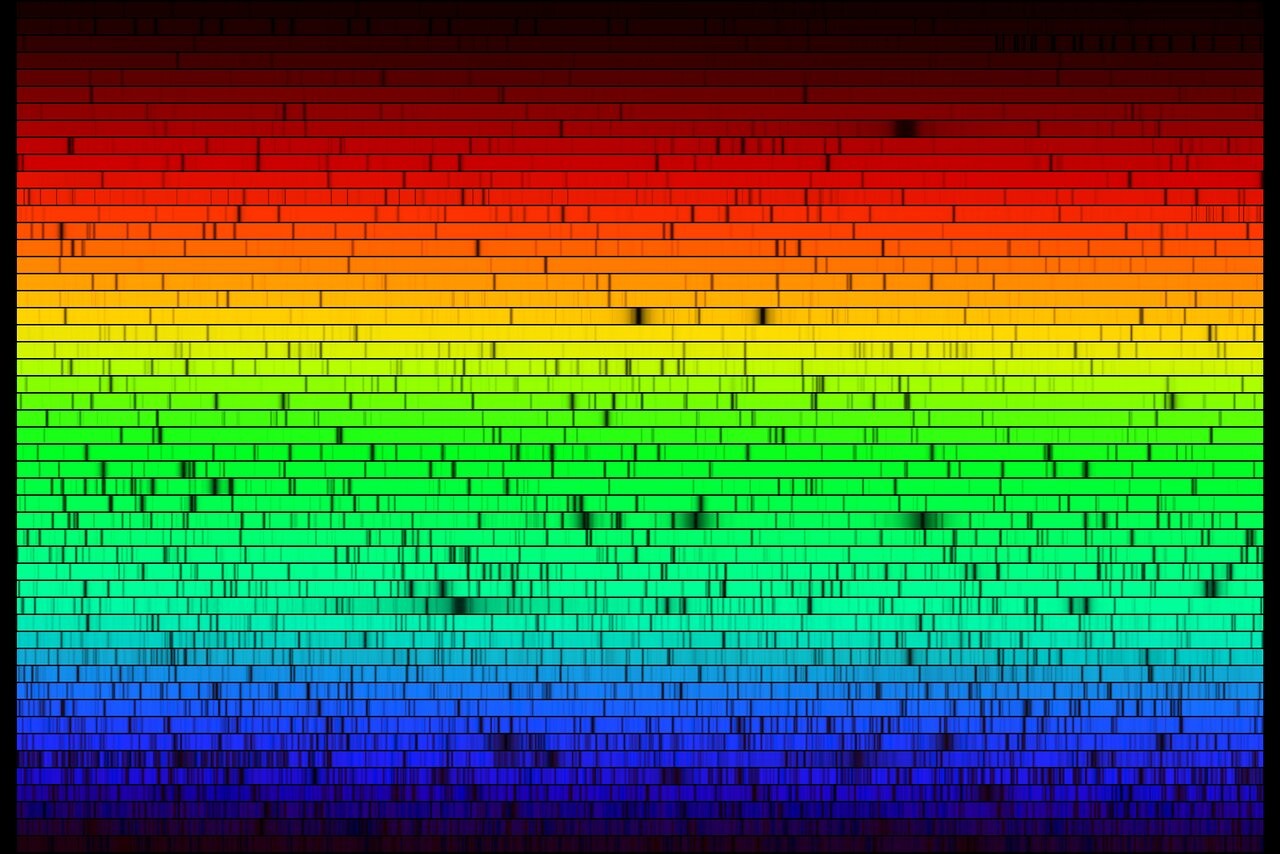
Yet, despite accessing highly detailed measurements, many lines defy correlation with existing atomic data. Their persistence points to missing information in our databases or insufficient understanding of atomic behavior under the Sun’s extreme conditions.
Unexplained Signatures Within the Solar Spectrum
Even the most sophisticated synthetic models simulating the solar atmosphere cannot replicate all the observed spectral lines. As noted above, these unidentified features do not align with known atomic or molecular transitions or with models that incorporate variables such as temperature, gravitational force, and stratified atmospheric layers.
A significant contributor to this issue is the incomplete nature of atomic and molecular databases. Elements in the iron group present especially challenging electron transitions to characterize, many of which remain undocumented, complicating definitive spectral line associations.

A 2017 analysis explored some of these enigmatic lines and concluded that even with advanced modeling, they fail to match recognized patterns. Minor variations in solar conditions can modify or mask these spectral features.
Dynamic Solar Activity Adds Complexity
The Sun is a highly dynamic body, with its outer layers continuously in flux due to vigorous convection currents and strong magnetic phenomena. These dynamic processes affect how absorption lines appear depending on the observational timing and technique.
Consequently, even premium data collections, such as those from Kitt Peak, prove challenging to interpret completely. Per ScienceAlert, some unmatched spectral lines might not be missing elements, but rather, they could be signatures altered by the solar environment itself.
The Sun’s ever-changing magnetic fields can influence atomic energy states within its atmosphere. This variability complicates efforts to pin down causes of overlapping or shifting absorption features.
Advancing Understanding, Yet Mysteries Remain
Ongoing efforts are progressively refining solar models and enhancing observational precision. With more sensitive instruments and expanding spectral line databases, discrepancies between observed and simulated spectra yield valuable insights, helping scientists better replicate solar conditions.
Nonetheless, a comprehensive understanding remains elusive. As reported by ScienceAlert, hundreds of unidentified spectral lines continue to challenge astronomers, underscoring that the Sun, our nearest star, still harbors secrets concealed within the very light it emits daily.
- Categories:
- Physics











0 comments
Sign in to Comment