
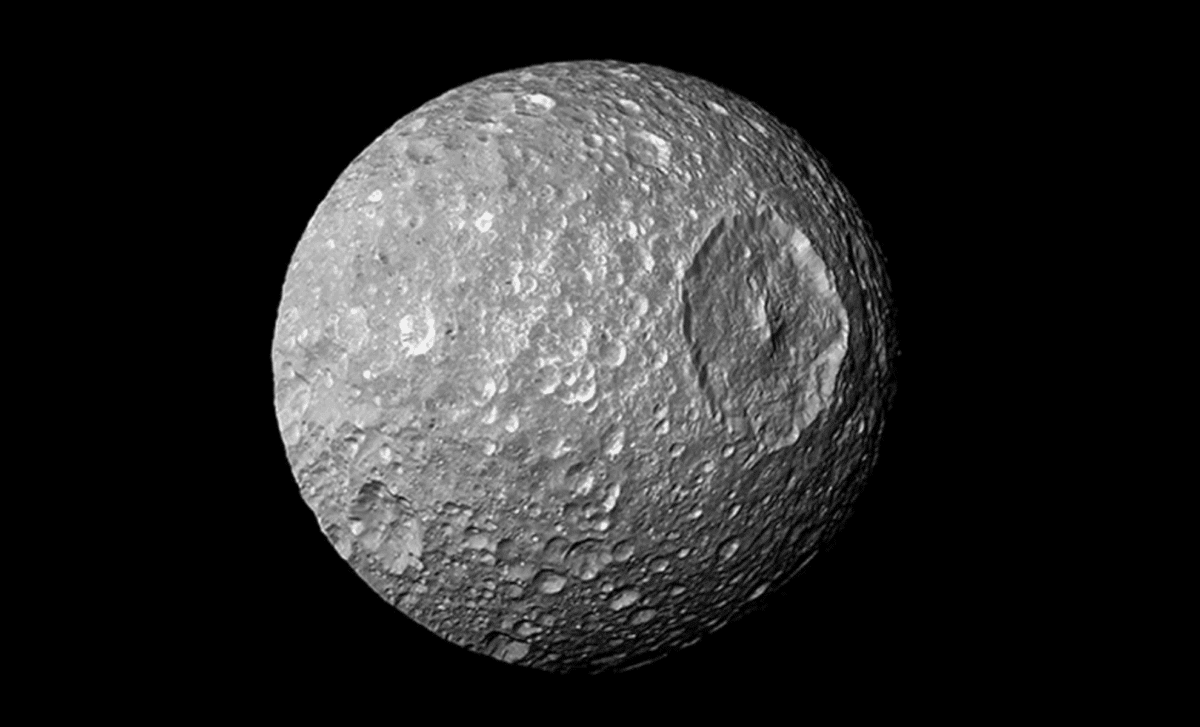
New research, including findings published on ScienceDirect, indicates that Saturn’s moon Mimas—famous for its resemblance to the "Death Star"—might conceal an underground ocean beneath its icy exterior. Despite Mimas’ seemingly plain surface, fresh insights gained from NASA’s Cassini data combined with sophisticated modeling propose the presence of a relatively young liquid water layer, revealing the moon in a new and fascinating light.
Mimas: More Than Just a Galactic Lookalike
Mimas initially presents itself as a straightforward, ice-covered satellite, highlighted by its massive Herschel crater whose size makes it unmistakably resemble the iconic Death Star from Star Wars. This impact feature spans over one-third of the moon’s diameter and has long captivated planetary researchers. Intriguingly, unlike well-studied icy moons such as Europa and Enceladus, Mimas does not showcase the typical surface fractures or deformations usually linked with subsurface oceans.
“When we look at Mimas, we don’t see any of the things that we’re accustomed to seeing in an ocean world,” said Alyssa Rhoden, a planetary scientist at the Southwest Research Institute (SwRI), during a recent meeting at the Europlanet Science Congress.
Add Cosmo Herald as a Preferred Source

This absence of visible tectonic features initially cast doubt on the idea of a subsurface ocean. However, new findings suggest these traditional signs might be concealed beneath a thick shell of ice, keeping the ocean’s existence under wraps for now.
Evidence Supporting a Recent Ocean Formation
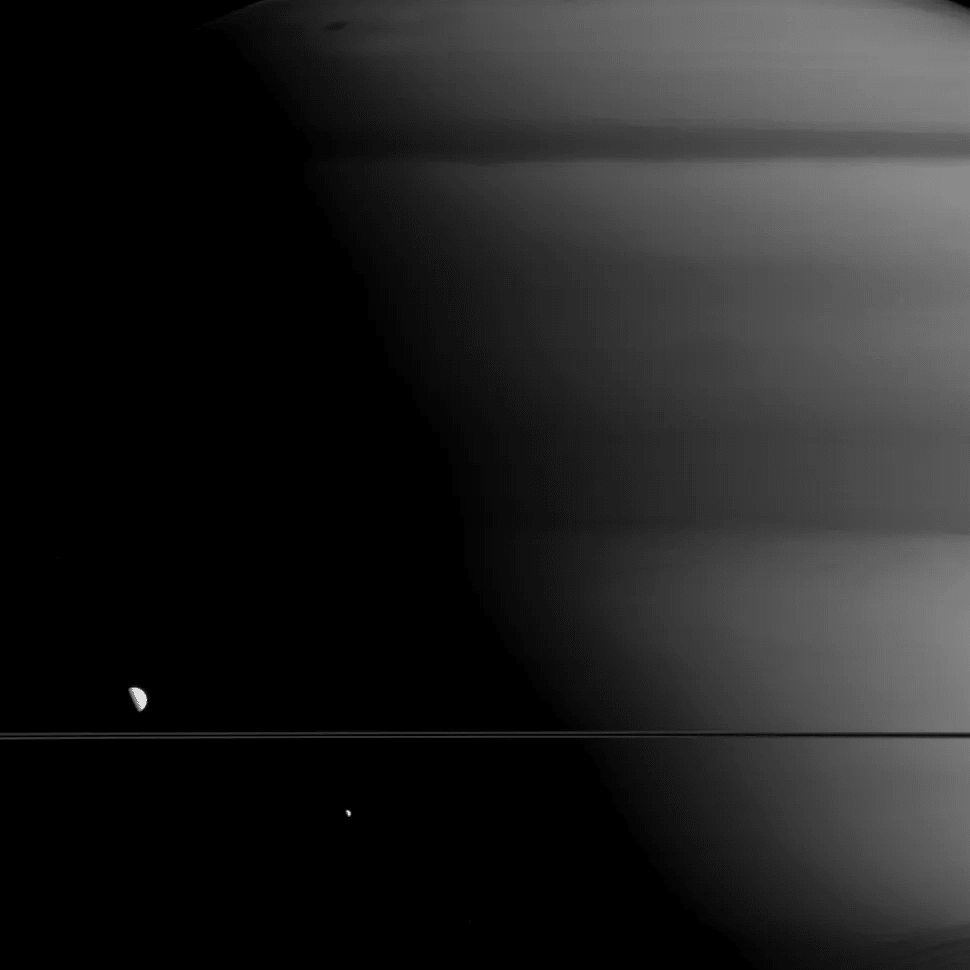
Studies suggest Mimas could contain a relatively young ocean formed within the last 10 to 15 million years. Scientists hypothesize that Mimas’ earlier, more elongated orbit generated stronger tidal forces from Saturn, producing enough internal friction to melt ice and create liquid water beneath the surface. This heating mechanism, called tidal heating, arises from gravitational interactions between the moon and its host planet.
Though the moon’s orbit has since circularized, the earlier tidal heating phase may have generated sufficient warmth to sustain a hidden ocean for millions of years.
Simulations probing Mimas’ thermal structure back this hypothesis. Alyssa Rhoden and her team found thermal models that suggest once melting begins within the icy crust, it accelerates quickly— a pattern seen on other watery moons such as Europa.
“Mimas needs to be right on the tipping point,” planetary scientist Adeene Denton, also at SwRI, explained. “It can stay on that tipping point for millions of years, but it needs to be close.”
This "tipping point" likely refers to the orbital shifts responsible for igniting tidal heating intense enough to spawn a subsurface ocean.
The Herschel Crater’s Clues to Mimas’ Past
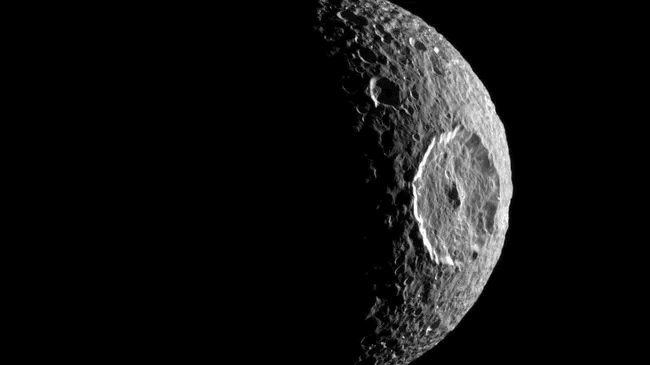
The Herschel crater offers crucial insights into the moon’s internal composition and history. When icy moons experience impacts, the crater formation usually reveals characteristics of the surface state at the time. On Mimas, the presence of a central peak within Herschel suggests the ice was not completely rigid during the impact, indicating partial melting likely occurred.
Model simulations propose that if Mimas’ crust had been underlain by liquid water, the impact would soften the ice, preventing the central peak from forming—a key structural feature. Adeene Denton noted that "water can’t make a structure like that," implying the ice must have retained enough strength during formation. This supports the idea that Herschel formed as Mimas’ icy shell was beginning to thaw, bolstering the argument for a relatively recent subsurface ocean.
Prospects for Confirming Mimas’ Ocean
Although evidence remains circumstantial, the prospect of an ocean beneath Mimas opens intriguing avenues for future research. Detecting such an ocean beneath its thick ice shell would be challenging but potentially achievable with upcoming space exploration technologies. Methods under consideration include measuring thermal emissions through the ice, which could indicate liquid water below.
Rhoden and her colleagues emphasize that these discoveries collectively present Mimas as a surprisingly dynamic body, possibly more habitable than once believed. A dedicated spacecraft mission in the future could offer definitive proof of the ocean’s existence, turning Mimas into a key target in the search for extraterrestrial life.
- Categories:
- News





0 comments
Sign in to Comment