

Scientists are closing in on identifying the first volcanic moon orbiting a distant planet beyond our solar system, reveals recent research from NASA’s Jet Propulsion Laboratory (JPL).
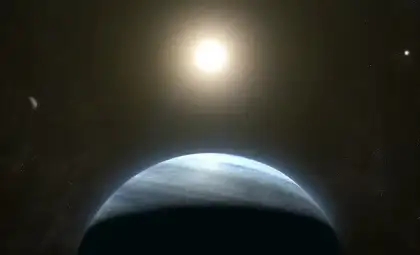
The investigation centers on WASP-49 b, a gas giant comparable in size to Saturn and situated approximately 635 light-years from Earth. The team reports spotting an enormous sodium gas cloud that might originate from an undiscovered moon. This finding is a critical advance in the quest to spot exomoons and offers exciting new prospects for detecting volcanic activity elsewhere in the galaxy.
Unraveling the Mystery of a Massive Sodium Cloud Around WASP-49 b
A pivotal outcome of this study is the identification of a sizeable sodium gas cloud near the exoplanet WASP-49 b, first observed in 2017. While sodium clouds have been seen in other solar systems, this one defies explanation since neither the planet nor its star appears to have sufficient sodium to produce it. The research team proposes that this enormous cloud, releasing up to 100,000 kilograms of sodium every second, may be fed by volcanic emissions from a hidden moon orbiting the planet.

Apurva Oza, from Caltech, has devoted years to studying the signature of volcanic exomoons through gas emissions detected from afar. Oza pointed out that the sodium cloud’s movement runs counter to what would be expected if it were part of the planet’s atmosphere, strongly hinting at an external source. “This is a crucial clue,” Oza stated. “The cloud flows in the opposite direction than physics predicts if it belonged to the exoplanet’s atmosphere.”
Volcanic Moons Like Io Guide This Investigation
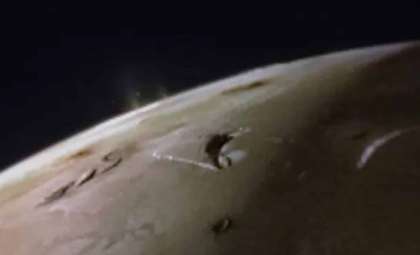
The research draws parallels with Jupiter’s moon Io, the most volcanically intense celestial body in our solar neighborhood. Io spews gases such as sulfur dioxide and sodium, creating expansive clouds surrounding Jupiter that extend up to 1,000 times the planet’s radius. This vigorous volcanic activity results from intense tidal forces caused by Jupiter’s gravitational pull, which bends and flexes Io’s interior, generating heat that powers its volcanoes.
For WASP-49 b, scientists theorize a similar process might be occurring. If a moon exists with volcanic activity akin to Io’s, the gravitational forces from WASP-49 b could incite eruptions that emit significant amounts of sodium and other gases. Observations showing that the sodium cloud intermittently replenishes when distant from the planet bolster the hypothesis that a volcanic satellite is triggering the emissions.
Overcoming Obstacles to Detecting Exomoons
Detecting exomoons is notoriously difficult due to their small size and faint light signatures, posing a major challenge for current instruments. To circumvent this, researchers analyzed the sodium cloud’s motion over time and compared it to models predicting volcanic exomoon activity. Their findings suggest a moon orbiting every about eight hours could create the irregular sodium cloud behavior observed.
Rosaly Lopes, a planetary geologist at NASA’s Jet Propulsion Laboratory and co-author of the study, highlighted the importance of the discovery. “The data strongly suggest that something other than the exoplanet and its star is responsible for producing this cloud,” Lopes noted. “Identifying an exomoon would be groundbreaking, and thanks to Io, we know a volcanic exomoon is within the realm of possibility.” Confirming this would represent a historic breakthrough in exoplanet research, as no exomoon has been conclusively observed so far.
The Potential Fate of This Volcanic Exomoon
The research also examines what lies ahead for this possible volcanic moon, with prospects appearing bleak. Intense tidal forces combined with rapid material loss could eventually lead to the satellite’s demise. Oza and collaborators suggest that if the volcanic activity matches Io’s, the moon may be torn apart over time by WASP-49 b’s strong gravitational effects. “If this moon exists, it faces a catastrophic future,” explained Oza.
This scenario resembles that of Io, which is gradually shedding material under Jupiter’s gravitational influence, though on a much slower scale. The findings offer insight into the turbulent and dynamic interactions shaping planetary systems beyond our own, where moons and planets can be heavily deformed or destroyed by their gravitational environments.
Continuing the Search for Exomoons
Although confirmation of this volcanic exomoon remains pending, this work sets a foundation for future efforts to uncover moons orbiting planets outside our solar system. Scientists believe a multitude of exomoons exist, but due to their diminutive size and faintness, they remain elusive. By analyzing atmospheric signatures such as gas clouds and atypical emissions, astronomers can gather indirect clues pointing to their presence, as showcased in this study.
With advancements in telescope technology and observational methods, researchers anticipate being able to capture direct images of exomoons and examine their geological characteristics in greater detail. This study offers an encouraging framework for identifying these shadowy worlds ahead, marking an important milestone in our understanding of the complex architectures of distant planetary systems.
- Categories:
- Astronomy ,
- News ,
- Science ,
- Nasa



0 comments
Sign in to Comment