
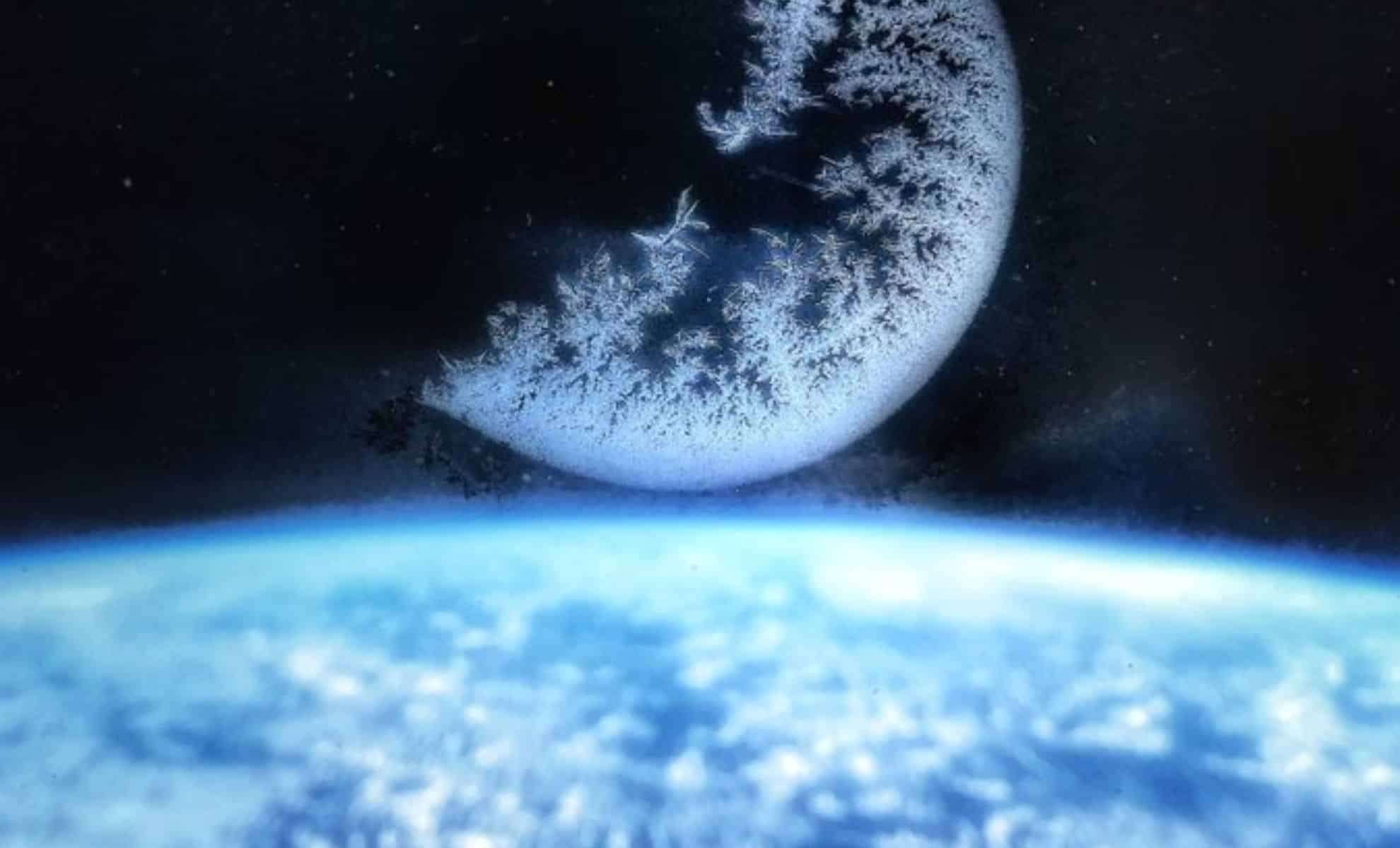
A recent investigation has revealed surprising insights into the properties of interstellar ice, overturning established beliefs regarding water's behavior in space's extreme cold. By integrating computational modeling with laboratory tests, scientists determined that ice previously thought to be wholly amorphous in space actually contains minute crystalline arrangements.
Rethinking Ice in the Cosmos
On Earth, crystalline ice with its orderly molecular structure is well understood, but it has been widely accepted that ice in the vacuum of space forms as an amorphous solid. This is because water vapor freezes directly onto surfaces without becoming liquid, producing a chaotic, disorganized form. However, new findings challenge this notion.
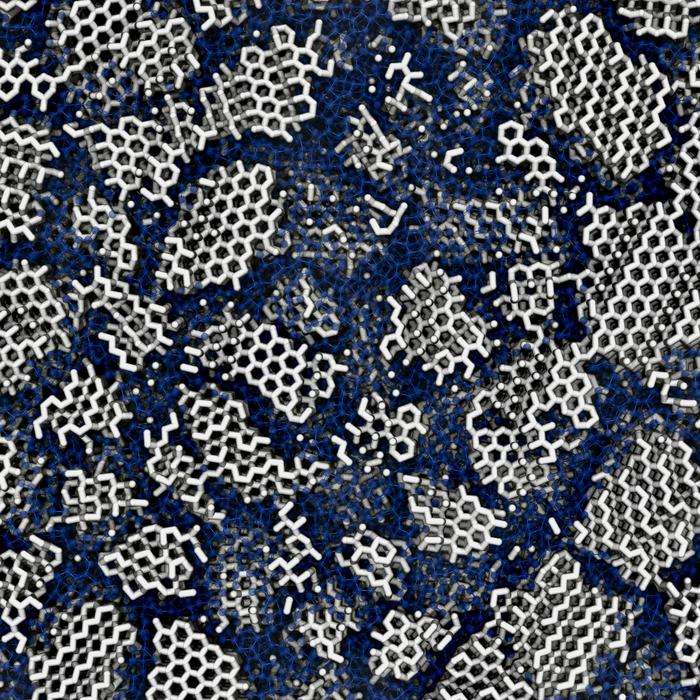
Under the leadership of physicist Michael Benedict Davies from University College London and the University of Cambridge, the team used sophisticated simulations paired with experimental evidence to recreate space-like ice formation. Their results showed that under certain freezing conditions—particularly near -120 °C (-184 °F)—space ice emerges as a hybrid of crystalline and amorphous types. Their calculations suggest the ice comprises roughly 20% crystalline and 80% amorphous structures, a significant change from the previously held belief of entirely disordered ice.

Laboratory Experiments Expose Unexpected Structure
To validate their hypotheses, researchers simulated cosmic ice by depositing water vapor onto ultra-cold surfaces, mimicking the direct freezing seen on planets and asteroids. Additionally, they compressed crystalline ice under freezing conditions to generate denser amorphous forms, representing the various states water may adopt off-Earth.
When samples were gently warmed, variations in the amorphous ice's structure emerged. These changes strongly indicate that seemingly disordered ice preserves ‘‘memories’’ of earlier crystalline configurations, especially in how hydrogen atoms are arranged.
"We now understand the atomic structure of what is likely the most prevalent form of ice in the cosmos," explained Davies. "This knowledge is vital because ice plays key roles in cosmic events such as planet formation, galaxy evolution, and the movement of matter throughout space."
Implications Beyond Astronomy
The discovery that amorphous ice contains crystalline inclusions extends beyond astrophysics. Christoph Salzmann, a physical chemist at University College London, emphasized the potential significance for cutting-edge materials science.
"These results provoke fresh considerations about the nature of amorphous materials," Salzmann stated. "Such materials are critical in tech fields, like glass fibers that enable high-speed data transmission, which rely on being disordered. Detecting and possibly eliminating microscopic crystals could enhance their efficiency."
This research suggests that substances traditionally viewed as completely amorphous might hold microscopic ordered regions that subtly impact their functionality. In space, this influences our understanding of the thermal and optical behavior of ice on comets, moons, and cosmic dust. On Earth, it opens doors to advancements in communications technology and data handling.
Revealing Ice's Hidden Depths
Water's behavior under freezing conditions is famously complex, with over 20 discovered phases. This study adds nuance by indicating the boundary between crystalline and amorphous ice is more blurred than believed.
"Earth’s ice is unique due to our warm climate, evident in the symmetrical designs of snowflakes," Salzmann pointed out. "Elsewhere in the universe, ice was assumed to be simply a frozen representation of liquid water — a random mesh frozen in place. Our research demonstrates that is not entirely accurate."
- Categories:
- News







0 comments
Sign in to Comment