
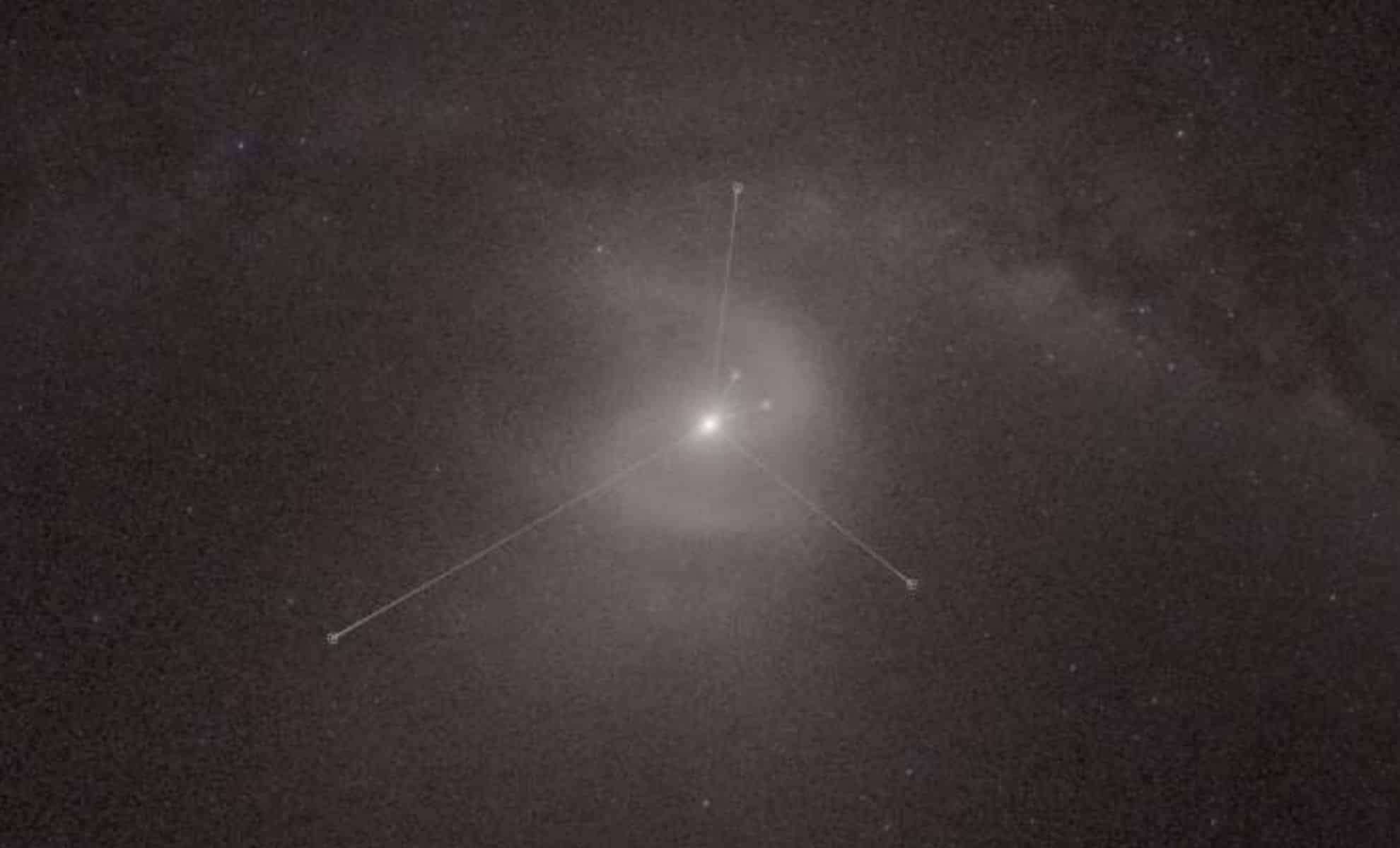
A swirling formation within the Oort Cloud, once believed to be a smooth shell of icy remnants, has been unexpectedly uncovered—thanks to a planetarium presentation. This surprising discovery arose while astronomers were refining the visuals for Encounters in the Milky Way, a digital exhibit hosted at the American Museum of Natural History. Originally intended to engage the public, these visuals sparked a reexamination of the outermost edges of our solar system. The results have now been peer-reviewed and The Astrophysical Journal has published the study.
A Serendipitous Find Beneath the Planetarium Dome
While preparing the immersive show, museum researchers spotted an unusual visual signature. The projection inside the dome revealed a distinct spiral shape within the Oort Cloud, a distant zone located billions of miles beyond Pluto's orbit. Contrary to the traditionally assumed smooth spherical shell, the inner region displayed a spiral pattern resembling a backwards S. This feature was not artistically added but emerged directly from astrophysical simulation data. “What could explain the spiral?” asked Jackie Faherty, an astrophysicist at the museum. This simple question prompted closer scientific scrutiny that led to a groundbreaking understanding of this remote part of the solar system. Instead of a simple, symmetrical layer, the Oort Cloud exhibits a complex, dynamic morphology.
From Simulation Curiosity to a Paradigm Shift
Initially, the visualization was not intended to reveal anything new. The data originated from simulations conducted by David Nesvorny of the Southwest Research Institute, an expert in planetary system dynamics. Even Nesvorny was surprised by the spiral evident in his models. “It’s a fortunate accident that this came to light,” he remarked. Although the spiral had never been explicitly depicted before, it is grounded in genuine orbital simulations of cometary objects influenced by gravitational forces exerted by the Sun, the gas giant planets, and the Milky Way galaxy. These forces have combined to sculpt the inner Oort Cloud into a barred spiral—a structure intriguingly analogous to that of our home galaxy.

Significance of the Spiral Formation in the Oort Cloud
The Oort Cloud is not merely a frozen collection of debris; it serves as the origin for long-period comets that sporadically enter the inner solar system. The presence of a spiral suggests a more complicated dynamical environment than once thought. Should this spiral arrangement prove to be a genuine characteristic and not an artifact of simulation, it could fundamentally alter how scientists model comet paths, evaluate collision hazards, and interpret the solar system’s formative era. Andre Izidoro, a planetary expert at Rice University uninvolved in the research, described it as “a profound transformation in our perception of the distant solar system.” This discovery highlights how even the most remote and slow-evolving regions of space are sculpted by the interplay of galactic and solar forces in ways just beginning to be understood.
How Science and Visualization Merged to Reveal a Hidden Truth
What distinguishes this discovery is how it originated. It did not come from direct astronomical measurement or space missions but emerged from a planetarium visualization originally created for education and engagement. The museum’s dedication to scientific fidelity in these presentations was crucial. Carter Emmart, the institution’s astrovisualization director, emphasized that the project involved more than crafting attractive images; it aimed to accurately interpret astrophysical data into immersive visual experiences. This rare blend of public outreach, art, and research helped uncover a pattern previously unnoticed. As Emmart eloquently stated, “You never quite know what discoveries await.”
- Categories:
- News











0 comments
Sign in to Comment