
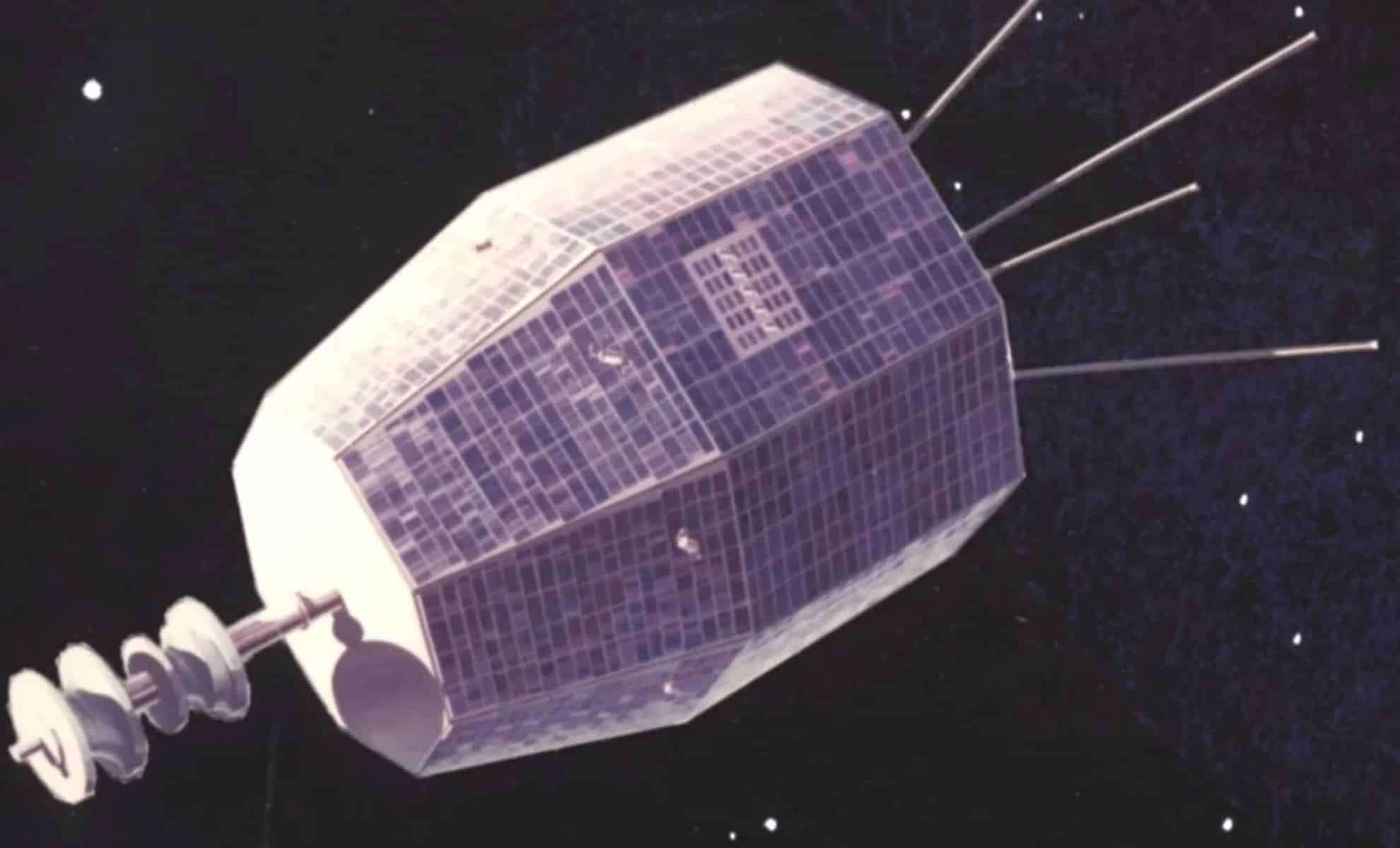
A brief yet intense radio emission has caught the attention of astronomers—not because of its intensity, but due to its unusual origin. In June 2024, the team behind the Australian Square Kilometre Array Pathfinder (ASKAP) observed a burst of radio waves lasting just 30 nanoseconds. Contrary to expectations, this signal did not come from distant cosmic sources like a Fast Radio Burst (FRB). Instead, its source was traced back to Earth’s orbit, linked to an old piece of NASA equipment launched during the Cold War era.
The origin was identified as Relay 2, a NASA experimental communications satellite that launched in 1964 and was thought to have ceased operations by 1967. Once instrumental in pioneering the global broadcasting of television signals, this satellite had remained silent for nearly 60 years. Now, it appears to have emitted a final sudden burst of radio energy, challenging current understanding of the behavior of inactive satellites. This remarkable occurrence is documented in a scholarly article published on arXiv, sparking lively debate among astronomers and aerospace experts.
Radio Burst Lasting 30 Nanoseconds Originating from Orbit, Not Deep Space
On June 13, 2024, astronomers using the Australian Square Kilometre Array Pathfinder (ASKAP) detected a sharp radio pulse initially resembling a Fast Radio Burst (FRB), which typically emanate from galaxies billions of light-years away. However, the signal’s features and trajectory indicated a source not in deep space but within low Earth orbit.

Measured to last less than 30 nanoseconds, this emission was significantly shorter than most known natural or human-made radio signals. Triangulation results pointed toward the orbital path of NASA’s Relay 2 satellite, launched in 1964 and officially deactivated in 1967. Designed as an early testbed for communications technology, Relay 2 transmitted television signals across continents. Despite being dormant for decades, this recent detection marks its first recorded transmission in more than 50 years.
Relay 2: Reactivation or Space Environment Phenomenon?
The sudden burst has prompted questions: did Relay 2 unexpectedly power up, or did environmental factors cause this signal? Lead researcher Clancy James from Curtin University suggests the emission might be accidental. One possibility is electrostatic discharge (ESD), where static electricity accumulation on the satellite’s surface abruptly dissipates. Although ESD has been observed on other spacecraft and at facilities like Arecibo Observatory, its occurrence on such a brief timescale is unprecedented.
Another potential explanation involves impacts from micrometeoroids. When tiny, fast-moving space particles collide with the satellite, they can generate a plasma cloud that produces a fleeting electromagnetic pulse. These events are invisible to the eye but might contribute to radio frequency interference and provide insights into satellite health.
When Spacecraft Seem to Come Back to Life: Understanding Zombie Satellites
While this episode may not indicate a true reactivation of Relay 2, it recalls instances of so-called zombie satellites—spacecraft once declared inoperative that later start transmitting again. A notable example is Galaxy 15, which lost communication in 2010 but surprisingly rebooted months afterward. Similarly, AMSAT-OSCAR 7, launched in 1974 and presumed inoperative after a 1981 battery failure, resumed transmissions in 2002—two decades later.
These cases challenge established ideas about spacecraft dormancy. Even decommissioned satellites endure conditions like thermal stress, radiation exposure, and collisions, making them potential contributors to radio noise, which can interfere with radio astronomy and communication networks.
- Categories:
- News









0 comments
Sign in to Comment