
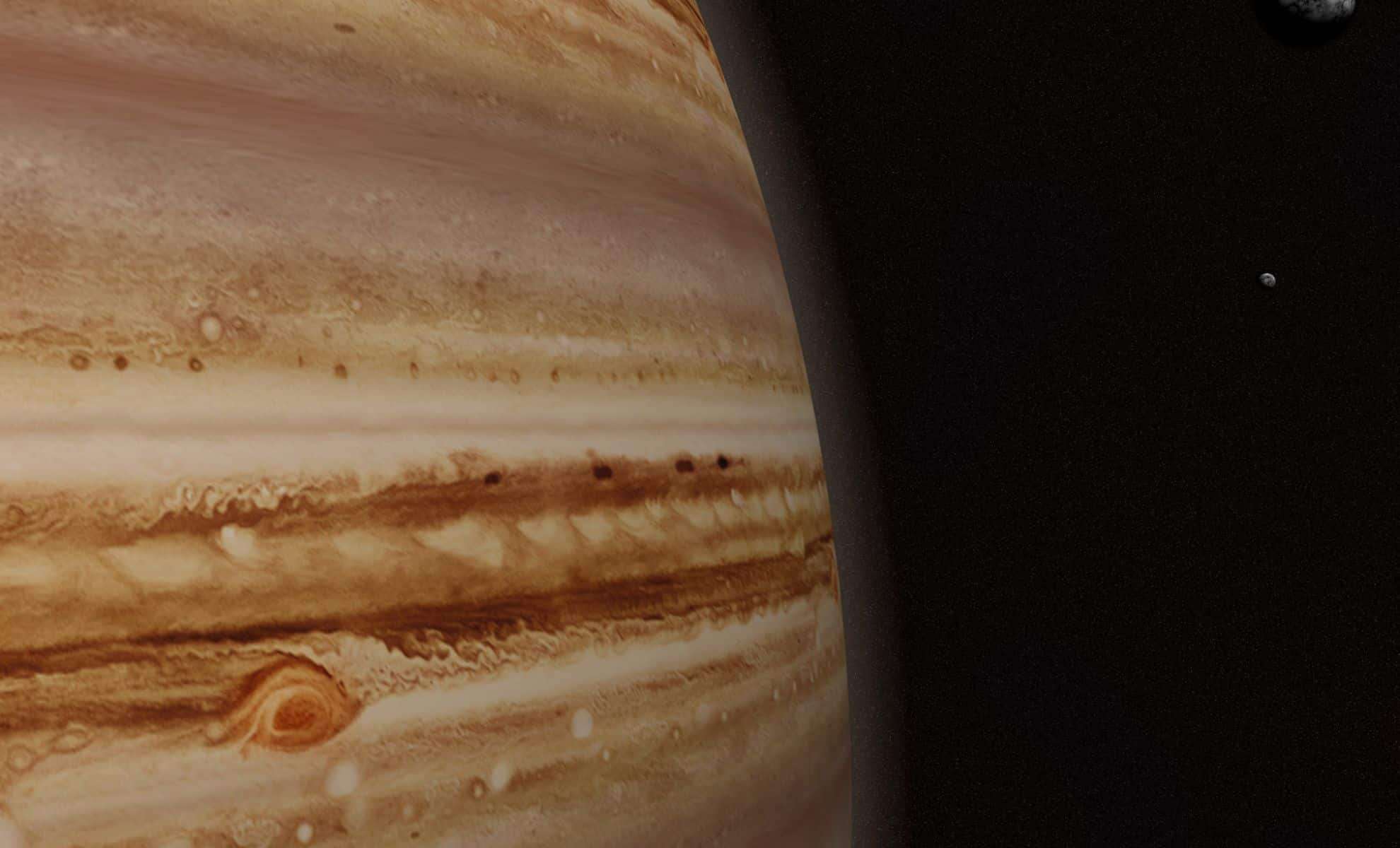
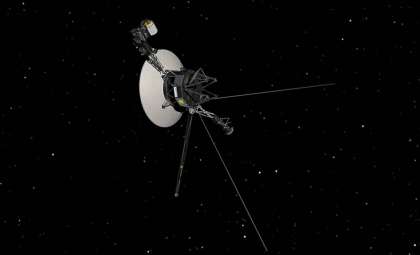
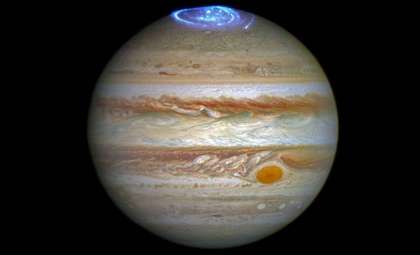
A breakthrough study published in Physical Review Letters has revealed an unprecedented type of plasma wave within the glowing auroras near Jupiter’s poles. Researchers at the University of Minnesota Twin Cities utilized measurements taken by NASA’s Juno spacecraft to uncover plasma activity unlike anything documented before in the solar system.
A Unique Phenomenon at Jupiter’s Poles
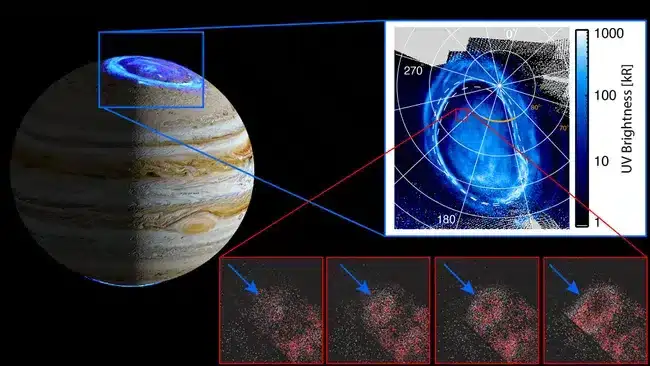
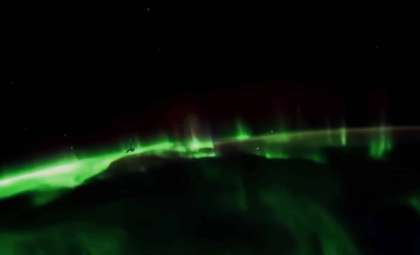
Unlike Earth’s visible auroras, characterized by green and blue hues dancing in northern skies, Jupiter’s auroras remain invisible to the human eye, emitting only in ultraviolet and infrared light. These energetic displays occur in areas where Earth’s polar skies are typically dark.
By orbiting Jupiter’s poles, the Juno mission provided an exclusive vantage point, capturing detailed data on how charged particles interact with Jupiter’s intense magnetic environment. During a low-altitude encounter, Juno recorded plasma waves at exceptionally low frequencies, marking a phenomenon never before detected around Earth.

Dr. Ali Sulaiman from the University of Minnesota explained that this innovative polar observation enabled scientists to deploy advanced analysis methods in one of the solar system’s most extreme settings. This fresh perspective unveiled a remarkable plasma behavior that had gone unnoticed until now.
As they pass through its magnetic field, Jupiter's largest moons make "footprints" in the planet's spectacular auroras. Footprints from three of the moons had been observed (left) but Callisto's remained elusive — until the #JunoMission found it: https://t.co/xEPV8QndD1 pic.twitter.com/kUyCwR8d6c
— NASA Solar System (@NASASolarSystem) September 4, 2025
Jupiter’s Magnetic Field Sets New Plasma Dynamics
Plasma, often deemed the fourth state of matter, consists of highly energized gas where electrons detach from atoms, forming a mix of ions capable of interacting with magnetic fields. While plasma is widespread in the universe—from stars to solar winds—the conditions around Jupiter present a distinct scenario.
Earth’s auroras typically appear as arcs or rings near but not over the poles, created by plasma funneled along magnetic lines into the upper atmosphere. Jupiter defies this pattern.
Due to its massive magnetic influence coupled with sparse plasma density near the poles, Jupiter’s magnetosphere allows charged particles to stream directly into the polar cap. This alters the auroras’ formation and fosters a plasma setting where Alfvén waves—a magnetized oscillation type theorized in the 1940s—manifest uniquely.
Robert Lysak, a plasma physics professor at the University of Minnesota, noted that the dual nature of plasma behaving both as a fluid and an entity shaped by internal and external magnetic fields creates sophisticated interactions intensified by Jupiter’s vast size and rapid rotation, resulting in the novel wave patterns observed.
Implications and Future Exploration
Researchers anticipate this finding marks just the start of deeper investigations. As Juno extends its mission around Jupiter, further revelations are expected from largely unexplored regions. Future endeavors such as the European Space Agency’s JUICE mission and NASA’s Europa Clipper are poised to probe the Jovian system more comprehensively, potentially capturing additional insights into these extraordinary plasma phenomena.
This discovery of exceptionally low-frequency plasma waves around Jupiter’s poles underscores the planet’s exceptional nature and the vast scientific opportunities its dynamic auroras present.
- Categories:
- News


0 comments
Sign in to Comment