

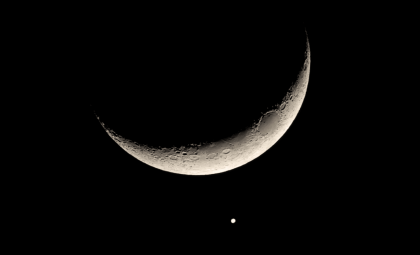
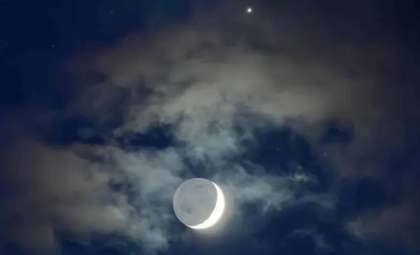
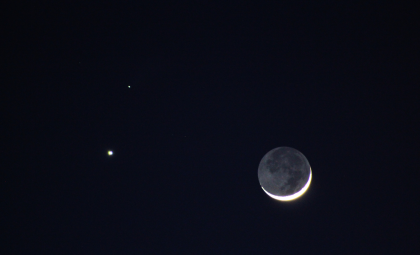
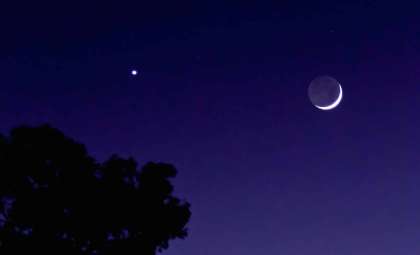
This evening on May 18, the western sky will showcase a stunning celestial event as Venus dazzles beside a slender crescent moon. Just after sunset, stargazers can witness two of the night sky’s brightest figures appearing unusually close together, creating an unforgettable scene.
An Evening Sky Showcase
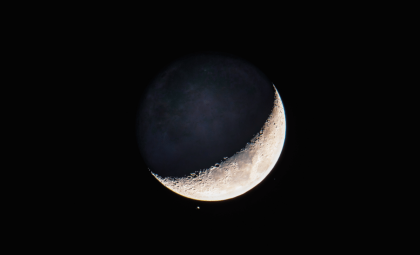
May 18 presents a captivating view with the crescent moon, only 7% illuminated and 2.1 days after the new moon, positioned about 3 degrees to the right of Venus. To grasp this separation visually, a fist held at arm’s length spans roughly 10 degrees, so the moon will appear roughly one-third of that distance from Venus. Despite their apparent closeness, the moon orbits Earth at approximately 224,000 miles (360,000 km), whereas Venus is located far beyond, at nearly 124 million miles (200 million km) away. This alignment creates a beautiful illusion highlighting the cosmic choreography of our solar system.
Which Object Shines More Brilliantly?
It’s a common belief that Venus outshines the slender crescent moon, yet the reality is intriguing. Venus glows with a powerful magnitude of -4.0, appearing as a bright pinpoint, but the moon’s thin crescent boasts a magnitude of -7.1, making it around 17 times brighter overall. The difference arises because the moon’s light is dispersed over its surface, whereas Venus’ luminosity is tightly focused. This contrast offers an excellent chance for sky enthusiasts to appreciate how brightness varies with size and intensity.

Venus Reaches Prime Visibility
Throughout May, Venus moves gradually farther from the Sun, extending its elongation from 24 to 32 degrees, which makes it very prominent for northern mid-latitude viewers. It sits roughly 25 degrees above the western horizon at dusk, displaying a gibbous phase that is about seven-eighths lit. According to Space.com, this period is ideal for telescopic viewing since the twilight dims sky glare, enhancing Venus’ crisp image. The planet will set near 10:50 p.m. local daylight time, allowing ample time to enjoy the view before it sinks out of sight.
- Categories:
- News




0 comments
Sign in to Comment