
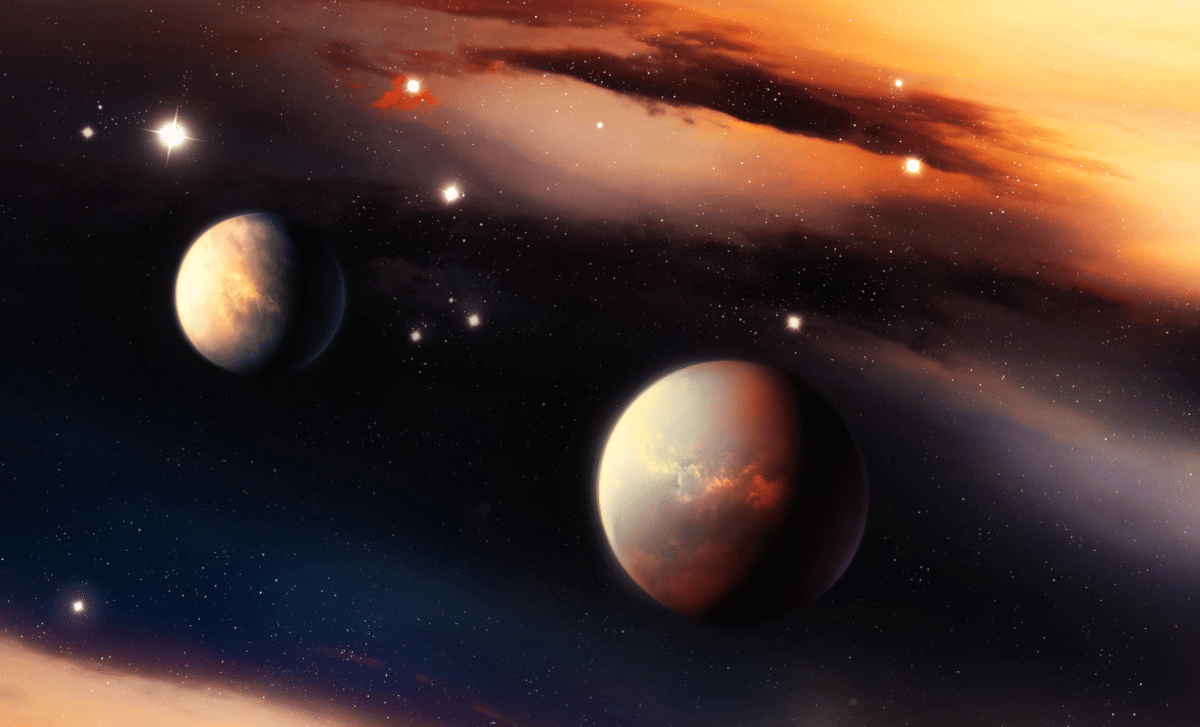
In the remote reaches of the Pegasus constellation, the HR 8799 star system is challenging current theories about how planets come to be. Situated 129 light-years away, this system hosts several super-Jupiters—massive gas giants far exceeding Jupiter in size—that orbit their star at great distances. These planets offer a rare glimpse into planetary genesis and evolution, serving as natural testbeds to understand processes that could also apply to Earth-like worlds.
An Extraordinary Assembly of Massive Gas Giants
HR 8799 is distinguished by its extraordinary group of four colossal gas giants, making it a standout among known planetary systems. These planets weigh between five and ten times the mass of Jupiter and orbit much farther from their host star than the giants in our solar system. This unique configuration allows researchers to investigate the early phases of planet development.
“HR 8799 is somewhat unique because, thus far, it’s the only imaged system with four massive gas giants, but there are other known systems with one or two even larger companions and whose formation remains unknown,” said Dr. Jean-Baptiste Ruffio, an astronomer at the University of California, San Diego.
Add Cosmo Herald as a Preferred Source

Unlike most exoplanets inferred through indirect means, HR 8799’s giants have been directly observed using cutting-edge techniques, enabling detailed examination of their properties.
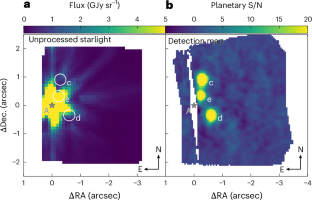
Direct observation provides scientists an unprecedented chance to analyze these planets’ atmospheres in depth. For HR 8799c, d, and e, the Webb Telescope’s exceptional sensitivity has revealed the presence of hydrogen sulfide gas, a landmark achievement in studying exoplanet atmospheres.
Decoding the Chemicals Shaping Super-Jupiters
The identification of hydrogen sulfide offers vital clues about the chemical environment during planet formation. While elements like carbon and oxygen are found both as solids and gases in protoplanetary disks, sulfur behaves differently, making it a key tracer.
“Carbon and oxygen in these planets have been studied from Earth-based observations in the past, but they’re not good signatures for solid matter because they can come from both ice or solids in the disk, or from gas,” explained Dr. Jerry Xuan, a postdoctoral researcher at the University of California, Los Angeles and Caltech.
According to Dr. Xuan, “Because these planets orbit so far from their star, sulfur must exist primarily in solid form.” This implies that sulfur detected in their atmospheres originated from solid components in the planets’ formative disk rather than gaseous accretion. As the planets' interiors warmed, these solids vaporized, releasing sulfur into their gaseous envelopes where it could be measured.
The discovery of hydrogen sulfide also suggests that planetary growth processes, involving the accumulation of heavy elements, may be more consistent across various star systems than previously assumed. The similar ratios of sulfur, carbon, and oxygen in these planets point to a potentially universal pattern of element enrichment during planet formation.
Advancing the Quest for Earth-Like Worlds
This breakthrough heralds exciting prospects for studying other exoplanets, including those akin to Earth. While current observations focus on massive gas giants, the ability to isolate planetary signals from their parent stars through visual and spectral methods opens doors for future research. As Dr. Xuan emphasized,
“The technique applied here, which lets researchers visually and spectrally separate the planet from the star, will be useful for studying exoplanets at great distances from Earth in clear detail.”
Although presently limited to large gas giants, this approach may eventually extend to smaller, terrestrial planets. Dr. Xuan cautions that identifying a true Earth analog remains a long-term goal, “likely decades away.” Nevertheless, ongoing improvements in telescope technology and instrumentation may soon make it possible to probe atmospheres of Earth-like planets for biosignatures like oxygen and ozone.
The findings, documented in Nature Astronomy, mark a significant stride in exoplanet exploration. Dr. Xuan expressed optimism: “We may see the first spectrum of an Earth-like planet within 20 to 30 years and begin the search for biosignatures such as oxygen and ozone.”
Expanding Our Knowledge of How Planets Form
This research enhances our comprehension of planetary development. The consistent enrichment of elements like sulfur, nitrogen, and oxygen in HR 8799’s planets suggests a natural, underlying accretion mechanism during planet formation. This trend, observed previously in Jupiter and Saturn, appears to extend beyond our solar system.
“Explaining uniform enrichments of carbon, oxygen, sulfur, and nitrogen in Jupiter has been challenging,” Dr. Xuan noted, “but observing this pattern elsewhere implies a universal process whereby planets accumulate heavy elements in nearly equal proportions.” This insight could transform our understanding of both giant planets and smaller worlds that might harbor life.
- Categories:
- Space






0 comments
Sign in to Comment