

The James Webb Space Telescope has unveiled an undiscovered planet within the famous Beta Pictoris star system, a breakthrough detailed in a recent publication in the Astrophysical Journal Letters. This unexpected discovery arose during an examination of another previously known planet, highlighting the continuing surprises in one of the closest planetary systems to Earth.
New Planet Detected Through Webb’s Infrared Data
Utilizing Webb’s sophisticated infrared instruments, astronomers were studying the established planet Beta Pictoris b. Although the search was not aimed at finding another planet, a peculiar signal emerged suggesting the presence of an additional celestial body orbiting the star.
Named Beta Pictoris c, this newfound planet offers scientists a fresh chance to explore planet formation processes around young stars. Situated roughly 63 light-years from our solar system, Beta Pictoris has attracted attention for decades due to its luminous debris disk and signs of active planetary development.

“We weren’t looking for a new planet,” said Gibbs. “We were trying to understand one we already knew existed. Then, this telltale signal appeared in the data where we didn’t expect it.”
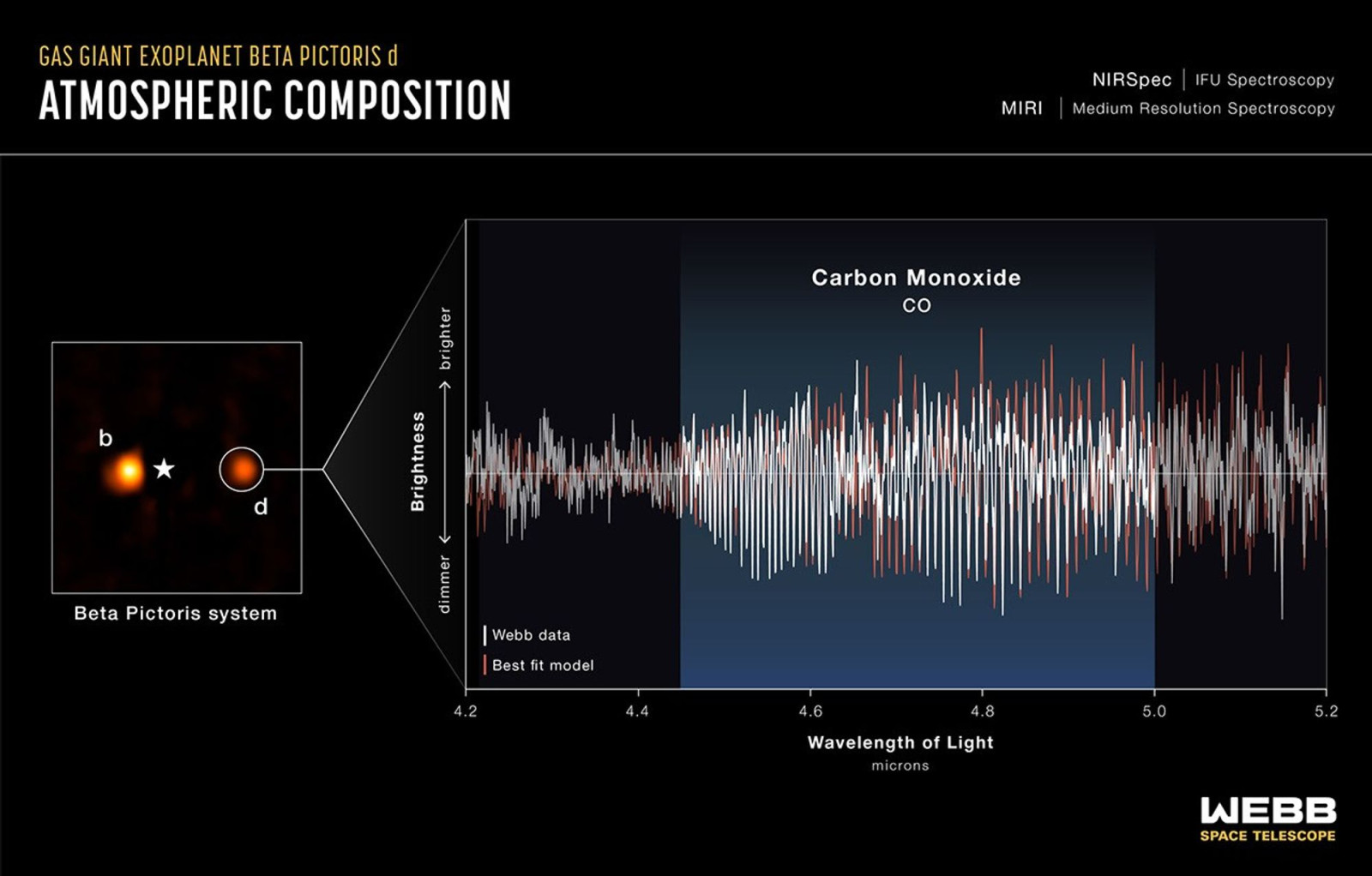
By combining detailed imagery with spectral analysis, the team distinguished genuine planetary signals from potential imaging artifacts or features within the surrounding debris disk.
“There was an unexpected bright source of light within the Integral Field Unit imaging, but we’ve learned not to trust bright blobs in images,” said Jean-Baptiste Ruffio, a research scientist at University of California, San Diego and principal investigator of the first Webb observations where the discovery was made. “They can be instrumental artifacts or other structures in the debris disk. By obtaining a spectrum at the same time as the image, we were able to quickly confirm our suspicions.”
Enhancing the Picture of the Beta Pictoris System
The study published in the Astrophysical Journal Letters significantly enriches the scientific understanding of Beta Pictoris, a key system used to investigate planetary evolution nearby our own galaxy.
At the heart of the system lies a youthful star enveloped by a vast disk of residual gas and dust from its formation, presenting an ideal setting to study how planets evolve and interact with their surroundings during their infancy.
“This discovery adds another piece to an already fascinating planetary system,” said Aidan Gibbs, lead author of a new study published Wednesday in the Astrophysical Journal Letters and a postdoctoral researcher at the University of California, San Diego. “Beta Pictoris has long served as a laboratory for understanding how planetary systems form and evolve, and now we have another planet helping us tell that story.”
The newly discovered planet presents an additional chance to examine atmospheric conditions, temperature profiles, and orbital behavior. Given the system’s proximity and active development, it offers invaluable insights into processes that could explain the formation and evolution of planetary systems, including our own solar neighborhood.

Beyond Pictures: The Power of Webb’s Spectroscopic Analysis
One of the Webb Telescope’s strongest features is its spectroscopic capability, which provides scientists with information beyond just visual observation. By dissecting the light from celestial bodies, spectroscopy reveals essential physical properties.
“A spectrum contains an incredible amount of information,” Ruffio said. “You don’t just learn that something is a planet; you immediately begin learning about its temperature, chemistry, and motion.”
This method helps astronomers grasp how exoplanets form, their composition, and their movements around stars. Webb’s instruments are finely tuned to capture these subtle data signatures, opening new windows into worlds that were once elusive.
Moreover, this breakthrough demonstrates how innovative observations can reshape established scientific perspectives, proving that even extensively studied systems can still conceal hidden treasures unveiled by cutting-edge technology.
- Categories:
- News












0 comments
Sign in to Comment