
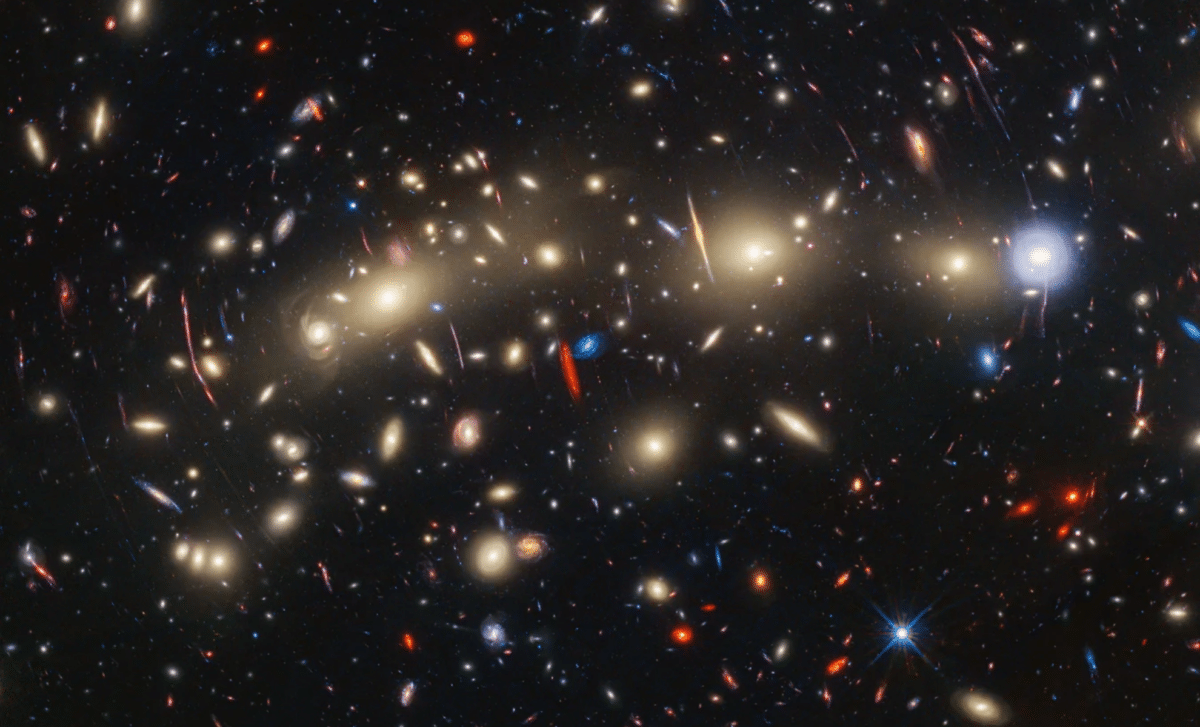
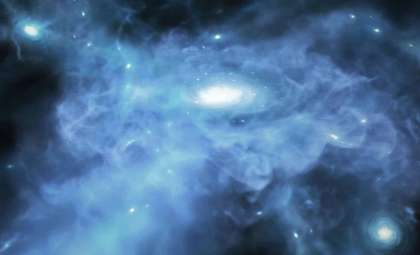
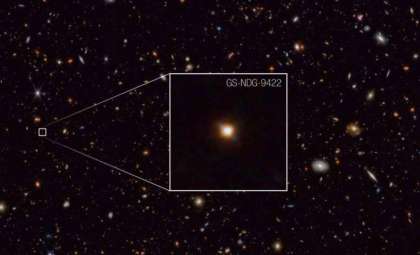
Researchers utilizing the James Webb Space Telescope have detected one of the most ancient galaxies observed to date, formed approximately 13 billion years ago, just 800 million years after the Big Bang. This remarkable finding, described in Nature, provides an exceptional view into the universe’s initial stars and chemically primitive galaxies, uncovering vital information about the dawn of cosmic architecture.
Peering Into the Universe’s Early Epochs
The distant galaxy, named LAP1-B, is remarkably dim and compact, making direct detection extremely challenging. The discovery was made possible by gravitational lensing, a phenomenon where a massive foreground galaxy cluster magnifies and brightens the light from a faraway source. In LAP1-B’s situation, this effect enhanced its brightness by a factor of 100, enabling detailed investigation by astronomers.
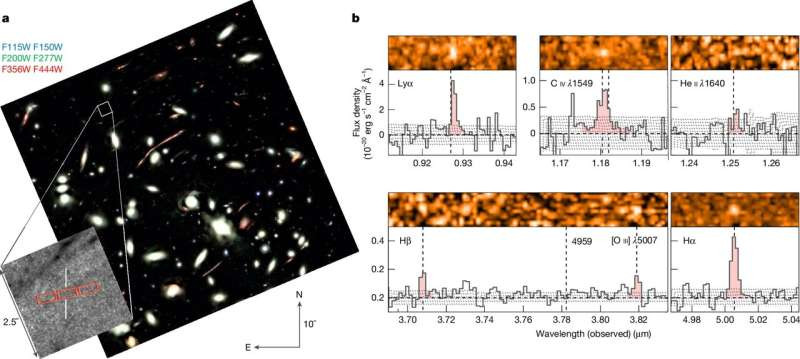
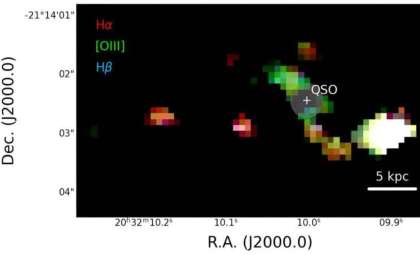
By applying sophisticated spectroscopic methods, the team examined the light emanating from the galaxy’s luminous gas clouds instead of its stellar population. Splitting this light into its spectral components allowed detection of emission lines, which revealed the chemical makeup of the galaxy. Findings highlighted extremely scarce heavy elements, with an oxygen content about 240 times lower than that found in the sun, identifying LAP1-B as one of the most chemically primitive star-forming galaxies ever recorded.

Signatures of the Universe’s First Stars
The emission lines also pointed to powerful ionizing radiation, indicative of the universe’s earliest stars, known as Population III stars. These primordial stars are thought to have illuminated the early cosmos, producing the first elements heavier than hydrogen and helium. The study found an unusually elevated carbon-to-oxygen ratio, consistent with theoretical predictions pertaining to supernovae explosions from these ancient stars.
This breakthrough not only reflects the chemical imprint left by the first stars but also unveils aspects of early galaxy formation, offering insight into the transformation from a vast, nearly uniform hydrogen-helium environment into the complex cosmic structures prevalent today.
Dark Matter’s Underlying Influence
Beyond chemical analysis, scientists measured the dynamics of gas within LAP1-B. Their observations indicate that this galaxy is stabilized by a substantial halo of dark matter, an invisible force crucial to its structural integrity. This supports the theory that dark matter was fundamental in the assembly of the earliest galactic systems, acting as an unseen framework that attracts and holds ordinary matter.
The unique combination of chemical primitiveness, Population III star evidence, and dark matter influence makes LAP1-B a rare glimpse at a “galactic fossil,” bridging our understanding of ultra-faint dwarf galaxies seen nearby today. By studying galaxies like LAP1-B, astronomers deepen their understanding of the universe’s formative stages.
Exploring the Cosmos’ First Light with Webb
Launched in 2021 with a $10 billion budget, the James Webb Space Telescope is engineered to examine the cosmos deeper than any earlier observatories. Its infrared instrumentation can capture light traveling over billions of years, offering scientists a window into the initial galaxies and stars. As detailed in the publication in Nature, LAP1-B exemplifies one of the earliest glimpses at galaxy formation, providing valuable clues about how the universe emerged from darkness into light.
- Categories:
- Astronomy



0 comments
Sign in to Comment