
For decades, scientists believed that organic compounds could not survive the fossilization of ancient remains. Yet, a novel investigation from the University of Liverpool has uncovered traces of collagen—a vital structural protein—in the 66-million-year-old bones of a dinosaur.
Unexpected Protein Detection in Dinosaur Fossils
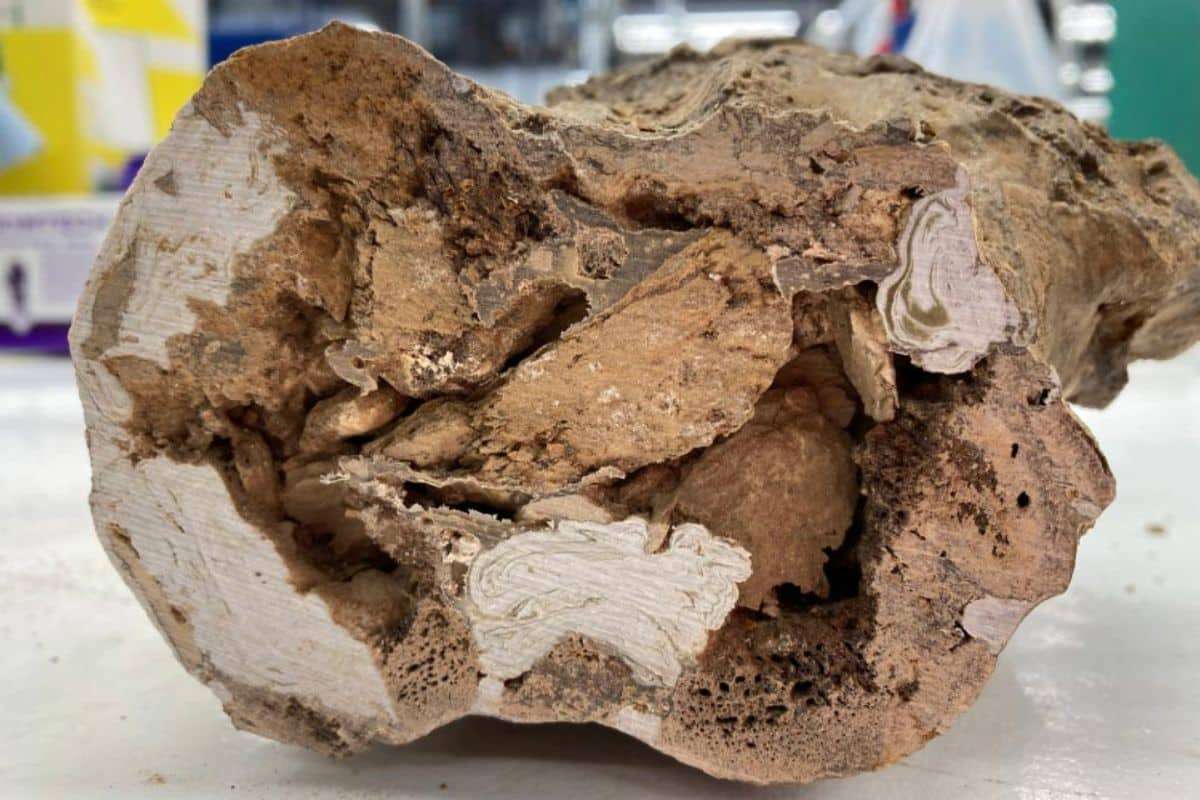
The research examined a well-preserved hip bone belonging to an Edmontosaurus, a duck-billed herbivore from the Cretaceous period. This approximately 50-pound (23-kilogram) fossil was recovered from South Dakota’s Hell Creek Formation and is housed within the University of Liverpool’s fossil archives.
Employing cutting-edge methods like mass spectrometry and protein sequencing, the team identified residual collagen within the bone. This discovery challenges the enduring notion that organic material in fossils arises solely from modern contamination. As stated by Professor Steve Taylor, leader of the Mass Spectrometry Research Group at Liverpool:

“This research shows beyond doubt that organic biomolecules, such as proteins like collagen, appear to be present in some fossils.” The presence of collagen in a fossil this old suggests that certain conditions may allow organic molecules to survive far longer than previously believed.
Understanding Collagen’s Role and Its Significance
Collagen is the primary protein found in bones, imparting strength, resilience, and structure. Its absence would render bones fragile and highly susceptible to damage. In living creatures, collagen is essential for maintaining bone strength, highlighting why its discovery in dinosaur fossils is remarkable.
Typically, collagen degrades over time, transforming into gelatin under heat and moisture—explaining why slow-cooked dishes containing bones become tender. Due to its usual rapid breakdown, detecting collagen remnants in a 66-million-year-old specimen is truly exceptional.
Confirming the Ancient Protein Presence
The collaboration employed precise analytical techniques to authenticate the collagen compounds within the dinosaur bone. Protein sequencing identified distinctive molecular fragments, while tandem mass spectrometry eliminated the possibility of contamination.
Microscopic imaging revealed preserved bone microstructures indicating that organic molecules had endured. Analysis pinpointed specific collagen alpha-1 fragments, a protein subtype crucial for bone stability.
Additional validation was received from the Center for Proteome Research at the University of Liverpool and UCLA, where sophisticated mass spectrometry techniques corroborated the findings.
Professor Taylor remarked, “These images may reveal intact patches of bone collagen, potentially offering a ready-made trove of fossil candidates for further protein analysis.”
Implications for Future Fossil Studies
Uncovering ancient proteins within fossilized remains opens novel scientific possibilities. This breakthrough might lead to reassessments of existing museum specimens, where fossils once believed entirely mineralized could still retain original organic traces.
Professor Taylor suggests that archived cross-polarized light microscopy images might highlight further instances of preserved bone collagen.
These insights encourage scientists to apply modern techniques to historical fossil collections, potentially exposing a wealth of data concerning dinosaur biology and evolutionary patterns.
- Categories:
- Science











0 comments
Sign in to Comment