
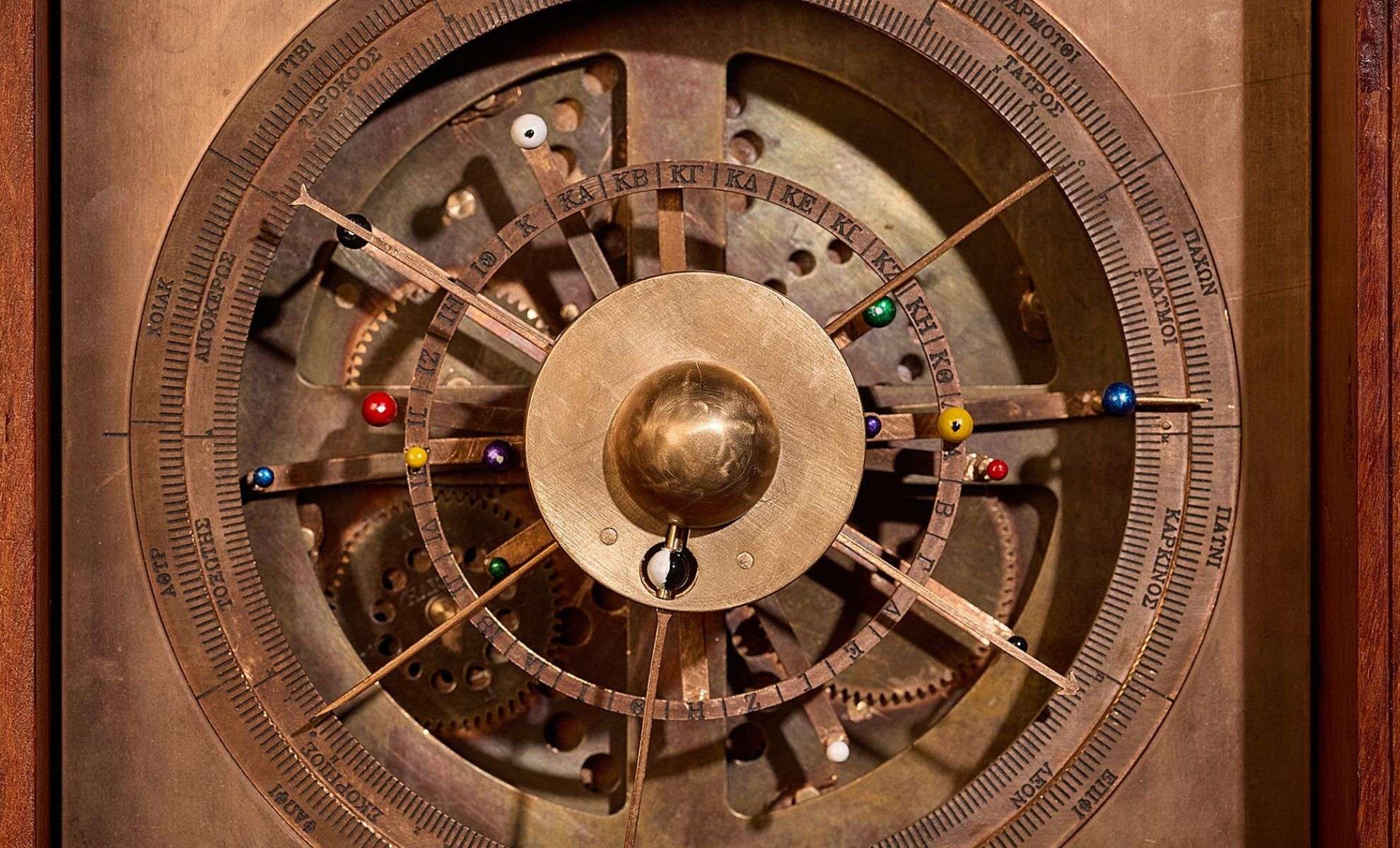
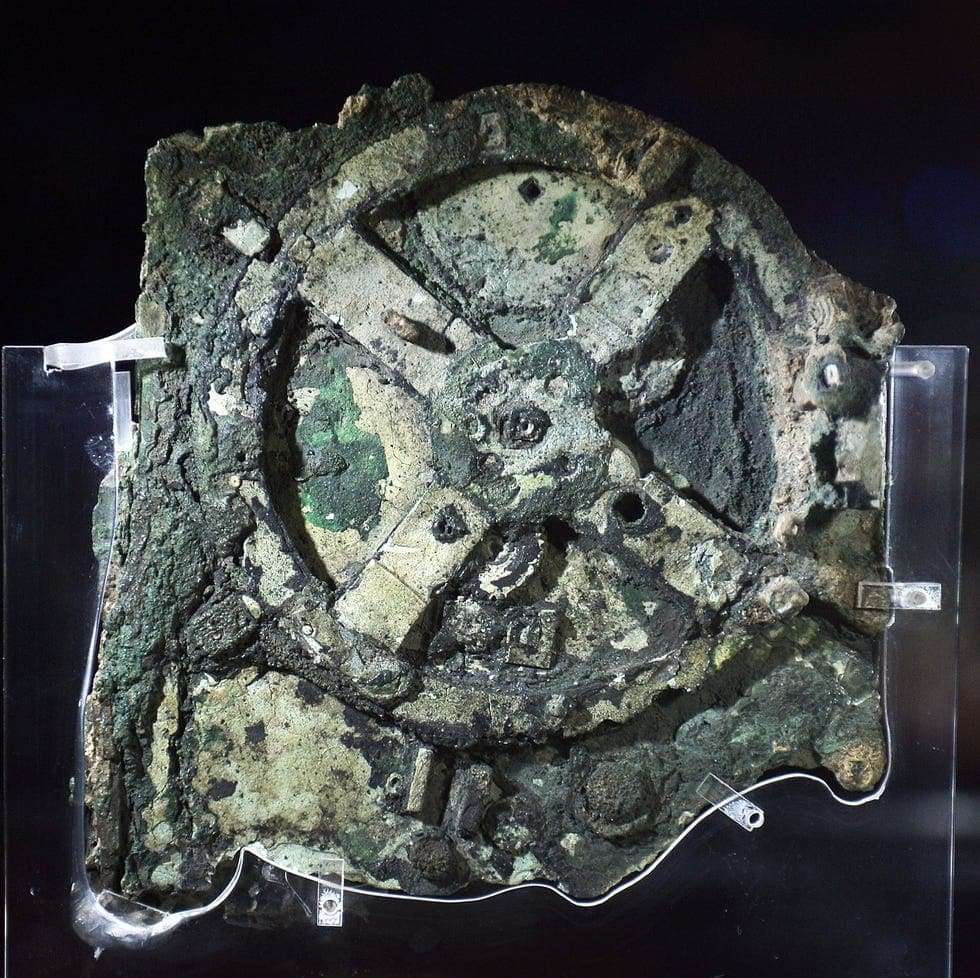
More than a century ago, sponge divers near the Greek island of Antikythera stumbled upon one of history’s most mysterious inventions. Amid a Roman-era shipwreck filled with artifacts like statues and coins, they discovered a heavily corroded cluster of interlocking bronze gears.
At first mistaken for mere junk, this artifact was later identified as the Antikythera mechanism—a compact, complex device that has amazed archaeologists, engineers, and scientists for generations. Now displayed at the National Archaeological Museum in Athens, it is considered the world’s earliest analog computer.
Its intricate design modeled the cosmos with remarkable accuracy, drawing comparisons to modern mechanical clocks and highlighting the advanced state of ancient Greek astronomy and technology.

Uncovering Ancient Engineering by Chance
The chance discovery of the Antikythera mechanism in 1900 occurred during a sponge diving expedition caught in a storm near Antikythera. Diver Elias Stadiatis surfaced alarmed, describing a seabed littered with “rotting corpses of women and horses”—in reality, these were bronze and marble sculptures.
One of the initial recoveries was a bronze arm, but soon after, a rusted mechanical object emerged that proved far more significant. The relic, salvaged from a shipwreck dated to the first century B.C.E., was not deciphered until 1902 when politician Spyridon Stais observed gear-like teeth on the fragment.
His cousin, Valerios Stais, then director of the museum, brought the find to academic attention. German scholar Albert Rehm first proposed it functioned as an astronomical calculating device after identifying epicyclic gears and inscriptions such as “Pachon,” the ninth month of the Egyptian calendar.
A Mechanical Model of the Heavens
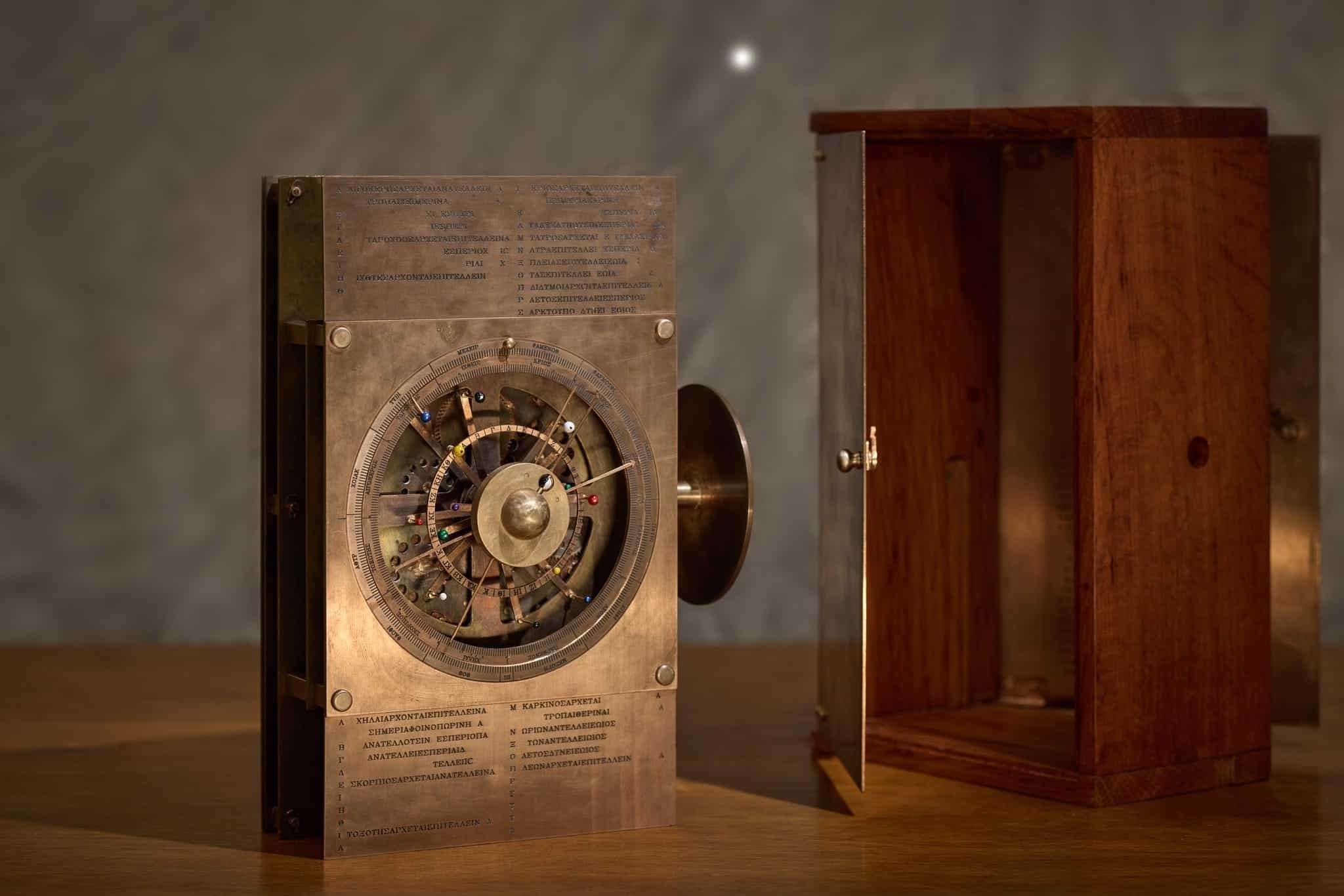
This device’s complexity was staggering for its era. Produced using tools such as bow drills and vertical lathes, it incorporated over 30 interlocking gears capable of simulating celestial phenomena with incredible precision. Its front dial, turned by a hand crank, tracked the sun, moon, and five planets recognized by the Greeks: Mercury, Venus, Mars, Jupiter, and Saturn.
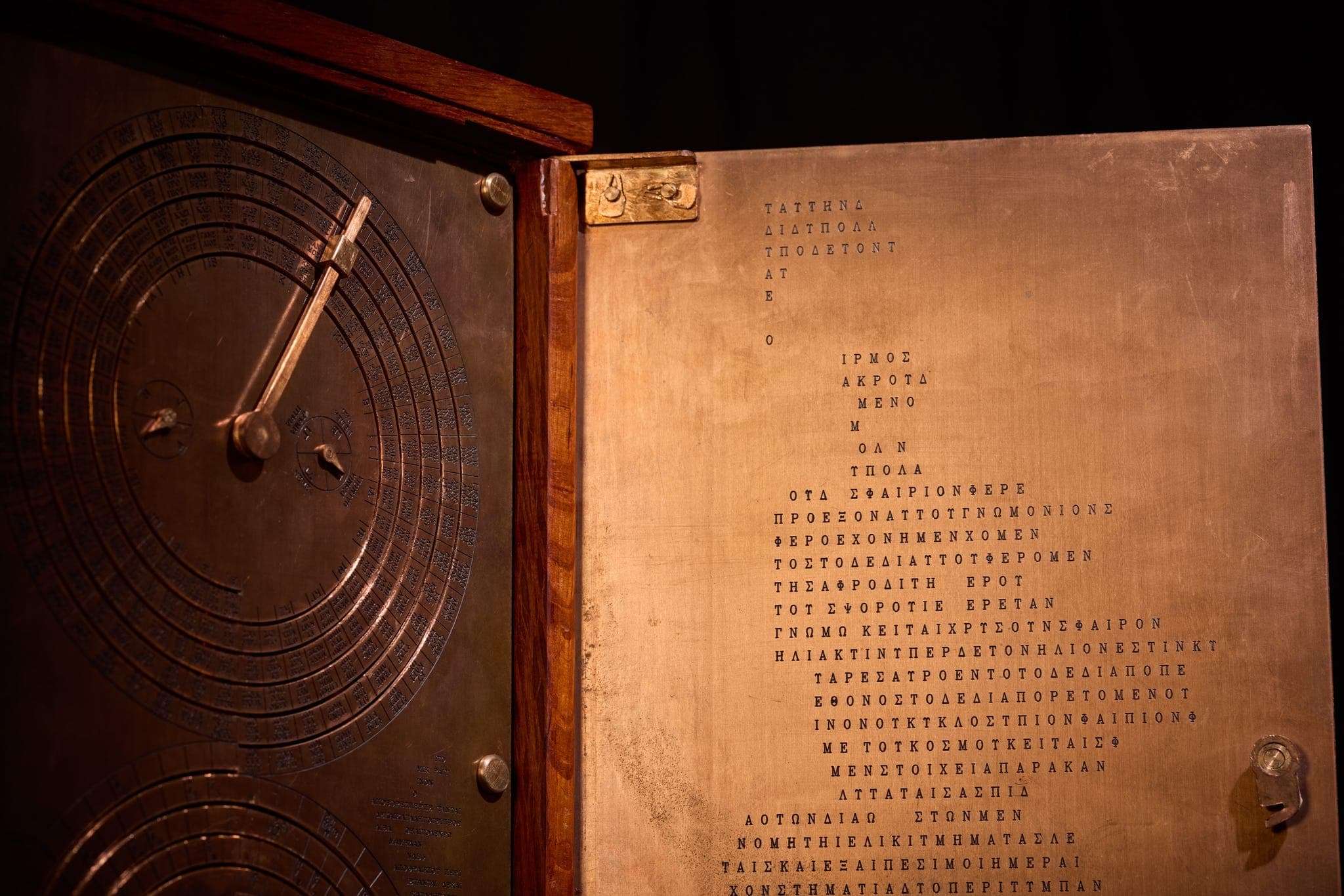
On its back, two spiral dials represented the Metonic cycle—a 19-year lunar calendar—and the Saros cycle, which predicted eclipses. A smaller dial marked significant events such as the Olympic Games and other Panhellenic festivals.
Most impressively, a pin-and-slot mechanism simulated variations in the moon’s velocity along its orbit, accounting for the changes observable at perigee and apogee. This was achieved through advanced epicyclic gearing, where gears rotate on other gears mounted on eccentric axes.
From Archimedes’ Legacy to Modern Examination
The device’s origins remain debated. Some researchers believe it drew inspiration from earlier designs attributed to Archimedes, the renowned Syracuse mathematician whose celestial models were said to mirror planetary motions. Roman writer Cicero mentioned a similar device brought to Rome after the conquest of Syracuse in 212 B.C.E.
Dating between the third and first centuries B.C.E., the mechanism might represent a culmination of Hellenistic engineering traditions, none of whose previous examples have survived. Modern scrutiny began in the 1950s when physicist Derek de Solla Price studied the mechanism, which was stored in cigar boxes.
With collaboration from Greek physicist Charalambos Karakalos, Price utilized X-ray imaging to probe the artifact’s internal workings. In his 1974 book Gears from the Greeks, he called the mechanism “a calculating machine” far beyond a mere decorative object, famously comparing its discovery to “opening a pyramid and finding an atomic bomb.”
This research drew in scientists such as mathematician and filmmaker Tony Freeth who, alongside astrophysicist Mike Edmunds, led new detailed scanning projects starting in the early 2000s. Employing high-resolution X-ray tomography, they transported a massive eight-ton imaging rig, dubbed the “Blade Runner,” to Athens in 2005. Combined with Reflectance Transformation Imaging (RTI) developed with Hewlett-Packard, these scans uncovered thousands of previously unreadable inscriptions and gear arrangements.
Enduring Mysteries and Recent Debates
Although much progress has been made, the Antikythera mechanism is fragmented, with only about one-third of the original surviving in 82 pieces. Subsequent work by Freeth and his team revealed the use of exeligmos cycles for refining eclipse predictions and constructed a model explaining planetary movement tracked via epicyclic gears, consistent with engraved inscriptions.
In 2024, controversy emerged when physicist Graham Woan from the University of Glasgow published a statistical analysis in The Horological Journal. Using Bayesian inference, Woan and colleague Joseph Bayley analyzed a broken calendar ring thought to lie behind the main dial. Examining 80 visible holes, they concluded the ring likely had 354 holes, indicating a lunar calendar system.
This challenged the prevailing solar calendar theory, which assumed 365 holes. Woan’s findings showed it was “299 times more probable” that the original hole count was 354. The conclusion faced strong criticism from Freeth, who rejected it as “just wrong,” arguing that a “simplistic lunar calendar” didn’t align with the device’s overall sophistication.
Woan, however, remains confident in his analysis, acknowledging that assumptions might need adjustment but emphasizing: “If the data are robust and tight enough… they will guide you to the truth—even if you resist it.”
The Antikythera mechanism continues to enthrall both scientists and the public alike. It stands as a testament to the ingenuity of ancient Greek civilization and embodies the relentless pursuit of knowledge through curiosity and debate. More than 120 years after its discovery, it remains one of archaeology’s greatest technological enigmas.
- Categories:
- Science











0 comments
Sign in to Comment