
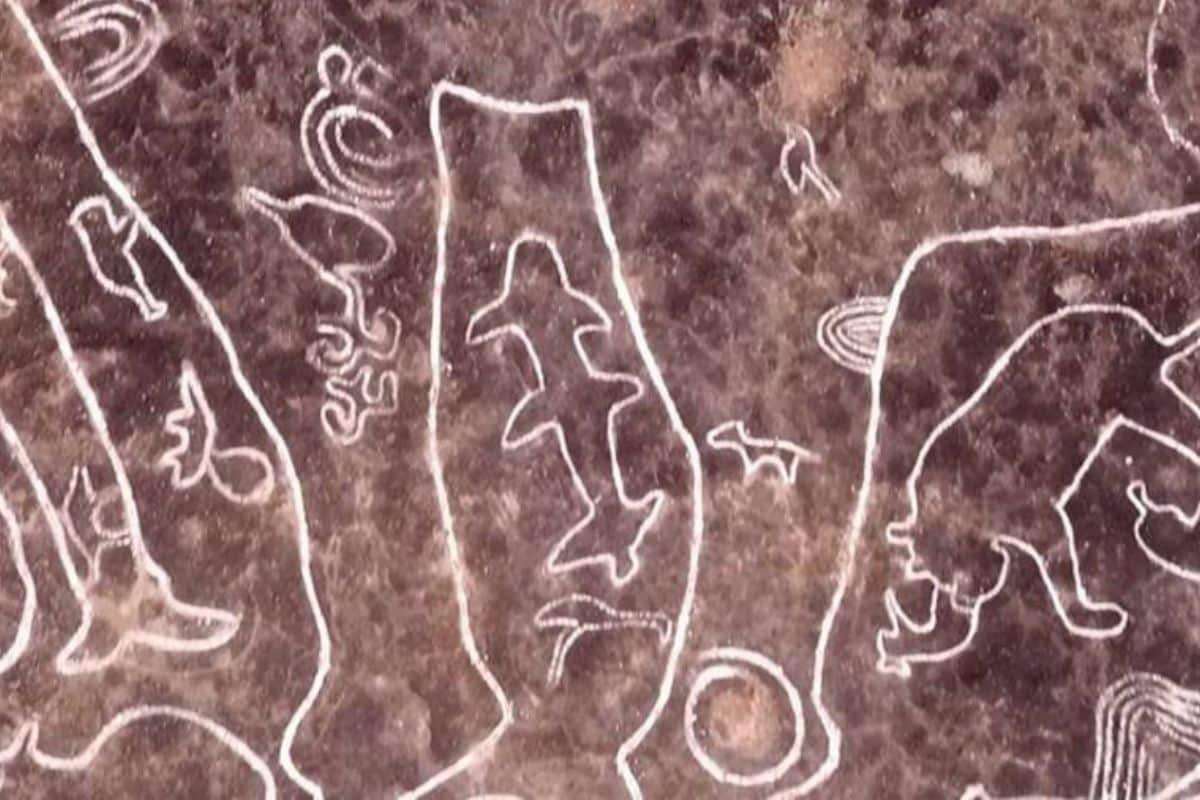
In the western Konkan region of India, archaeologists have uncovered thousands of ancient petroglyphs that could provide evidence of a civilization lost to history, dating back more than 12,000 years.
12,000-Year-Old Images Revealed Beneath the Surface
As reported by Allthatsinteresting, these rock carvings were found mostly in the Ratnagiri and Rajapur districts of Maharashtra. Etched into smooth hilltops, they remained obscured under layers of soil and vegetation until recently. Local enthusiasts Sudhir Risbood and Manoj Marathe, who first discovered a few of these petroglyphs, turned their initial curiosity into a large-scale expedition that revealed the true extent of the findings.
With the help of villagers and schoolchildren, they identified petroglyphs scattered across 52 villages, though only five communities had any previous knowledge of these markings. In some areas, the carvings were even regarded as sacred symbols.

The Symbols Within — And What’s Missing
The petroglyphs display diverse imagery, comprising humans, animals, birds, and abstract geometric patterns. Notably, the depictions of animals demonstrate a sophisticated artistic skill, indicating a profound familiarity with the regional wildlife.
Equally noteworthy is the absence of agricultural themes. Tejas Garge, head of Maharashtra's archaeology department, highlights the lack of any farming-related artwork.
“There are no depictions of agricultural activities. The carvings focus heavily on hunted animals and show detailed representations of fauna. This suggests that the creators relied on hunting rather than farming for their sustenance.”
Mysterious Fauna From Distant Ecosystems
Among the carvings, researchers have identified images of animals uncommon to the Konkan region, such as rhinoceroses and other species absent in later periods. This raises intriguing possibilities: either these animals inhabited this area in an ancient climatic phase, or the artists originated from regions where these creatures were native.
These findings suggest that the petroglyphs might have been produced by a distinct, potentially migratory group with customs not previously associated with known ancient Indian civilizations.
From a Local Initiative to a Broader Movement
What began as an investigation by two individuals soon expanded into a regional effort. As awareness grew, students engaged elders in their communities to uncover stories and locate other carvings, blending community knowledge with formal research.
“People began sending us photos, and we involved schools to help locate more petroglyphs. Students interviewed their grandparents and village elders about other engravings, which enriched our database significantly,” Sudhir Risbood told BBC.
Next Steps for the Rock Art Sites
With the petroglyphs now receiving scholarly attention, teams are preparing comprehensive analyses including radiocarbon dating and 3D digital documentation. The aim is to reveal not only the carvings’ historical timeframe but also the cultural identity and mobility of the people behind them.
This discovery challenges previous understandings of ancient settlements, artistic traditions, and migration in South Asia, opening new avenues in the study of prehistoric human activity.
- Categories:
- Science





0 comments
Sign in to Comment