

New research shared on arXiv proposes that a star passing close to our Solar System millions of years ago might continue to impact the trajectories of icy comets arriving in the inner Solar System. The star, identified as HD 7977, is believed to have approached within a few thousand astronomical units around 2.5 million years ago, disturbing the distant Oort Cloud and triggering a prolonged influx of long-period comets. This study suggests that current comet orbits may still bear the mark of this ancient stellar encounter, connecting observations to reconstructed history derived from Gaia mission data.
Tracing a Stellar Influence through Comet Movements
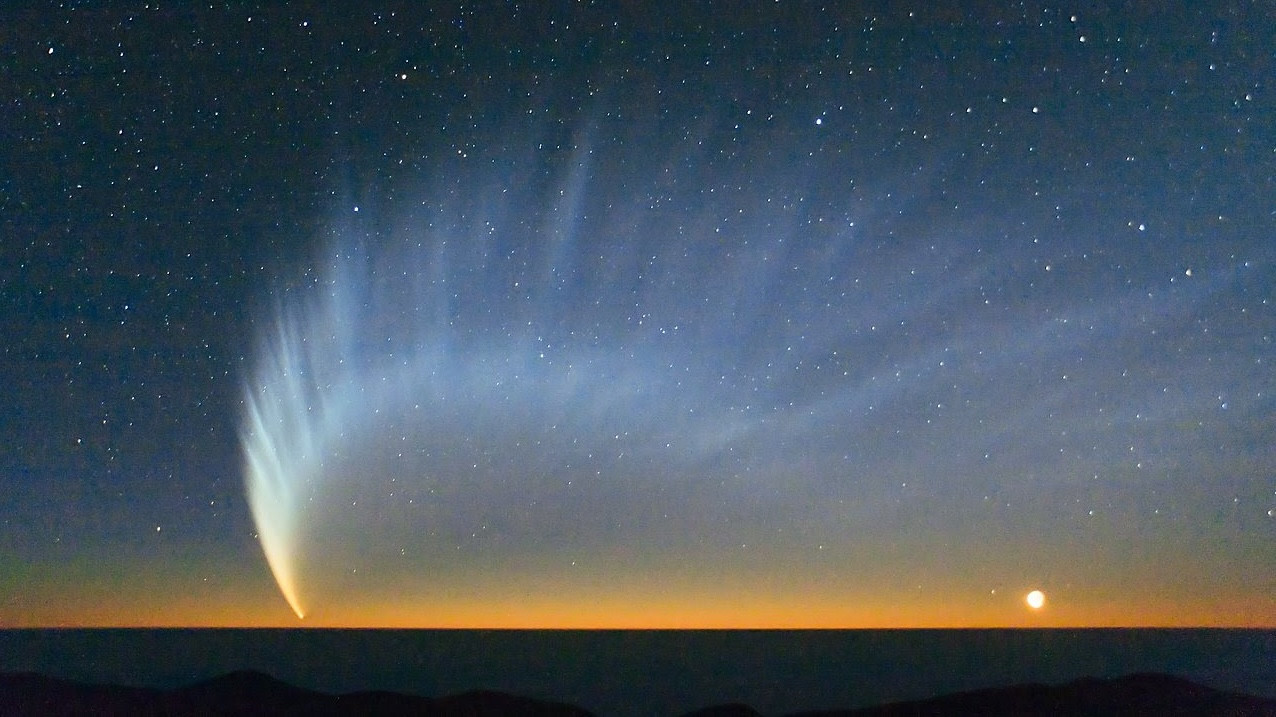
Thanks to advanced 3D reconstructions of stellar motions, scientists have identified HD 7977 as a prime suspect for a close sweep past the Sun’s outer gravitational sphere. Utilizing Gaia’s precise measurements, the star's past path suggests it ventured close enough to perturb the delicate arrangement of icy bodies in the Oort Cloud. Instead of creating a sudden spike in comet activity, this disruption likely led to a slow, evolving stream of long-period comets making their way inward over millions of years.
Viewed this way, the population of long-period comets acts as a dynamic record of past gravitational disturbances. The outer regions of our Solar System are continuously shaped by galactic tides, passing stars, and internal gravitational forces. A near stellar passage could temporarily dominate over the Milky Way’s tidal effects, shifting the orbits of distant icy objects and sending them sunward. Supporting this interpretation, simulated comet orbit patterns closely align with expected signatures from HD 7977’s flyby, implying the Solar System may still be experiencing the tail end of a comet surge initiated by that event.

Gaia’s Crucial Role in Stellar Motion Reconstruction
The study, posted on arXiv, integrates observed comet data with dynamic models of stellar flybys. Gaia’s high-precision astrometry enables researchers to rewind the motions of nearby stars with unprecedented detail, situating comet studies within a larger galactic framework. By matching simulated comet distributions with real detections since the late 1900s, scientists aim to determine if a singular star passage can explain present-day orbital characteristics.
“The distribution of comet orbits suggests we are living through an unusual time where HD 7977 has dominated the generation of new comets and not the larger gravitational field of the Milky Way, as it usually would. This would also mean we’re living through the late stages of a pretty rare and powerful comet shower,” says Kaib.
This research implies that the Solar System’s gravitational environment is not constant but can vary significantly due to infrequent close encounters with stars. These events leave enduring dynamical imprints, meaning the comets we observe today may not represent a stable state but rather a phase still influenced by past disruptions. Models indicate that older, repeatedly returning comets reflect the broader galactic gravitational effects, while newer comets exhibit signatures of a more recent stellar trigger.
Model Challenges and Ongoing Uncertainties
Although simulated results align reasonably with observed comet data, some inconsistencies remain, particularly regarding comet orbit sizes. These discrepancies hint at missing elements in current models or a more complex Oort Cloud structure than previously assumed. Because the Oort Cloud is a distant and diffuse repository, accurately simulating its behavior and response to stellar flybys remains challenging.
“Like many other works that simulate long-period comet production, we find that our comets’ orbit sizes aren’t a great match for the observed distribution. It’s possible we’re missing some important physics from our simulations, and it’s conceivable that this has caused us to misinterpret comet orbit data,” said Raymond.
Additional factors such as non-gravitational forces—outgassing jets or subtle radiation pressure—may influence comet trajectories once they enter the inner Solar System, complicating efforts to isolate the impact of any one stellar encounter. Alternative explanations may also involve a more intricate internal structure of the Oort Cloud or overlapping gravitational effects accumulated over millions of years.
Future Observations Could Verify Predictions
Despite these uncertainties, the study offers a testable forecast. Gaia’s ongoing data releases will refine measurements of HD 7977’s motion, enhancing past trajectory reconstructions within the coming year. At the same time, expanding catalogs of long-period comets from new surveys will provide larger datasets to compare against model predictions, potentially confirming the role of this star or revealing more complex origins.
“The nice thing about our prediction is that it will be testable pretty soon. Gaia is still publishing new data on the motions of stars, and in 6–12 months, it should be able to improve our understanding of HD 7977’s motion and tell us if we are right or wrong,” said Kaib.
Over the next ten years, wide-field astronomical surveys are expected to vastly increase the number of detected long-period comets. Analysis of their orbital properties will sharpen insights into their sources, either reinforcing HD 7977’s influence or suggesting alternative stellar encounters. Regardless, this research highlights how the Solar System’s comet cloud is more dynamically linked to its galactic environment than previously recognized.
- Categories:
- Astronomy




0 comments
Sign in to Comment