
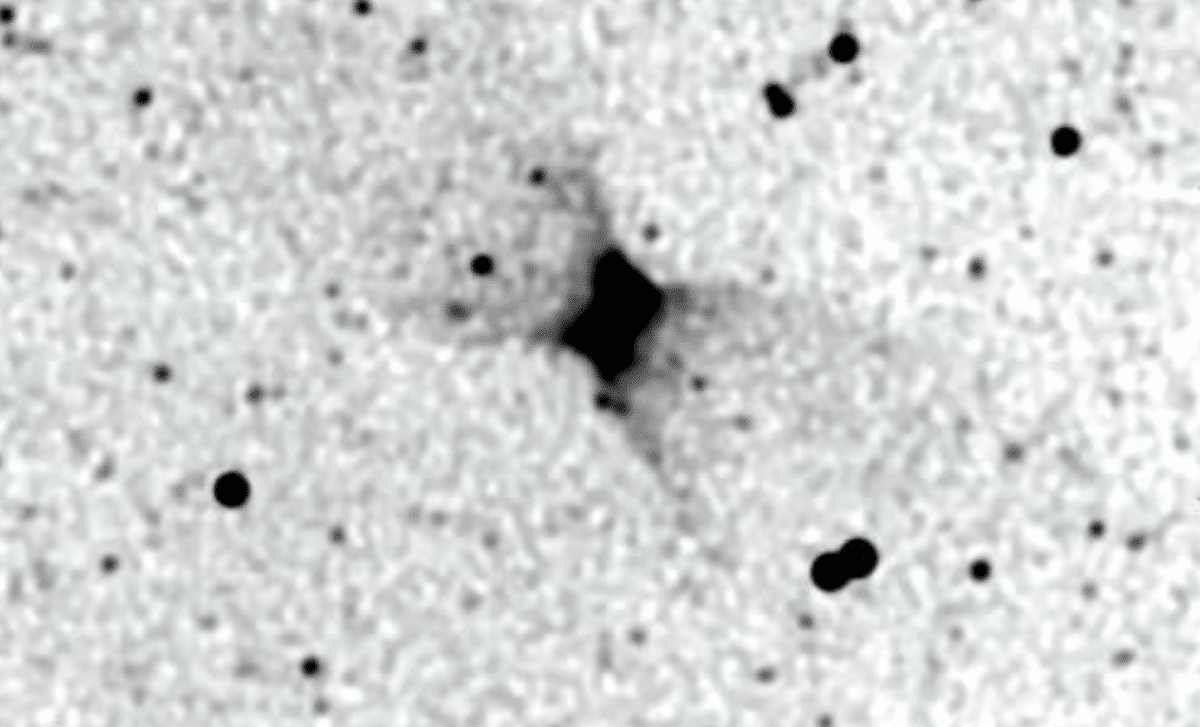
Astronomers utilizing the Australian Square Kilometre Array Pathfinder (ASKAP) have uncovered a colossal bipolar outflow of material streaming out from the disk of galaxy ESO 130-G012. This discovery offers fresh insights into the mechanisms driving galaxy evolution and the activity of central black holes. The findings, led by a team from Western Sydney University and released on arXiv in December 2025, were made possible through the Evolutionary Map of the Universe (EMU) survey.
An Immense Hidden Formation
While ESO 130-G012, situated about 55 million light years away, appears as an unassuming, edge-on spiral galaxy with roughly 11 billion times the mass of our Sun in stars and an average star formation rate of 0.2 solar masses annually, ASKAP observations revealed something remarkable. At 944 MHz, the telescope exposed a huge bipolar outflow extending into the galaxy’s halo.
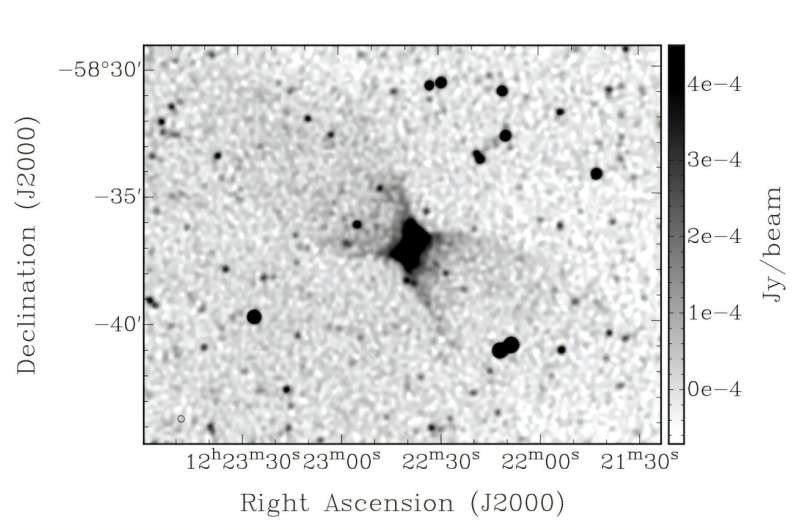
The research team described the structure as spanning at least 6 arcminutes (approximately 30 kiloparsecs) above and below the plane of the galaxy. “While inspecting deep ASKAP EMU 944 MHz radio continuum images, we discovered a bipolar outflow extending at least 6′ (∼30 kpc) above and below the edge-on stellar disk of ESO 130-G012,” the scientists note. This symmetrical formation resembles a cosmic hourglass erupting from both sides of the galactic disk.

Characteristics of the Hourglass-Shaped Outflow
The bipolar outflow creates an impressive hourglass configuration stretching up to 160,000 light years into the surrounding halo on each side. The central narrow region, termed the “waist” of the hourglass, measures about 33,000 light years across and aligns with the star-forming disk. The outflow’s well-organized morphology reveals multiple radio components arranged concentrically around the galaxy’s core.
The ASKAP radio continuum data reveals a complex structure comprising several elements: a central radio core, knots associated with an inner stellar ring, a thin stellar disk, and a box-shaped thick disk. Extending from this box-shaped feature are X-shaped radio wings, which form the broad funnels of the outflow. These X-shaped patterns commonly occur in galaxies harboring active galactic nuclei (AGN), adding layers to the interpretation of the phenomenon.
The flow starts with a strong vertical ascent from the disk, broadening sideways further out and shaping two funnels with opening angles of roughly 30 degrees on either side of the galactic plane.
Unraveling the Cause of the Outflow
A major question is what drives this remarkable outflow. The study, accessible via arXiv, proposes that star formation, stellar winds, and cosmic ray pressure distributed across the stellar disk may be the primary forces. Despite the galaxy’s modest star formation rate, these factors could still generate large-scale galactic winds under suitable conditions.
The researchers also consider the potential influences of an active galactic nucleus (AGN) or a former intense starburst phase. The supermassive black hole at the galaxy’s center, estimated to be 50 million times the Sun’s mass, might have experienced a more energetic past. Its current inactive state does not exclude the possibility of historical activity.
“Our discovery of a large-scale radio continuum outflow from the disk of ESO 130-G012 makes it a promising target to further explore its disk-halo interface and model the outflow formation,” the team concludes.
- Categories:
- Space









0 comments
Sign in to Comment