
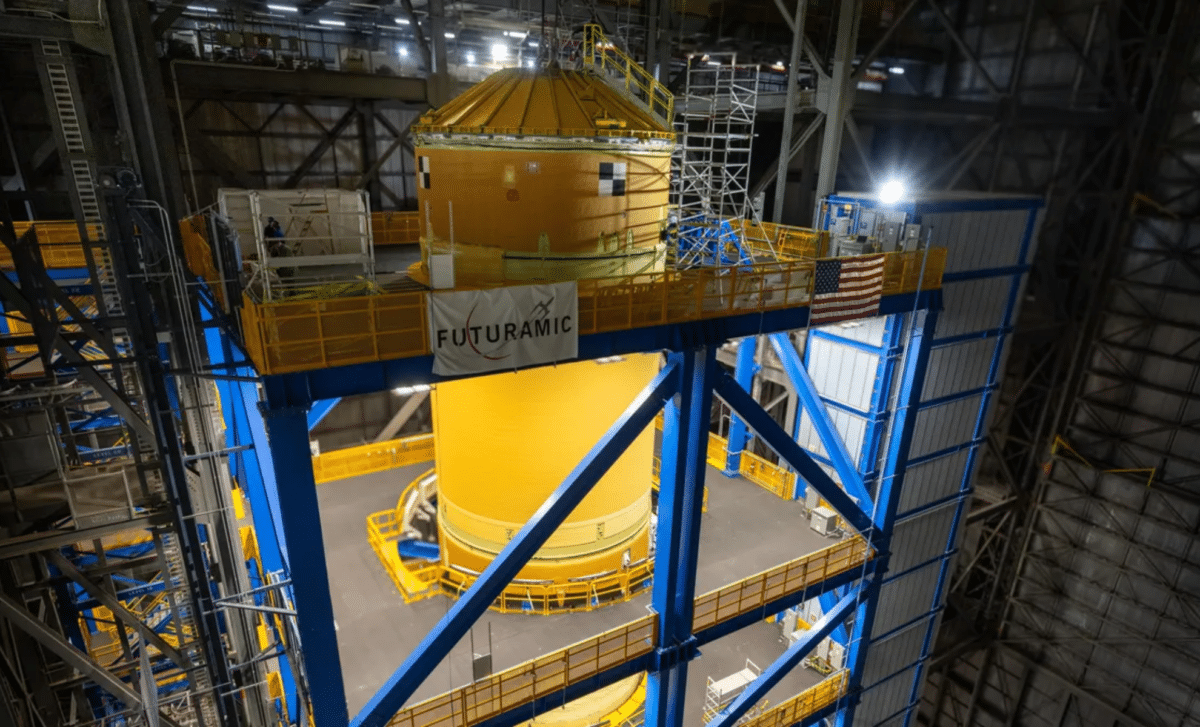
NASA has begun the construction of the formidable Space Launch System rocket intended for the Artemis III mission at the Kennedy Space Center. This development marks a significant move forward for the agency’s upcoming crewed space mission. Technicians have already elevated the rocket's core stage within Florida's renowned Vehicle Assembly Building, where the vehicle will undergo further assembly leading up to a target launch date in 2027. Artemis III will be a critical mission, as it will test the lunar landing systems developed by SpaceX and Blue Origin before astronauts attempt a lunar return.
Core Stage of Artemis III Rocket Rises Inside Iconic NASA Facility
The core segment of the Artemis III SLS rocket now stands upright in High Bay 2 within the Vehicle Assembly Building, one of the largest spaces dedicated to human spaceflight operations. This main stage rises 212 feet and is designed to host four advanced RS-25 engines, which were originally developed for the Space Shuttle. When fully assembled with its upper stage, twin solid rocket boosters, and the Orion crew capsule, the rocket will extend to an impressive 322 feet and weigh approximately 5.75 million pounds at launch.
NASA shared an update celebrating this milestone, stating, “Technicians at @nasakennedy have completed lifting the largest section of the core stage for NASA’s Artemis III SLS rocket into High Bay 2.” The upcoming phase involves connecting the engine portion of the rocket before moving it to High Bay 3, where it will be fully stacked in preparation for launch.

This progress underscores how quickly NASA has advanced following the success of Artemis II, which recently marked Orion’s first crewed lunar flyby. Insights gained from Artemis II are now guiding preparations for the more complex and significant Artemis III mission.
Updated Mission Approach for Artemis III
The objectives of Artemis III have evolved considerably from the program’s initial vision. Initially planned as NASA’s first crewed lunar landing under Artemis, persistent delays in developing the Human Landing System forced a mission redesign. Rather than delivering astronauts directly to the lunar surface, Artemis III will prioritize testing key rendezvous and docking operations in Earth’s orbit.
There's nothing better than seeing an SLS rocket stage vertical! 🏗️
— NASA Marshall (@NASA_Marshall) May 10, 2026
Technicians at @nasakennedy have completed operations of lifting the largest section of the core stage for NASA’s Artemis III SLS rocket into High Bay 2, where it will be connected to the engine section.
Learn… pic.twitter.com/qCEtIS7lir
The mission aims for Orion and its crew to rendezvous with one or both of the lunar landers now in development: SpaceX Starship and Blue Origin Blue Moon. This flight will enable astronauts and mission teams to rehearse close-proximity maneuvers and confirm the readiness of these landers for future moon expeditions.
This revised mission plan enhances NASA’s adaptability and minimizes the risks tied to rushing untested spacecraft for a lunar touchdown. Artemis III thereby transforms into a critical proving ground for two pioneering spacecraft designed for deep space human exploration.
Critical Evaluation for SpaceX and Blue Origin
The results of Artemis III will heavily influence which provider will ferry astronauts to the lunar surface first. Currently, SpaceX is favored to support Artemis IV in 2028, having won NASA’s initial contract for lunar landings with its Starship vehicle. Meanwhile, Blue Origin’s Blue Moon lander continues to progress through its development and testing phases, keeping the potential for future changes to NASA’s plans open.
Both companies still face significant technological hurdles before their vehicles can carry astronauts safely. Starship must prove the ability to refuel in orbit and land reliably on the moon, while Blue Moon is advancing infrastructure critical for sustained missions beyond Earth orbit. Artemis III provides NASA’s first chance to directly assess how these landers perform in combination with the Orion spacecraft during a crewed mission.
The stakes are high for these demonstrations, as NASA’s extended lunar exploration strategy relies on the success of commercial lunar landers. The agency envisions these vehicles enabling routine moon missions and supporting a permanent human foothold at the lunar south pole in the early 2030s.
- Categories:
- News









0 comments
Sign in to Comment