
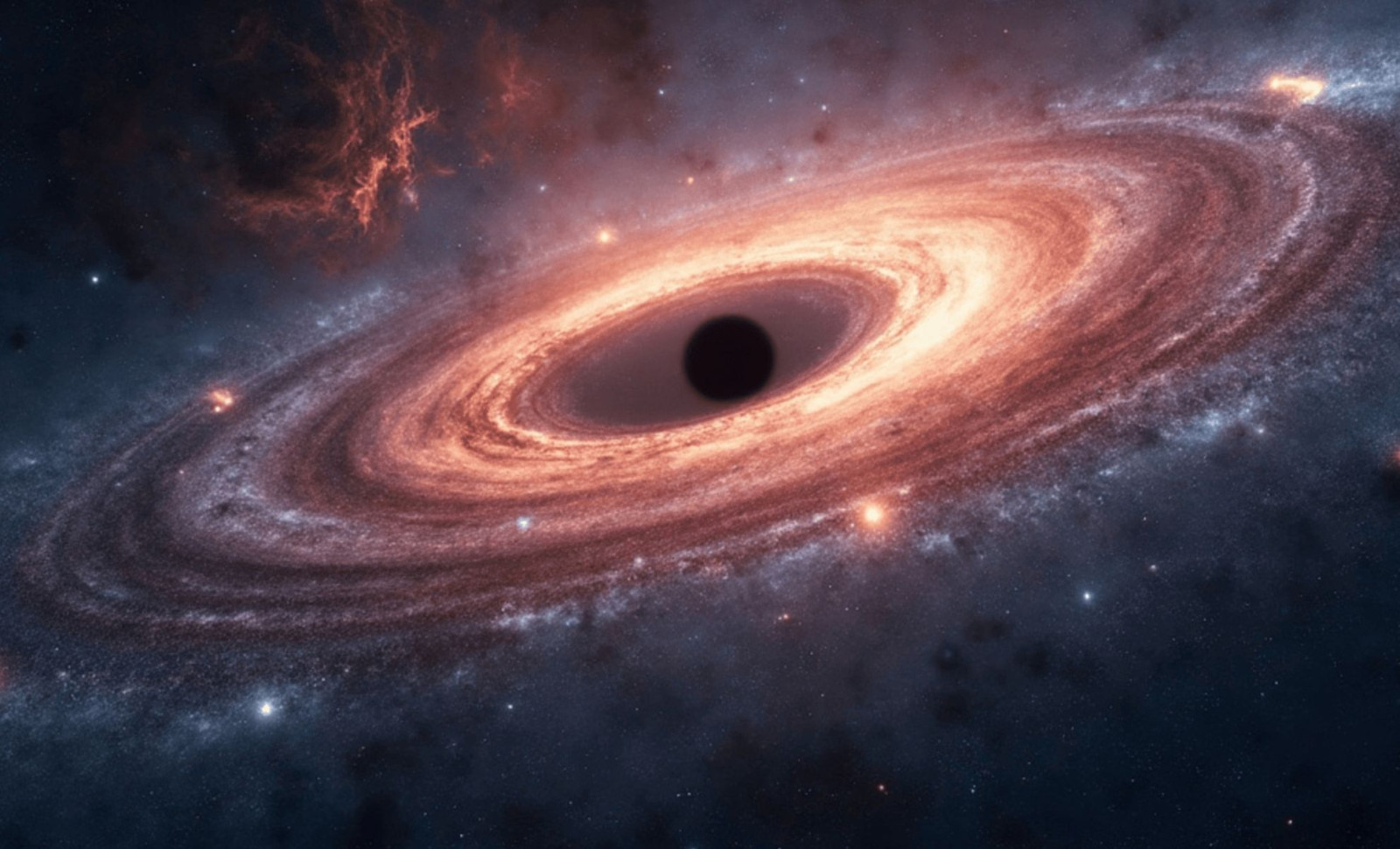
A quasar located billions of light-years away is challenging key principles of black hole behavior. This quasar, identified as ID830, is expanding its mass at a rate 13 times higher than predicted by physics while simultaneously emitting strong X-rays and powerful radio jets, a combination researchers did not anticipate.
Approximately 12 billion years ago, when the universe was only about 15% of its present age, this colossal supermassive black hole (SMBH) had already attained a mass roughly 440 million times that of our Sun. Its mass surpasses that of Sagittarius A, the black hole at the center of the Milky Way, by over two orders of magnitude.
The study, published on January 21 in The Astrophysical Journal, relies on observations across multiple wavelengths to shed light on what allows such rapid early growth. The authors propose that an intense and brief phase of excessive accretion could explain this exceptional behavior, reaching beyond traditionally accepted physical boundaries.

A Black Hole Exceeding the Eddington Growth Limit
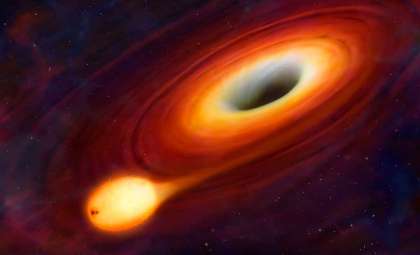
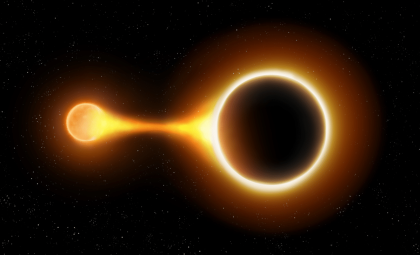
Black holes feed material via a spinning accretion disk composed of gas and dust. As this matter falls inward, it heats up and emits radiation. This radiation exerts outward pressure, setting a natural growth cap known as the Eddington limit, a delicate balance between inward gravitational pull and outward radiation pressure.
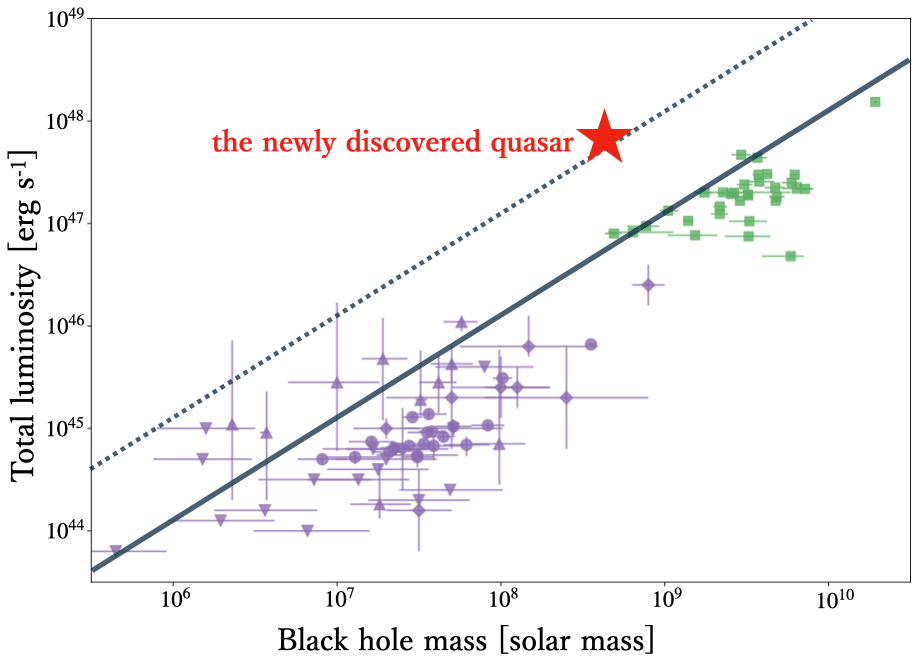
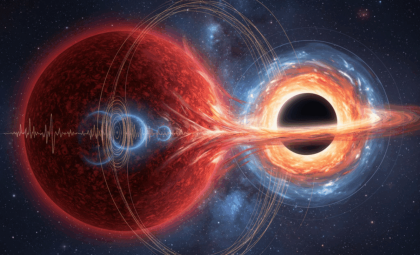
However, ID830 defies this restriction. By analyzing its ultraviolet (UV) and X-ray brightness, scientists estimated that its mass ingestion rate is approximately 13 times the Eddington limit. The publication suggests this rapid feeding phase may have been triggered by a sudden influx of gas, potentially from the black hole disrupting a giant star or devouring a massive gas cloud. Study co-author Sakiko Obuchi of Waseda University explained to Live Science:
“For a SMBH as massive as ID830, this would require not a normal (main-sequence) star, but a more massive giant star or a huge gas cloud.”
She further noted that this brief super-Eddington feeding phase likely lasts about 300 years, a very short interval in cosmic terms.
Connection Between X-Rays and Radio Jets
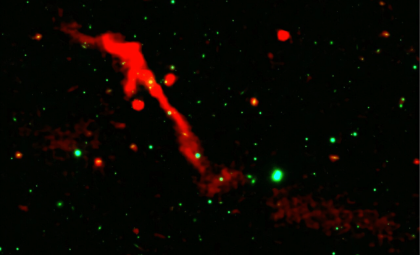
The scenario becomes even more intriguing due to the quasar’s emission profile. Conventional theories indicate that super-Eddington accretion should inhibit the formation of strong radio jets. Yet ID830 displays both vigorous radio jet activity and intense X-ray emissions simultaneously. The team highlighted in their announcement:
“This unexpected combination hints at physical mechanisms not yet fully captured by current models of extreme accretion and jet launching.”
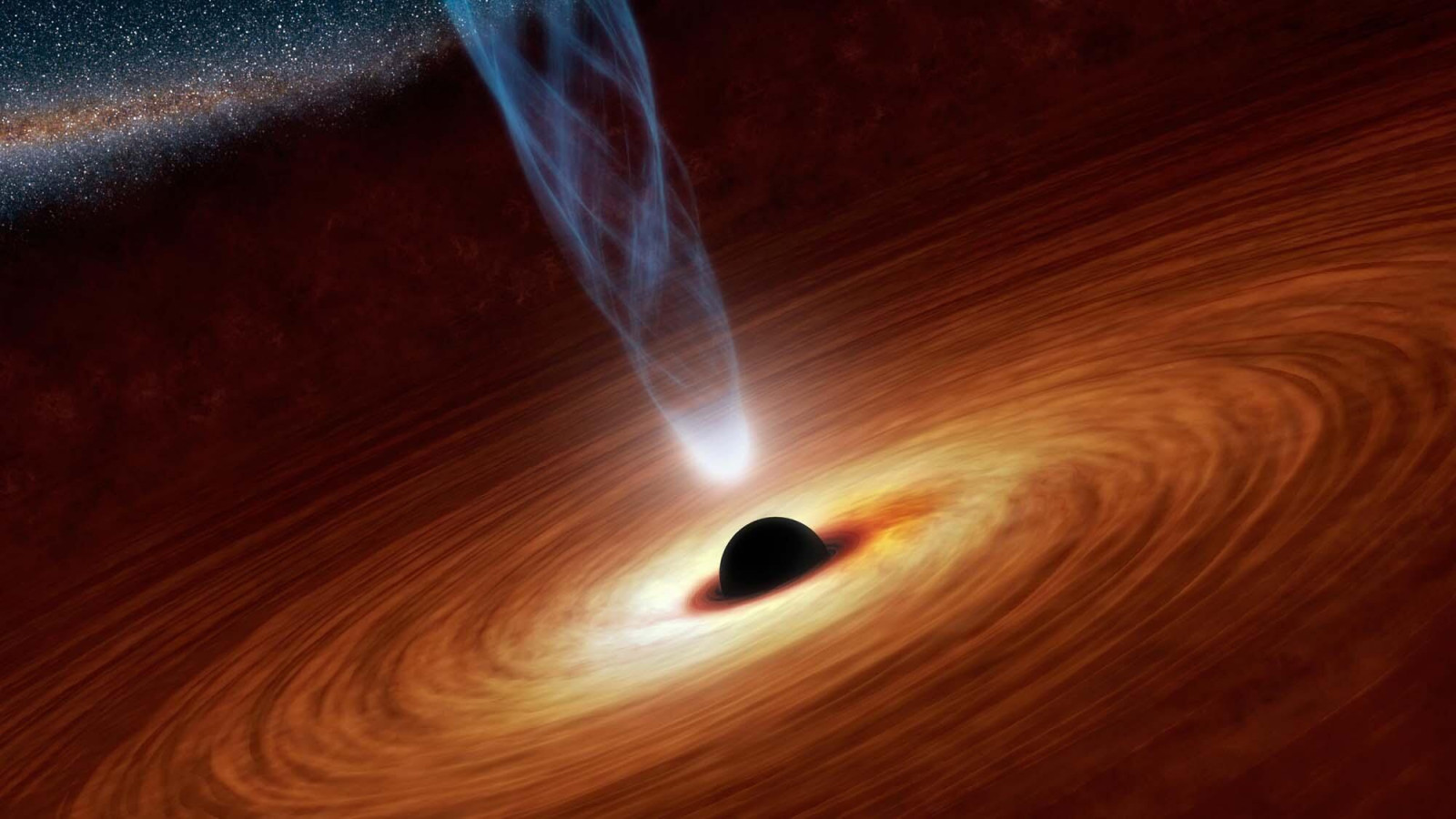
The X-ray radiation is thought to emerge from the corona, a turbulent, hot plasma of particles heated to billions of degrees by magnetic processes above the accretion disk.
NASA describes these coronas as some of the universe’s most extreme environments, where particles move at speeds approaching light. The existence of a luminous corona alongside large radio jets in ID830 calls for revised theories on how energy is managed in rapidly growing black holes.
Understanding the Swift Formation of Early Black Holes
Observations from the James Webb Space Telescope reveal that supermassive black holes formed far earlier and expanded more quickly than prior models suggested. Even if the initial black holes started as remnants of massive Population III stars with about 1,000 solar masses, they would still require more than 650 million years of steady accretion at the Eddington limit to reach their massive sizes. Maintaining such continuous accretion depends on abundant gas supplies, raising questions about how such conditions were sustained. Short-lived super-Eddington phases similar to the one observed in ID830 might bridge this gap between theory and data.
This intense accretion activity also influences the black hole’s host galaxy. The energy produced via radiation and jets during these growth spurts can heat and expel gas from the interstellar medium, hampering star formation processes. Consequently, early supermassive black holes like ID830 could have grown rapidly while shaping the developmental path of their surrounding galaxies.
- Categories:
- Physics






0 comments
Sign in to Comment