
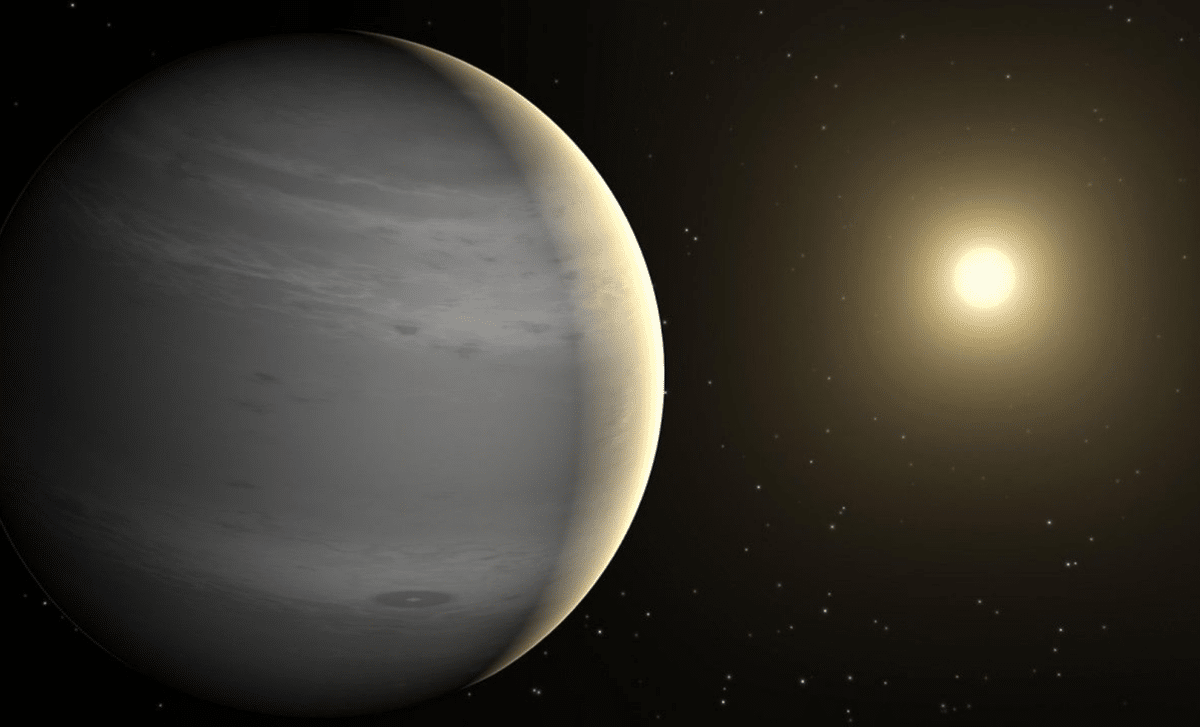
A recent study, initially shared as a pre-peer-reviewed paper on arXiv and soon to be published in Astronomy & Astrophysics, reveals that the huge gas giant HD 206893 B, situated 133 light-years away, may be hosting a colossal exomoon that challenges traditional concepts of what qualifies as a moon. Utilizing the GRAVITY instrument mounted on the Very Large Telescope (VLT) in Chile, astronomers spotted subtle anomalies in the planet’s orbit, indicating gravitational influence from an unseen, massive companion unlike any previously detected.
Uncovering a Planetary Motion Disruption
Scientists observing HD 206893 B with the VLT’s GRAVITY interferometer aimed to study the planet’s trajectory. Their findings were surprising: the planet exhibited a distinct wobble caused by the gravitational pull of another object in orbit around it.
“What we found is that HD 206893 B doesn’t just follow a smooth orbit around its star. On top of that motion, it shows a small but measurable back-and-forth ‘wobble’. The wobble has a period of about nine months and a size comparable to the Earth–moon distance,” team leader and University of Cambridge astronomer Quentin Kral told Space.com. “This kind of signal is exactly what you would expect if the object were being tugged by an unseen companion, such as a large moon, making this system a particularly intriguing candidate for hosting an exomoon.”
Add Cosmo Herald as a Preferred Source

The detected exomoon’s path is inclined by nearly 60 degrees, possibly due to dynamic gravitational influences in the system’s history. Should this be verified, the moon would orbit its giant host every nine months, creating a unique planetary relationship previously unrecorded.
Astrometry Unlocks the Discovery
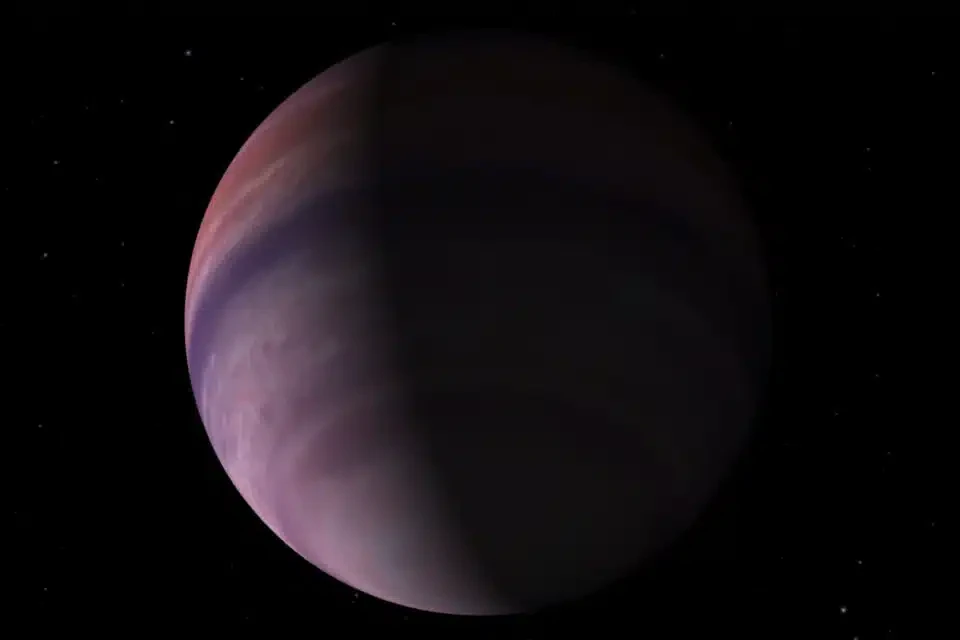
The breakthrough came through the technique of astrometry, which involves precise tracking of celestial objects’ positions to detect minuscule shifts indicative of additional bodies.
“This technique has previously been used to measure the long, slow orbits of massive exoplanets and brown dwarfs, where observations spaced years apart are sufficient,” Kral explained. “In our study, we pushed this approach much further by monitoring the object over much shorter timescales, from days to months. What we found is that HD 206893 B doesn’t just follow a smooth orbit around its star. On top of that motion, it shows a small but measurable back-and-forth ‘wobble’.”
Typically challenging at such vast distances, the precision achieved by the GRAVITY instrument enabled detection of subtle orbital shifts, pointing to a substantial hidden companion. This research, which appears on arXiv and will be published in Astronomy & Astrophysics, marks an important advancement in the emerging field of exomoon discovery.
When a Moon’s Mass Challenges Its Classification
The standout feature of this potential exomoon is its immense size. Estimates suggest it could possess around 40% of Jupiter’s mass, equivalent to roughly nine times Neptune’s mass, which is thousands of times greater than any known moon in our Solar System.
“In our solar system, the most massive moon is Ganymede, which is still extremely small compared to what we are inferring here. Ganymede is thousands of times less massive than Neptune, so there is an enormous gap in mass between the largest moons we know and this potential exomoon candidate,” Kral said.
Such extraordinary size leads to a fundamental dilemma: does this object really fit the moon category?
“This naturally raises the question of whether such an object should even be called a moon. At these masses, the distinction between a massive moon and a very low-mass companion becomes blurred. However, there is currently no official definition of an exomoon, and in practice, astronomers generally refer to any object orbiting a planet or substellar companion as a moon,” Kral continued.
This finding might compel the scientific community to rethink classifications of bodies orbiting planets, especially near the borderline between moons and binary companions.
The Difficulty in Exomoon Detection
Detecting exomoons remains highly challenging, as these objects generate extremely subtle effects often hidden within the fluctuations caused by their host planets.
“Exomoons are difficult to detect because they produce signals that are extremely small compared to those of planets, and those signals depend very strongly on both the observing technique and the system’s geometry,” Kral explained.
Although the transit method has transformed exoplanet detection by identifying dips caused by planets passing in front of stars, it is generally ineffective for spotting moons due to their faint light signatures.
Conversely, the astrometry method opens new avenues by being sensitive to objects orbiting more distant planets, where large moons have a better chance of existing steadily. This makes the GRAVITY discovery particularly promising for the future of exomoon exploration.
Upcoming Prospects in Exomoon Research
Advancements in observational methods and instrumentation are expected to revolutionize our understanding of planetary systems in the near future.
“It’s important to keep in mind that we are likely only seeing the tip of the iceberg,” Kral concluded. “Just as the first exoplanets discovered were the most massive ones orbiting very close to their stars — simply because they were the easiest to detect — the first exomoons we identify are expected to be the most massive and extreme examples.”
“As observational techniques improve, our definitions and understanding of what constitutes a moon will almost certainly evolve.”
If the enormous exomoon orbiting HD 206893 B is confirmed, it not only broadens the catalog of known celestial companions but also challenges the conventional distinctions between planets and moons, likely prompting astronomers to revisit these long-standing classifications.
- Categories:
- Astronomy





0 comments
Sign in to Comment