
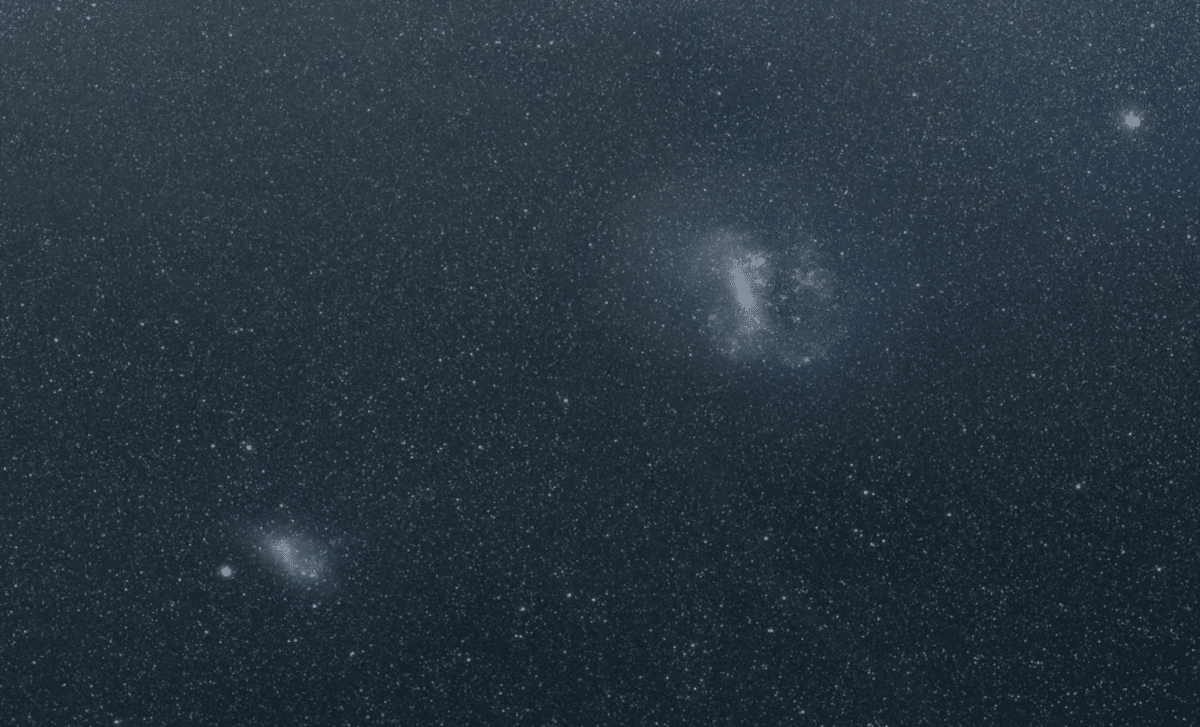
The Small Magellanic Cloud (SMC) is undergoing significant structural changes as it experiences intense gravitational forces from the more massive Large Magellanic Cloud (LMC). Utilizing more than ten years of near-infrared data collected by the Visible and Infrared Survey Telescope for Astronomy (VISTA), researchers have unveiled a complex relationship between these two dwarf galaxies, detecting streams of stars extending outward from the SMC’s center—a process extending over billions of years.
Detailed Mapping of Stellar Movement Within the SMC
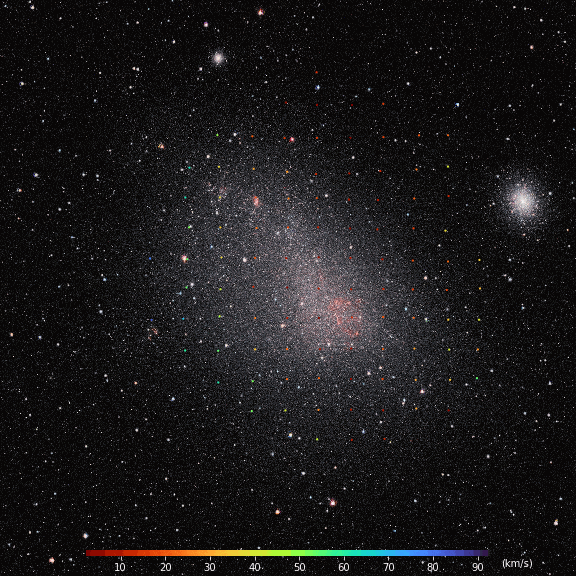
For the first time, scientists have precisely traced the motions of millions of stars inside the SMC. "The clarity of the stellar motion data amazed me when I first saw it," remarked Florian Niederhofer from the Leibniz Institute for Astrophysics Potsdam (AIP) in Germany. "By analyzing observations spanning more than a decade, we produced an exceptionally detailed map of the Small Magellanic Cloud’s internal dynamics, a remarkable achievement for ground-based astronomy."
These findings demonstrate that stars in the SMC do not simply orbit its core as previously assumed. Instead, they are moving outward along an axis oriented toward the LMC, reflecting tidal forces stretching the smaller galaxy. Traveling at average speeds near 17 kilometers per second, these stars drift thousands of light-years over hundreds of millions of years, highlighting the prolonged impact of gravitational influences over cosmic history.

How the Large Magellanic Cloud Shapes Its Companion
More than just a nearby galaxy, the LMC plays a key role in altering its companion's development. Repeated close passages over billions of years have caused tidal expansion in the SMC, contradicting earlier dwarf galaxy models. “Our results show widespread tidal stretching throughout the SMC and challenge the traditional view of it as a rotating disk,” explained Sreepriya Vijayasree, lead author of the research published in Astronomy & Astrophysics. “We find that star motions in the Small Magellanic Cloud are dominated by gravitational disturbances from repeated interactions with the LMC over billions of years, rather than orderly rotation.”
This new perspective reshapes how scientists interpret the history and future of the Magellanic Clouds. Although the Milky Way’s gravity has long been seen as a disrupting factor, it is now evident that these sibling galaxies themselves exert strong forces, pulling out streams of stars and gas from the SMC and producing an elongated, irregular structure. This research also enhances our understanding of galactic evolution, illustrating how smaller galaxies are molded by their larger neighbors.
Insights From Ancient Stellar Movements
Observations reveal that some older red giant stars in the SMC are collectively drifting northward, likely the result of an enigmatic gravitational event approximately two billion years ago. Notably, this interaction may have occurred independently of the Milky Way’s influence, highlighting the complexity and longevity of galactic encounters. Tracking these stellar motions enables astronomers to piece together a chronological record of past gravitational interactions, effectively using stars as a historical archive of cosmic events.
- Categories:
- Astronomy





0 comments
Sign in to Comment