

The rotation of Mars is subtly accelerating, and researchers have pinpointed a vast underground plume as the likely reason behind this gradual change.
Findings published in the Journal of Geophysical Research: Planets, leveraging data from NASA’s InSight mission, indicate that the length of a Martian day is becoming shorter over time compared to historic data from the Viking landers.
While Mars is often viewed as geologically quiet, these observations hint at ongoing dynamic activity beneath its surface.

Is Mars’ Spin Really Increasing?
Mars is spinning about 70 microseconds faster each year. Analysis from InSight and Viking data shows this subtle trend has persisted for decades. Because the change affects the entire planet, scientists believe the underlying cause lies within Mars’ interior rather than surface influences.
“The Martian surface is so old and shows all these complex but largely not well understood process[es], which I think we can start to unravel by combining interior with surface,” noted Bart Root, lead author of the study and Assistant Professor at TU Delft.
A Colossal Underground Feature Beneath Tharsis
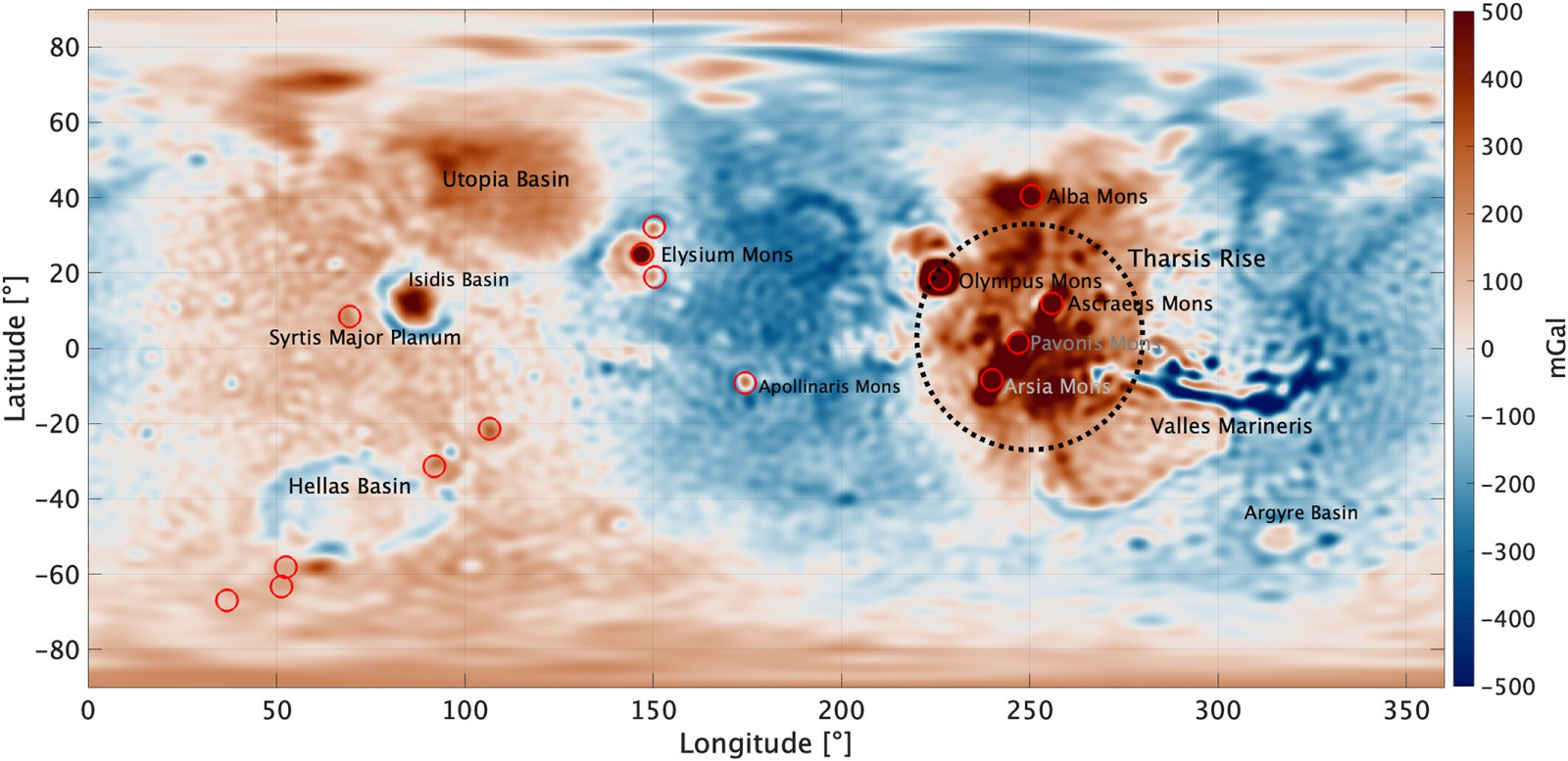
Research focused on the Tharsis region, a gigantic volcanic province spanning roughly 6,000 kilometers. This area hosts some of the largest volcanoes in our solar system, formed without Earth-like plate tectonics. Using InSight measurements, researchers from Delft University of Technology detected what they call a negative mass anomaly beneath Tharsis. The team described the feature as follows:
“The negative or light mass anomaly will move upwards and hit the lithosphere of Mars, introducing melt pockets that have the potential to penetrate the crust and erupt as volcanoes.”
This upward motion creates pockets of molten material under the crust, which could explain the formation of such massive volcanic structures over time.

Deeper Internal Processes Causing Mars' Rotation Shift
The rise of this lighter underground material may cause heavier mass to move closer to Mars’ axis of rotation, leading to the planet’s faster spin.
“A negative mass flowing upwards means something heavier needs to go down, and because the mass anomaly is located on the equator of Mars, this means the heavier mass is going closer to [the] rotation axis, hence a speed up,” Root said.
According to the recent research published in JGR Planets, this mechanism is similar to a figure skater pulling their arms inward to spin faster. Their calculations align closely with the observed acceleration in Mars’ day length.
The study indicates that Mars retains more internal heat and activity than previously understood, challenging the notion of the planet as a long-dormant world after billions of years.
- Categories:
- Astronomy













0 comments
Sign in to Comment