
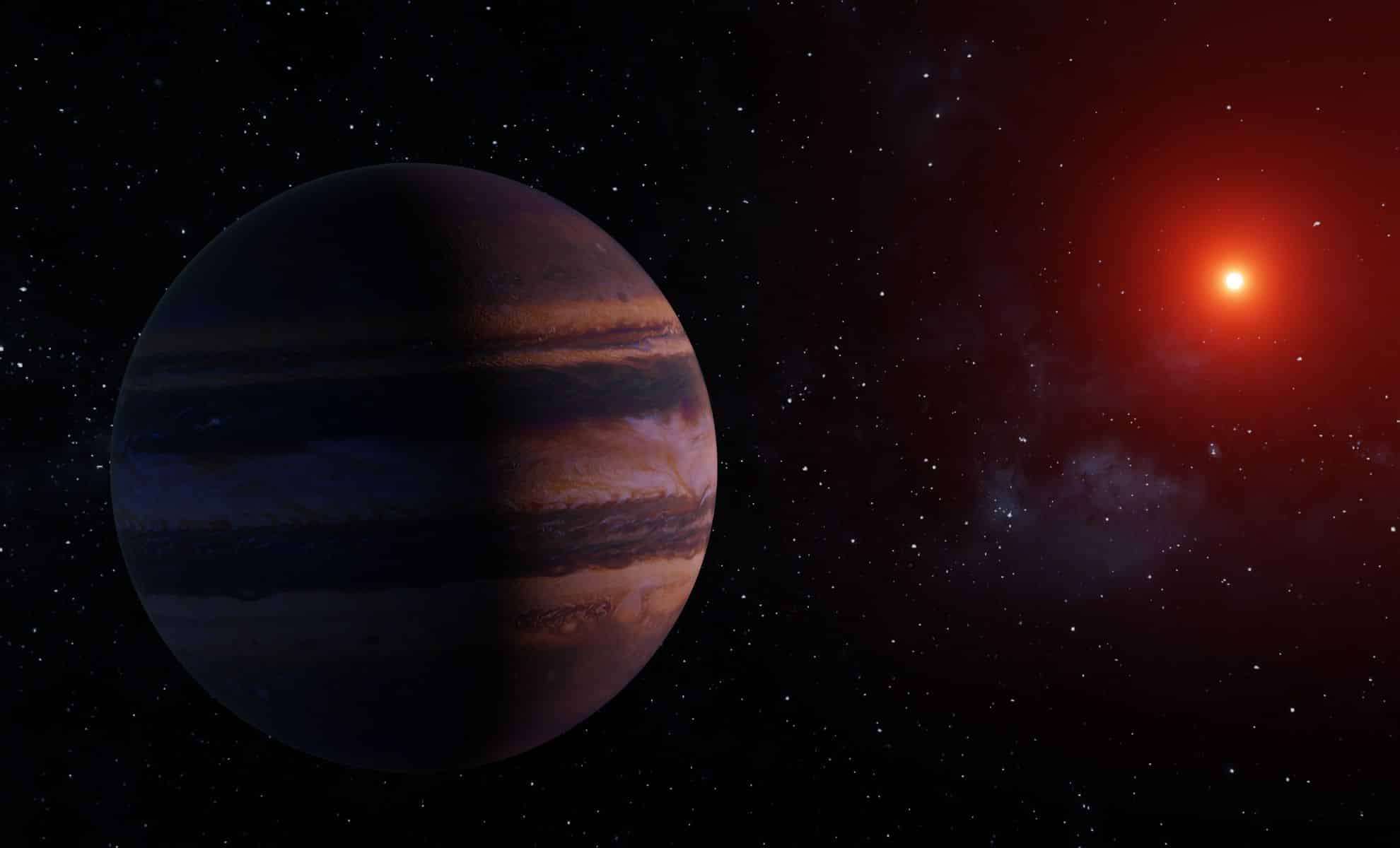
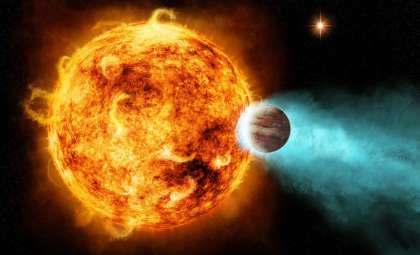
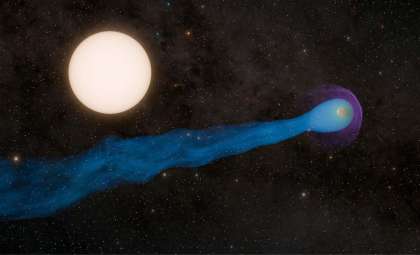
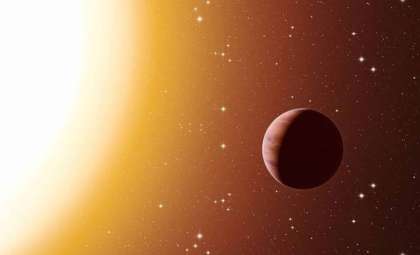
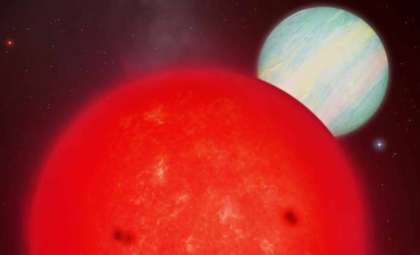
Researchers have uncovered an exceptionally large gas giant planet revolving around an unusually small red dwarf star, upending established ideas about planet formation. This exoplanet, known as TOI‑6894b, is marginally bigger than Saturn but carries just about 56% of Saturn’s mass. It orbits its host, TOI‑6894, a diminutive red dwarf star situated approximately 240 light-years away within the constellation Leo.
Published in Nature Astronomy, this discovery is remarkable due to the vast size difference between the giant planet and its comparatively tiny star — a pairing previously believed to be nearly unattainable.
A Planet Challenging Existing Paradigms
The star TOI‑6894 has only 21% of the Sun’s mass, ranking it among the smallest stars known to host a transiting giant planet. Contemporary planetary formation models suggest such a relationship is extremely unlikely. Current theories indicate that stars of this size typically lack the substantial disks of gas and dust necessary to form massive planets before these disks dissipate.

Typically, smaller stars are thought to generate smaller, mostly rocky or icy planets rather than large gas giants akin to Saturn. Therefore, the identification of TOI‑6894b compels researchers to rethink how planets form around low-mass stars.
The stark contrast between the star and its planet is notable: TOI‑6894 is only about 2.5 times wider than the giant planet it hosts. This is the first time astronomers have recorded a giant planet transiting such a small star, establishing a new precedent. The Instituto de Astrofísica de Canarias (IAC) highlighted that "the star is about 40% smaller than the previous smallest known star hosting a transiting giant planet."
Rapid Orbit and Unique Features
Adding to the intrigue, TOI‑6894b orbits very close to its star, completing a revolution every three days. This proximity exposes the planet to intense radiation from its star, likely influencing its atmospheric and internal characteristics. Scientists hypothesize the planet contains a dense core encompassed by a thick layer of hydrogen and helium. There’s additional speculation it may contain methane and ammonia — substances typically found in colder regions of planetary systems.
The exoplanet was initially spotted by NASA’s Transiting Exoplanet Survey Satellite (TESS). Subsequent observations with the European Southern Observatory’s Very Large Telescope (VLT) confirmed its dimensions, mass, and orbital parameters.
Upcoming Studies with James Webb Space Telescope
Because of TOI‑6894b’s relatively low density combined with its close proximity to the star, scientists are gearing up to analyze it in detail using the James Webb Space Telescope (JWST). They aim to unravel the planet’s atmospheric makeup and better understand the formation of such a massive planet around a small star.
Initial models propose that the planet probably formed farther from its star within the protoplanetary disk before migrating inward. However, even this hypothesis does not fully clarify how a giant planet could acquire sufficient mass in a disk considered too sparse for forming such bodies according to prevailing theories.
This breakthrough has significant consequences. Since red dwarf stars like TOI‑6894 are the most numerous in the Milky Way galaxy, gas giants may be more prevalent around these stars than formerly believed.
- Categories:
- News



0 comments
Sign in to Comment