
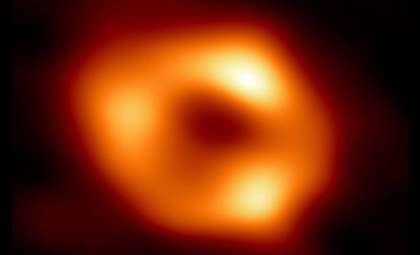
A recent discovery introduces an extensive network of elongated, thread-like formations extending several light-years near the Milky Way’s core, shedding new light on the activity surrounding Sagittarius A. Detailed in The Astrophysical Journal Letters, this finding reveals new phenomena connected with our galaxy’s central black hole, prompting fresh inquiries into how it impacts its cosmic surroundings.
Identification of a Novel Galactic Structure Type
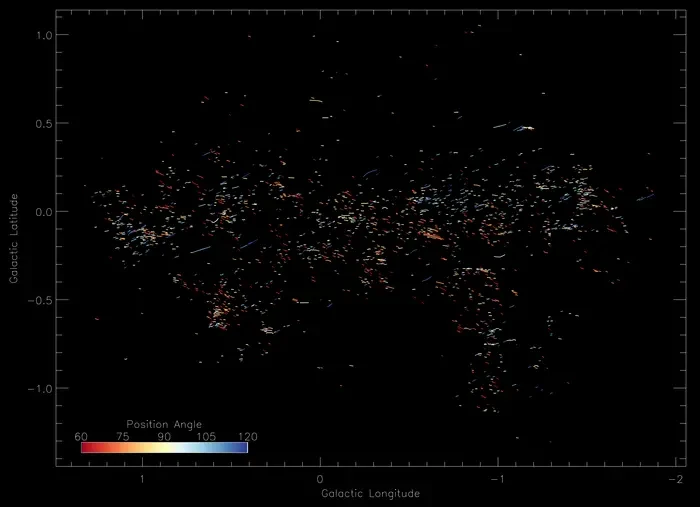
Scientists have detected horizontal filaments stretching 5 to 10 light-years across the galactic plane, contrasting sharply with the previously documented vertical filaments. These linear features seem to be oriented directly toward Sagittarius A, implying a direct association with the supermassive black hole at the galaxy’s center. Unlike the towering vertical filaments that span up to 150 light-years and feature highly energetic particle emissions, these horizontal filaments display thermal radiation, suggesting distinct origins and mechanisms.
The research presented in The Astrophysical Journal Letters explains that these structures consist of charged particles interacting with magnetic fields. Their unique alignment and clustering on one side of the galactic nucleus hint at a significant previous energetic event rather than an arbitrary arrangement.

“Encountering this unexpected set of filaments directed toward the black hole was astonishing,” said Farhad Yusef-Zadeh. “We performed extensive analyses to ensure these were genuine features and found they are likely linked to outflows from the black hole. Investigating them further could reveal insights into the spin and accretion disk orientation of Sagittarius A. Discovering order amid the complexity at our galaxy’s core is truly rewarding.”
Insights from the MeerKAT Radio Telescope
This landmark detection was made possible by the MeerKAT radio telescope located in South Africa, known for its exceptional sensitivity and imaging precision. Using advanced data processing methods to filter background interference, researchers uncovered these subtle structures that had eluded previous observations.
“MeerKAT’s observations have revolutionized our understanding,” Yusef-Zadeh noted. “With enhanced technology and dedicated observation time, we gained new information. This achievement represents a major technical milestone for radio astronomy.” The clarity from these observations allowed researchers to differentiate the horizontal filaments from complex ambient emissions and validate their organized pattern. Without such technological innovation, the faint, widespread filaments would have remained masked by the chaotic radio signals near the galactic center.
Challenging Established Views on Galactic Filaments
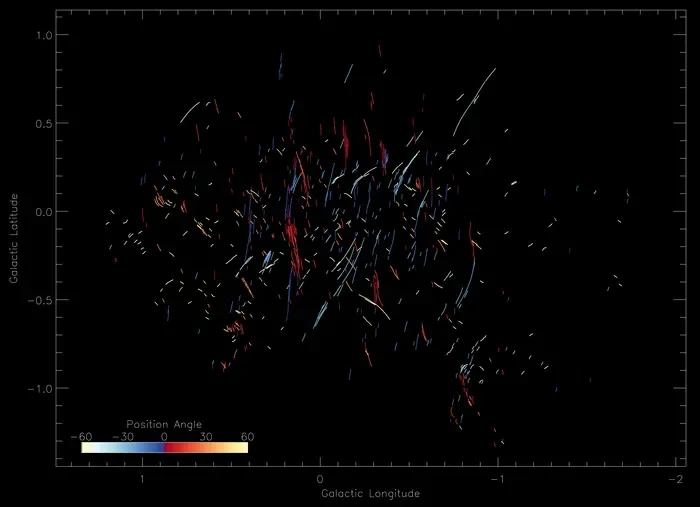
For many years, astrophysicists focused on vertical filaments that rise perpendicular to the Milky Way’s plane, typically linked to robust magnetic fields and particles moving near light speed. The emergence of horizontal filaments introduces a starkly different perspective, as these run parallel to the galactic disk and exhibit thermal emissions, indicative of slower interactions with ambient molecular clouds.
“Vertical filaments have long dominated our understanding,” Yusef-Zadeh commented. “Discovering aligned structures along the galactic plane forced us to rethink energy flows around Sagittarius A. The co-existence of vertical and horizontal filaments likely reflects varying phases of black hole activity during its history.”
Evidence Suggests an Ancient Black Hole Eruption
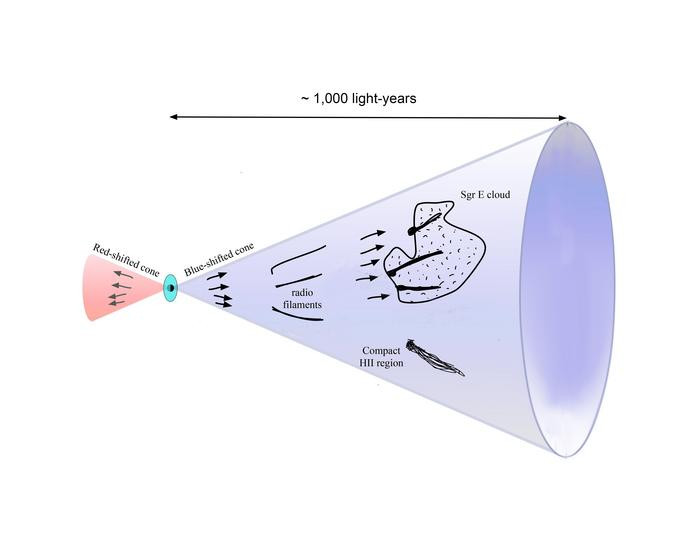
Growing evidence supports that these horizontal filaments were shaped by an energetic outburst from Sagittarius A millions of years ago. Their alignment and spatial arrangement indicate that they were molded by ejected material interacting with neighboring gas and dust clouds.
“The radial outflow we detected reveals the orientation of both the black hole’s accretion disk and jet-driven emissions aligned along the galactic plane,” explained Yusef-Zadeh. Such observations provide a unique avenue to deduce the geometry and behavior of Sagittarius A’s accretion system, which is generally challenging to observe directly.
“We believe these filaments resulted from outflows initiated by an active phase a few million years back,” Yusef-Zadeh added. “They likely formed through interactions with nearby matter. Our research continues as we gather new data, test our theories, and refine our analyses.” This emphasizes how the discovery opens new lines of inquiry about the dynamic evolution of our galaxy’s core.
- Categories:
- Astronomy




0 comments
Sign in to Comment