
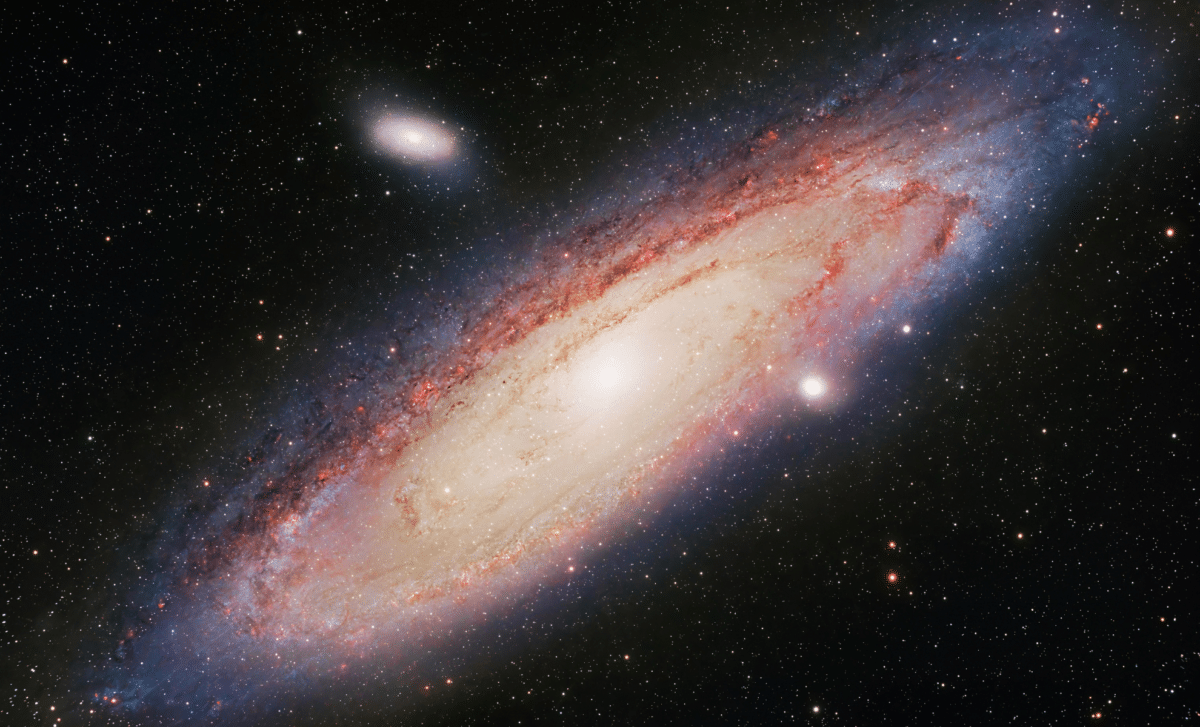
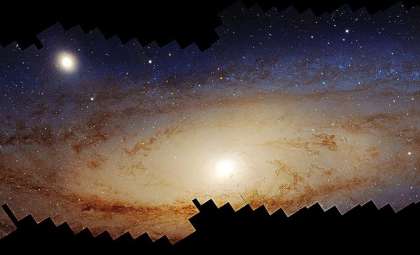
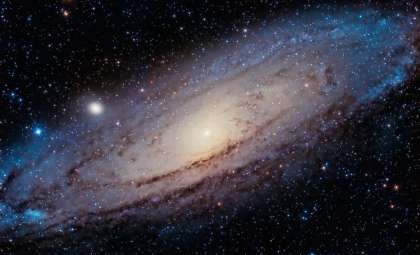
Astronomers have long been intrigued by the unexpected approach of Andromeda, the Milky Way’s nearest large galactic neighbor. While most galaxies move away from each other due to the universe’s expansion, Andromeda has been closing in at about 68 miles per second, defying Hubble’s Law which predicts galaxies should recede. A recent pioneering study published in Nature Astronomy sheds light on this cosmic mystery.
Unveiling a Vast Flat Dark Matter Structure
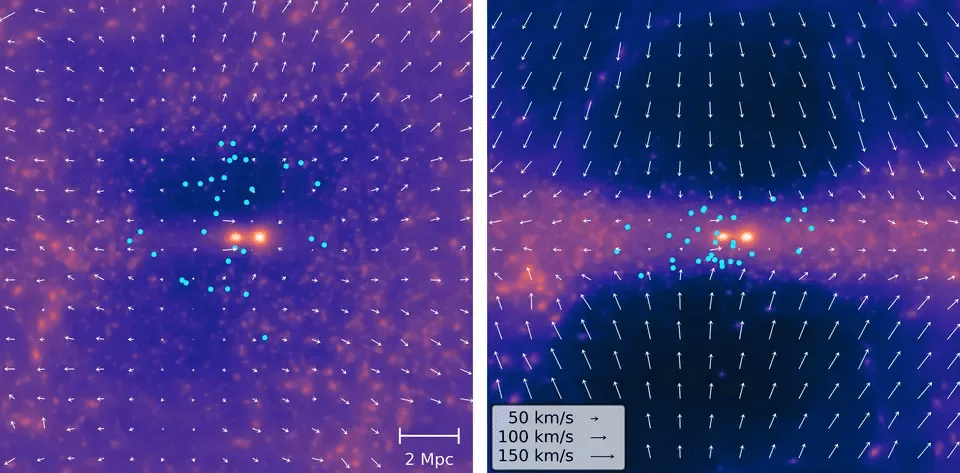
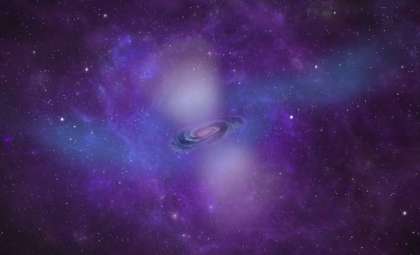
Scientists have identified that the unusual acceleration of Andromeda stems from the gravitational influence of an immense, flat sheet of dark matter enveloping both the Milky Way and Andromeda. This dark matter, constituting a large fraction of the universe’s mass, exerts strong gravitational forces on galaxies within the Local Group. Contrary to being uniformly spread out, this dark matter forms an extensive flat plane stretching across tens of millions of light-years.
“The observed motions of nearby galaxies and the joint masses of the Milky Way and the Andromeda Galaxy can only be properly explained with this ‘flat’ mass distribution,” the researchers said in a statement.
Add Cosmo Herald as a Preferred Source

This discovery provides a fresh perspective on local galaxy dynamics and reveals how dark matter may shape the movements within our immediate cosmic vicinity.
What Drives Andromeda’s Approach Toward Us?
The gravitational influence of this colossal, flat dark matter plane directly impacts Andromeda’s trajectory, pulling it closer to our galaxy. Galaxies within this region experience different motions compared to those farther away. As study co-author Simon White noted:
“Thus, galaxies closer than [roughly 8 million light-years] are moving away from us slower than predicted by Hubble’s Law, whereas galaxies farther than [that] are actually receding faster than predicted.”
If dark and visible matter around the Milky Way and Andromeda were arranged more spherically, the gravitational effects would differ, causing galaxies to slow their recession uniformly. Yet, the distinctive flat shape counters this pull, drawing Andromeda inward while imparting outward motion to other nearby galaxies. This explains Andromeda’s collision path with our galaxy.
The Significance of Cosmic Voids
The research also emphasizes the role of cosmic voids—vast, largely empty areas lacking galaxies. These voids expand faster than denser parts of the universe, causing matter and galaxies to concentrate along intervening “walls.” These dense cosmic walls, containing dark matter and galaxies, critically influence the movement of Local Group galaxies.
“As a result these regions expanded faster than average, and their matter was ‘pushed’ outwards,” said Simon White.
Over time, the low-density voids have propelled material into these walls, which now play a pivotal role in shaping galaxy motions such as those of Andromeda and our own Milky Way.
Broader Impact on Cosmology
This innovative model transforms our grasp of how galaxies behave on cosmic scales. By illustrating dark matter’s dominant gravitational impact on galactic motions, the findings enhance cosmological frameworks and align simulation predictions with observed galaxy movement. The study underscores dark matter’s greater importance in galactic evolution than previously recognized, paving the way for deeper exploration into dark matter properties and their cosmic influence.
- Categories:
- Astronomy





0 comments
Sign in to Comment