
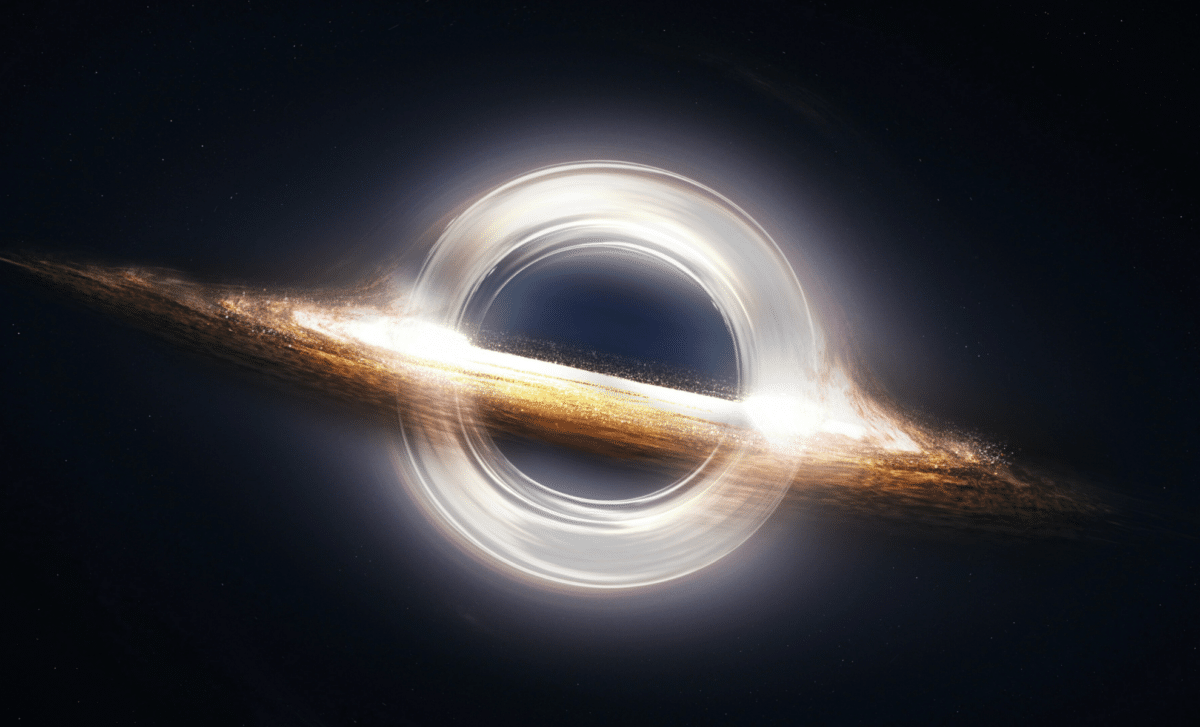
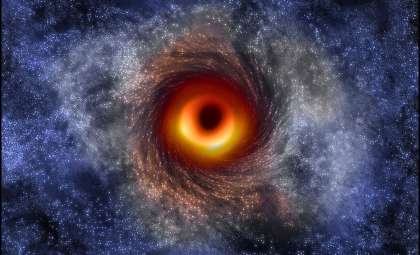
Black holes have long fascinated scientists as some of the most mysterious phenomena in the cosmos, challenging our concepts of space, time, and matter. Now, an astonishing proposition is gaining renewed attention in scientific circles: the entire universe might be contained within a black hole that exists inside a far larger universe. This intriguing idea, once on the fringe, is being revisited thanks to advances in thermodynamics, quantum theory, and holographic principles.
The Puzzle of Lost Information in Black Holes
Scientists have struggled for years with perplexing issues arising from black hole behavior. The traditional view, detailed by the French astrophysicist Jean-Pierre Luminet, paints black holes as cosmic traps with baffling properties.
“In classical general relativity, a black hole prevents any particle or form of radiation from escaping from its cosmic prison,” Luminet explains in a 2016 review. “For an external observer, when a material body crosses an event horizon all knowledge of its material properties is lost. Only the new values of M [mass], J [angular momentum], and Q [electric charge] remain. As a result, a black hole swallows an enormous amount of information.”
Add Cosmo Herald as a Preferred Source

This loss of information contradicts a core tenet of quantum theory, which says that information must not vanish, creating what is known as the black hole information paradox. This challenge has inspired many scientists to seek new theoretical approaches that could reconcile conflicting aspects of black hole physics and quantum mechanics.
Hawking Radiation and the Rise of Holography
Stephen Hawking’s groundbreaking work in the 1970s revealed that black holes emit subtle radiation due to quantum effects at their boundaries. Rather than solving the paradox, this discovery deepened the mystery.
“Hawking then pointed to a paradox. If a black hole can evaporate, a portion of the information it contains is lost forever,” Luminet continued. “The information contained in thermal radiation emitted by a black hole is degraded; it does not recapitulate information about matter previously swallowed by the black hole. The irretrievable loss of information conflicts with one of the basic postulates of quantum mechanics. According to the Schrödinger equation, physical systems that change over time cannot create or destroy information, a property known as unitarity.”
To resolve these conflicting principles, scientists developed the holographic principle. This proposes that all information within a volume of space can be encoded on its boundary, analogous to a three-dimensional image emerging from a two-dimensional surface.
Viewing the Universe as a Holographic Projection
Physicists like Gerard ’t Hooft and Leonard Susskind expanded on these ideas, suggesting that black holes store information about everything they engulf on their event horizons.
“From the point of view of information, each bit in the form of a 0 or a 1 corresponds to four Planck areas, which allows one to find the Bekenstein–Hawking formula for entropy,” Luminet continues. “For an external observer, information about the entropy of the black hole, once borne by the three-dimensional structure of the objects that have crossed the event horizon, seems lost. But on this view, the information is encoded on the two-dimensional surface of a black hole, like a hologram. Therefore, ’t Hooft concluded, the information swallowed by a black hole could be completely restored during the process of quantum evaporation.”
This concept challenges traditional views of space and time and suggests our perceived universe might be a holographic projection arising from the surface of an enormous cosmic black hole. If so, stars, galaxies, and all matter could essentially be encoded as information patterns on a two-dimensional plane.
A Captivating Numerical Convergence
One of the most compelling arguments supporting this view is the fascinating similarity in scale between the Hubble radius, the extent of the observable universe, and the Schwarzschild radius, the theoretical size of a black hole formed by compressing all the universe's matter.
This coincidence encourages some theorists to propose that the cosmos we inhabit might be the interior of a gigantic black hole. Mathematical models that merge elements of general relativity and quantum field theories seem to reinforce this elegant, if speculative, hypothesis.
Though empirical evidence is still lacking, this framework continues to fascinate scientists exploring deep relationships among quantum information, gravity, and the essence of spacetime.
A Universe Nested Within Another Universe?
If this holographic framework is correct, it could imply that the origins of our cosmos, including the Big Bang, might be understood as the interior emergence of a black hole formed by a collapsing star in a higher-dimensional environment.
Within this “parent” black hole, the dimensions of time and space could have unfolded, giving rise to the expansion of the universe we observe today. This perspective reinterprets cosmic inflation as a feature of the internal dynamics of a black hole universe embedded inside another cosmos.
While conclusive proof remains elusive, ongoing studies in quantum gravity—such as the work highlighted in arXiv—continue to probe the fundamental links between information processing, spacetime geometry, and the ultimate structure of reality.
- Categories:
- Astronomy




0 comments
Sign in to Comment