
A puzzling gravitational-wave observation recorded by LIGO has revived interest in a longstanding theory in cosmology. Scientists from the University of Miami propose this event could represent the first signs of a primordial black hole, an entity believed to have originated moments after the Big Bang.
Unlike typical black holes formed by the collapse of massive stars, primordial black holes are thought to have materialized much earlier, during the extreme conditions of the universe's infancy.
Although the concept has persisted for decades, no primordial black hole has been empirically verified. Their significance extends beyond just black hole science, as they have been theorized to potentially account for dark matter, which comprises approximately 85 percent of all matter and is crucial for the gravitational cohesion of galaxies.

A Unique Gravitational-Wave Signature
This recent investigation was triggered by an anomalous gravitational-wave detection by the Laser Interferometer Gravitational-Wave Observatory (LIGO). Such waves are perturbations in spacetime generated by massive cosmic occurrences like black hole collisions.
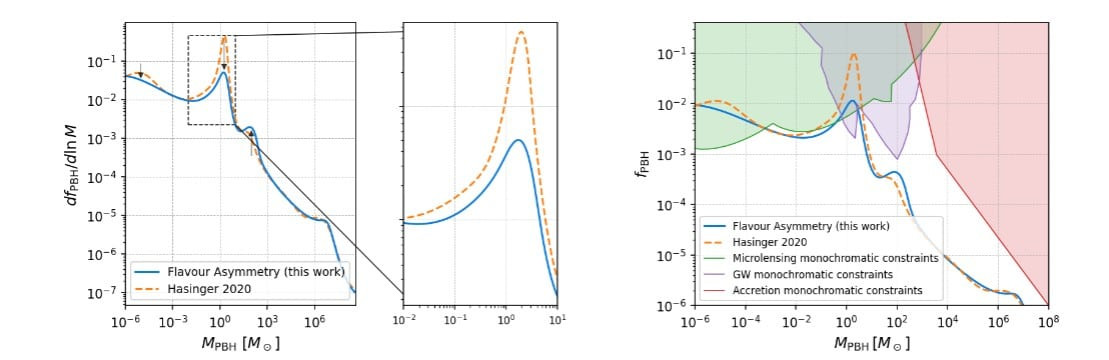
At the end of last year, LIGO issued an alert involving a merger event with at least one component having a mass less than that of the Sun. This finding was unexpected since conventional stellar evolution models do not predict black holes with such low masses.
“The most common black holes form as the result of a supernova, the death of a massive star. So, their masses can range from a few times the Sun’s mass to billions of solar masses,” said Nico Cappelluti, an associate professor in the University of Miami’s Department of Physics.
The validity of this signal remains under debate, with some astrophysicists suggesting it might be noise in LIGO’s detectors. Nevertheless, conventional astrophysics struggles to explain this event.
Could This Be a Primordial Black Hole?
Cappelluti and doctoral researcher Alberto Magaraggia investigated whether the detection could be attributed to a primordial black hole formed within the high-density environment of the early universe.
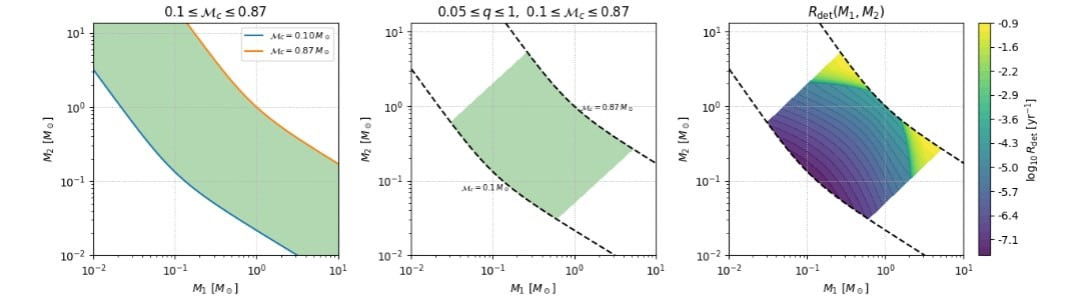
Their research, published in The Astrophysical Journal, supports this hypothesis based on the evidence. They also calculated the expected abundance and frequency of detection for such objects.
“We attempted to estimate how many primordial black holes may exist in the universe and how many of them LIGO should be able to detect,” Magaraggia explained. “And our results are encouraging. We predict that subsolar black holes like the one LIGO may have observed should indeed be rare, consistent with how infrequently such events have been seen so far.”
The team concluded that subsolar primordial black holes are likely to be rare, aligning with the infrequent occurrence of similar gravitational-wave signals observed to date.
Reevaluating a Classic Theory
The concept of primordial black holes was first introduced by Soviet physicists Yakov Zeldovich and Igor Novikov, and later expanded upon by Stephen Hawking, who proposed their potential role in explaining dark matter.
For many years, this theory remained largely untested until gravitational-wave astronomy emerged, marked by LIGO’s first direct detection of gravitational waves in 2015.
The authors of this new work stress that a single detection is insufficient to confirm the existence of primordial black holes definitively; further observations are essential before drawing conclusive evidence.
- Categories:
- Science












0 comments
Sign in to Comment