
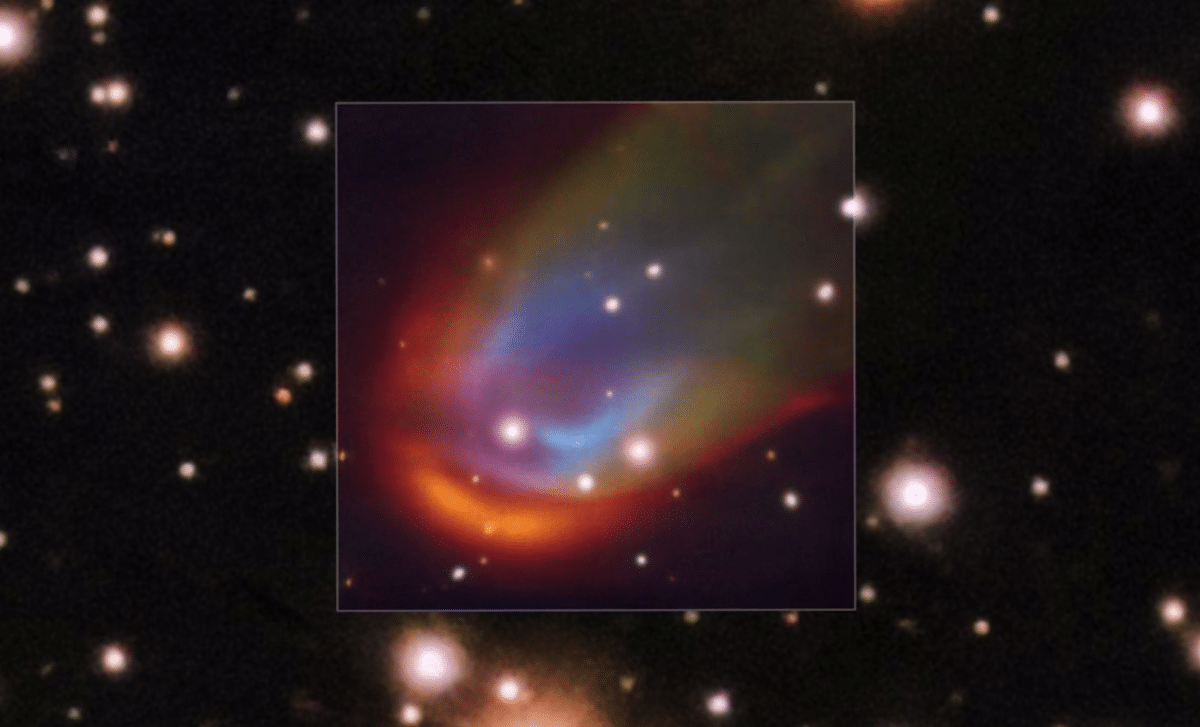
An unusual, rainbow-hued glow has been observed encircling a white dwarf star located just 731 light-years away from us. This glow envelops RXJ0528+2838, a stellar remnant that eludes current models of star death and evolution. Highlighted in Nature Astronomy, this extraordinary display indicates that even long-extinguished stars can exhibit surprising energetic phenomena, prompting astronomers to reconsider the interactions between dead stars and their cosmic surroundings.
A Silent Star That Surprises
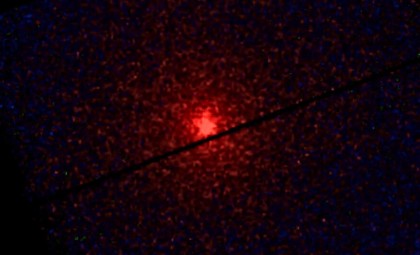
When stars like our own Sun exhaust their fuel, they cast off outer layers and leave a dense, Earth-sized core known as a white dwarf. These remnants typically fade quietly without producing luminous outflows or glowing clouds. However, RXJ0528+2838 defies this behavior by radiating a vibrant multicolor light, shaped into a bow shock resembling a cosmic rainbow across the void.
Astronomer Simone Scaringi from Durham University reflected on their team’s discovery:

“We found something never seen before and, more importantly, entirely unexpected. The surprise that a supposedly quiet, diskless system could drive such a spectacular nebula was one of those rare ‘wow’ moments.”
The emission lines dominated by hydrogen, oxygen, and nitrogen hint at a powerful energetic source active for roughly a millennium. Despite extensive study, no familiar explanation has emerged since RXJ0528+2838 lacks the accretion disk commonly responsible for such phenomena.
The Puzzle of No Accretion Disk
In typical binary systems, matter from a companion star spirals into the white dwarf via a rotating disk, where heating and magnetic turbulence create outflows and stellar winds. RXJ0528+2838 has a companion star, but lacks any visible disk structure.
Scientists suggest an exceptionally strong magnetic field might redirect matter flow, channeling gas directly from the companion to the white dwarf’s magnetic poles. This configuration could produce outflows powerful enough to illuminate the distinctive bow shock without involving a disk.
Astronomer Krystian Ilkiewicz from the Nicolaus Copernicus Astronomical Center in Poland commented:
“Our observations reveal a powerful outflow that, according to our current understanding, shouldn’t be there. Our finding shows that even without a disc, these systems can drive powerful outflows, revealing a mechanism we do not yet understand. This discovery challenges the standard picture of how matter moves and interacts in these extreme binary systems.”
This finding could revolutionize our grasp of magnetically influenced accretion and star life cycles in binary star systems.
Rewriting Stellar Theories
Published in Nature Astronomy, the discovery reveals rare intensive activity in what was once considered a quiet, aging stellar remnant. The white dwarf’s glowing halo offers a valuable testbed for investigating plasma behavior under extreme magnetic and gravitational conditions.
Previously, such bow shocks were mainly associated with fast-moving stars losing mass or explosive stellar events. RXJ0528+2838 challenges this understanding by displaying steady activity without recent eruptions. This suggests fundamental gaps remain in knowledge about energy transport and magnetic fields in stellar environments.
Future observations with powerful tools like ESO’s Very Large Telescope and Pan-STARRS may reveal whether the outflow changes over time or if similar effects occur around other nearby white dwarfs. Both outcomes promise to deepen our insight into the hidden forces within stellar remnants.
- Categories:
- Space





0 comments
Sign in to Comment