
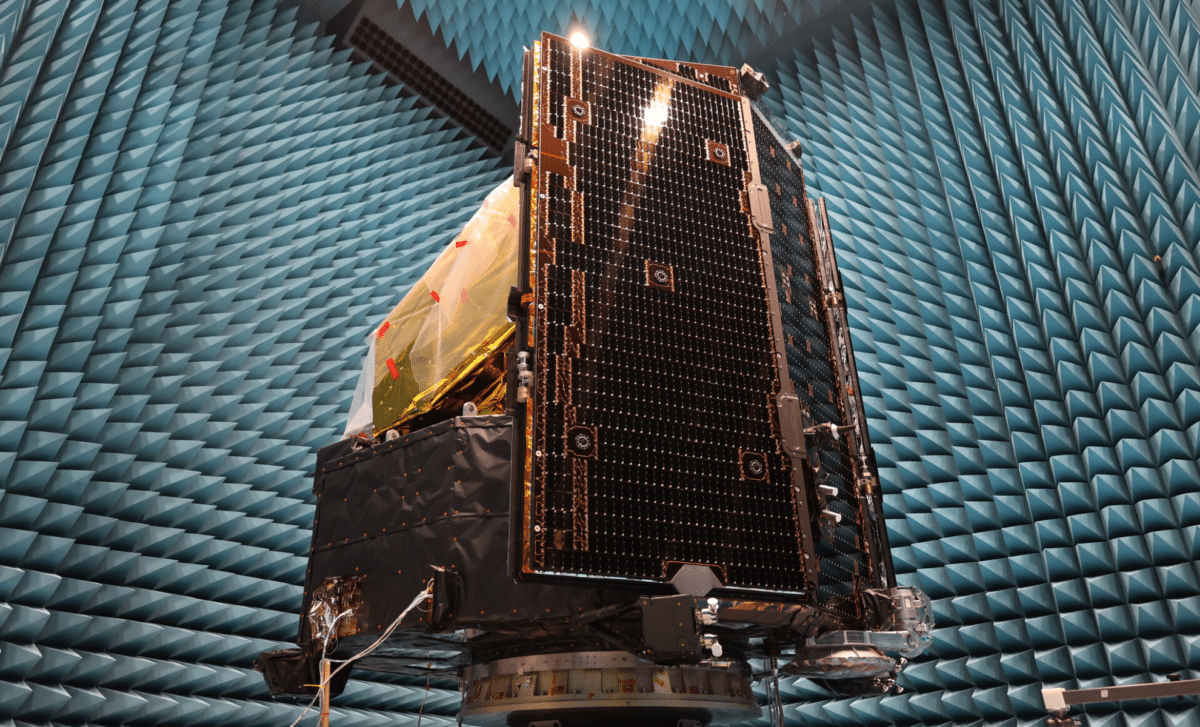
The European Space Agency (ESA) has reached a crucial milestone with its Plato space observatory after successfully completing extensive pre-launch electronic testing. This achievement brings the mission one step closer to its goal of identifying Earth-sized planets orbiting stars near our solar system. The spacecraft’s systems have proven their readiness, enabling ESA engineers to continue final preparations for deployment. Plato is designed to examine thousands of stars to find planets that could resemble Earth while offering new perspectives on planetary system formation.
Preparing a New Planet Hunter for Launch
The Plato mission, an acronym for PLAnetary Transits and Oscillations of stars, aims to explore distant star systems by employing advanced techniques and sensitive instruments. The spacecraft will observe numerous stars simultaneously, searching for slight dips in brightness caused by planets crossing their faces.
By detecting these transit events, astronomers can determine a planet's size, orbital duration, and its distance from the host star. Such information is vital for pinpointing planets located in zones where water might exist in liquid form.

Focusing on stars akin to our Sun, the mission plans to produce a comprehensive study of nearby planetary populations. Unlike missions concentrating on large-scale distant surveys, Plato will provide detailed examinations of selected exoplanetary systems.
The observatory will combine data from multiple cameras to cover vast swaths of the sky, enabling it to monitor numerous stars and detect minute changes indicating the presence of concealed planets.
ESA Announces Successful Completion of Electronics Trials
ESA recently disclosed that the electronic assemblies of the Plato spacecraft have passed a rigorous series of tests designed to confirm their functionality under space-like conditions. These assessments verified how various components interact, ensuring dependable operation once in orbit.
Among the systems tested were those responsible for communication, power supply control, onboard processing, and other essential subsystems. These checks are integral to verifying the spacecraft’s overall stability and reliability ahead of launch.
Conducting such thorough evaluations helps identify and resolve potential technical faults early, a critical precaution since in-orbit repairs are unfeasible for missions operating millions of kilometers from Earth.
Given that Plato will conduct prolonged scientific observations, the electronics must sustain consistent data collection and maintain accuracy in measuring distant stars throughout its operational life.
This successful validation marks a key step in finalizing Plato as it advances toward deployment and mission commencement.
Plato meets Maxwell
— ESA Science (@esascience) July 20, 2026
Our terrestrial planet hunter Plato has recently completed a series of key tests inside the Maxwell Test Chamber at ESTEC, demonstrating that its electronic equipment is fit to work in space.
1/3 pic.twitter.com/9I7q1057OL
Aiming to Discover New Earth Analogs
Plato’s principal objective is to identify and analyze rocky exoplanets with Earth-like traits. Of particular interest are planets orbiting stars where conditions could allow for detailed study of their atmospheres and potential habitability.
The mission will also conduct asteroseismology—studying star vibrations—to precisely determine stellar ages, sizes, and internal structures.
This stellar knowledge is essential for understanding planetary system development, enabling scientists to better grasp how Earth-like environments emerge and evolve throughout the galaxy.
Building on discoveries from earlier exoplanet observatories, Plato focuses on in-depth research of nearby systems, complementing other efforts aimed at examining distant planets and their atmospheres.
The mission is expected to deliver a valuable catalog of promising planets for future space telescopes seeking potentially habitable worlds.
Europe's Next Step in Exoplanetary Science
Upon activation, Plato will contribute to an expanding global initiative to explore worlds beyond our solar system. The pursuit of Earth analogs remains a top priority in contemporary astronomy, fueled by cutting-edge optics and data techniques.
Thanks to its expansive field of view and precise instruments, the observatory will conduct prolonged monitoring of numerous stars, essential for discovering planets with year-long orbits like Earth’s.
Scientists will sift through the collected data to identify planets worthy of further scrutiny, potentially leading to detailed atmospheric studies with next-generation observatories.
The successful completion of the electronic system tests moves Plato closer to deployment as an operational space-based observatory. As launch day approaches, the scientific community anticipates new discoveries that might drastically alter our understanding of Earth-like planet frequency and distribution across the Milky Way.
- Categories:
- News











0 comments
Sign in to Comment